Lets see a .3 inch square section of blade that is .1 inch thick
would weigh .0027 pounds. or .0000843 slugs.

At 15000 RPM and a one inch radius it would be going 47124 inches per

minute or 785 inches a second or 65.45 feet per second.

Centrifugal force is = to mV^2/r

65.45 squared is 4284. Times .0000843 slugs is .356 pounds. The area
to resist this force is .1 times .3 or  .03 square inch. The stress
would therefore be 12 psi if my math is correct. Seems like the blade
should withstand that no matter what the temp.


Lets try a 2 inch radius.

At 15000 RPM it is going twice 65.45 feet per second or 130.9 feet
per second

That squared is 17,135. Times .0000843 slugs is 1.444 pounds Stress
is only 48 psi.

Obviously something else is going on here.

At 6000 RPM the engine is putting out 12000 pulses per minute or 200
pulses per second. You don't suppose the blades have a bending
resonant frequency of 200 hertz do you? Could be.

The bending  force on the blade is not much from the
average pressure of 5 psi. Blade area is only .09 square inches so
this .45 pounds. Peak pressure could be many times this due to the
explosive nature of the rotary exhaust.

Lets say it is 20 pounds.

A cantilevered beam .3 by .3 by .1 inches thick
would have a bending moment of 3 inch pounds at 20 pounds. (ball park
number)
Bending stress with 20 pounds of load would be 30 psi (ball park
number). Not much!

Despite the great loss in strength of the turbine material at 1750 F
I don't think simple centrifugal force and bending stress on the
blade is causing the failure.

If I extrapolate this loss in strength curve for valve steel out to
1750 F we are still looking at a max stress level of about 5000 psi.
Fatigue life can be 5% of max stress or 250 psi or less.

I suspect that the stock 2nd gen 1989 to 1991 turbo has a blade
bending resonant problem at certain RPM's. Just like a metal prop
blade. The car
never sees 6000 RPM at high power continuously.

If a chunk of blade breaks off and jams between the rest of the
turbine and housing that will shear the hot shaft due to compressor
rotational inertia.

The resonant condition and magnitude of the pulse can be changed by
many things. Just the shape of the intake manifold can have a major
effect. Small difference in the thickness and shape of the blade can
also change the bending resonant frequency greatly.

All this is dependent on my arithmetic and physics above being
correct so by all means check me carefully on this.

I am looking forward to showing this failed turbine of Dave's to some
ME professor at UCLA.

Paul Lamar
Joe Hull wrote:
Paul - aren't there 3 pulses per rotor per revolution? If so, then at
6000 RPM there would be (6000 x 3 x 2) or 36,000 pulses per minute.
Not sure this matters in the big scheme of things.

Thanx,
Joe Hull
Cozy MkIV #991 (working on Engine & Electrical & Finishing)
http://www.maddyhome.com/canardpages/pages/JoeHull/index.html
Three pulses on a three rotor but only two on a two rotor.
One pulse per rev on a one rotor. A two rotor is the same as a four cylinder
four cycle piston engine or a two cylinder two stroke piston engine.

That brings up an interesting possibility. The same turbo that fails on a
two rotor may live on a three rotor.

Paul Lamar
"Gift A. Mar" wrote:
I am confused. At 6000 shaft RPM, I was under the impression that the rotor
is turning 2000 RPM, no big deal. That would provide 3 impulses per
revolution per rotor. I think that the little turbine is far above 15000
rpm. I am guessing that at 6000 rpm it would be in the 100 thousand range or
more. This would be a significant difference on the blade forces.
Giffen Marr
LIV-P/20B 27%
Not to fret everybody is always confused about the rotary. Very subtle animal.

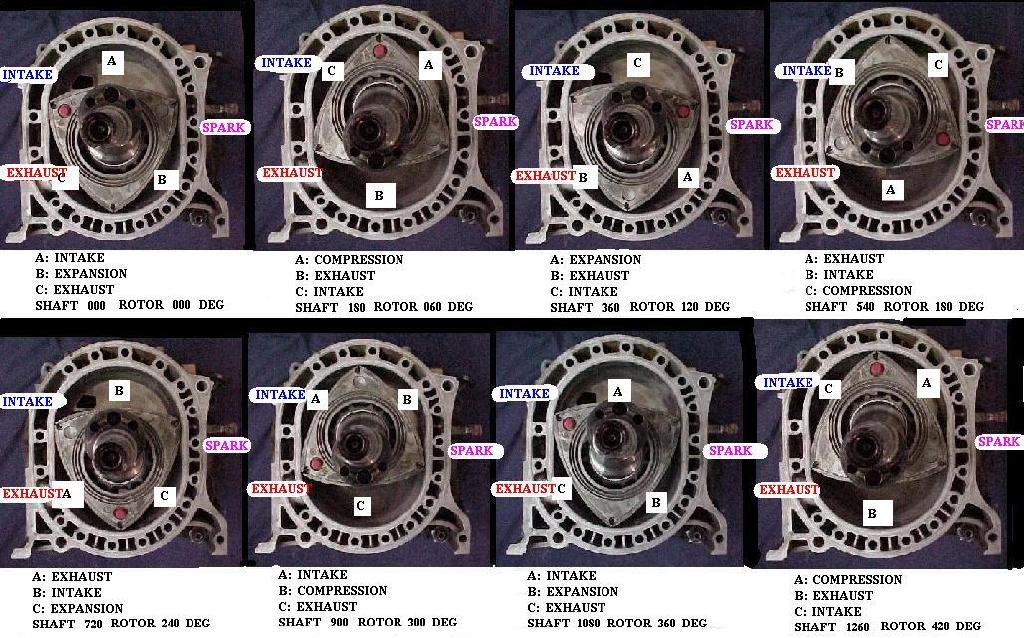
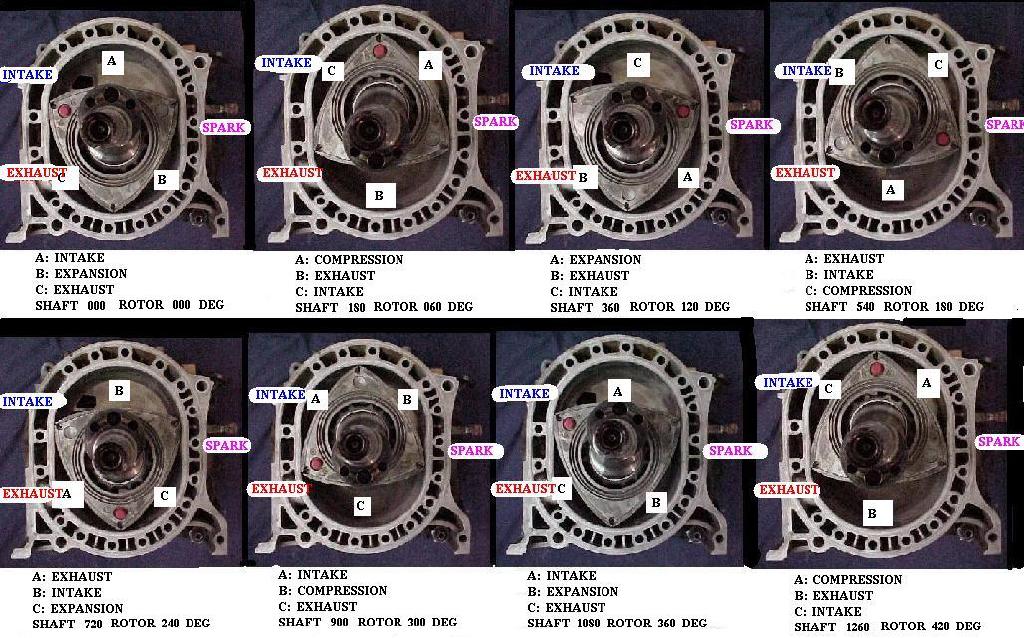
Yes the rotor is turning at 2000 RPM but each face of the rotor acts like
one piston top. Lets call them A, B & C. Follow A around and you will see that it takes
almost one complete turn of the eshaft just for the intake stroke.
Then almost another complete turn of the e-shaft for the compression stroke.
Actually 270 degrees. Another 270 for the expansion stroke and finally
another 270 degrees for the exhaust stroke.

So three turns of the e-shaft is 1080 degrees. 1080 divided by 270 degrees
is 4 or four strokes.

The other two faces are simultaneously in different phases of the four strokes.
One face hits top dead center and fires  once every 360 degrees of the e-shaft rotation.

Very ingenious indeed on the part of Felix to think this up.

Paul Lamar

The Rotary Engine NewsLetter.  Powered by Linux.
ACRE NL web site. http://home.earthlink.net/~rotaryeng/
Copyright 1998-2004 All world wide rights reserved.