Lets see a .3 inch square section of blade that is .1 inch thick
would weigh .0027 pounds. or .0000843 slugs.

At 15000 RPM and a one inch radius it would be going
47124 inches per
minute or 785 inches a second or 65.45 feet per second.

Centrifugal force is = to mV^2/r

65.45 squared is 4284. Times .0000843 slugs is .356 pounds.

The area to resist this force is .1 times .3 or  .03 square inch.

The stress would therefore be 12 psi if my math is correct.

Seems like the blade should withstand that no matter what
the temp.
Lets try a 2 inch radius.

At 15000 RPM it is going twice 65.45 feet per second or
130.9 feet per second

That squared is 17,135. Times .0000843 slugs is 1.444 pounds
Stress is only 48 psi.

Obviously something else is going on here.

At 6000 RPM the engine is putting out 12000 pulses per minute
or 200 pulses per second. You don't suppose the blades have a
bending resonant frequency of 200 hertz do you? Could be.

The bending  force on the blade is not much from the
average pressure of 5 psi. Blade area is only .09 square inches
so this .45 pounds. Peak pressure could be many times this
due to the explosive nature of the rotary exhaust.

Lets say it is 20 pounds.

A cantilevered beam .3 by .3 by .1 inches thick
would have a bending moment of 3 inch pounds at 20 pounds.
(ball park number)
Bending stress with 20 pounds of load would be 30 psi (ball
park number). Not much!
Despite the great loss in strength of the turbine material
at 1750 F I don't think simple centrifugal force and bending
stress on the
blade is causing the failure.

If I extrapolate this loss in strength curve for valve steel
out to 1750 F
we are still looking at a max stress level of about 5000 psi.
Fatigue life can be 5% of max stress or 250 psi or less.

I suspect that the stock 2nd gen 1989 to 1991 turbo has a
blade bending
resonant problem at certain RPM's. Just like a metal prop
blade. The car
never sees 6000 RPM at high power continuously.

If a chunk of blade breaks off and jams between the rest of the
turbine and
housing that will shear the hot shaft due to compressor
rotational inertia.
The resonant condition and magnitude of the pulse can be
changed by
many things. Just the shape of the intake manifold can
have a major
effect. Small difference in the thickness and shape of the
blade can also
change the bending resonant frequency greatly.

All this is dependent on my arithmetic and physics above
being correct
so by all means check me carefully on this.

I am looking forward to showing this failed turbine of
Dave's to some ME
professor at UCLA.

Paul Lamar
Sorry that should have been "shape of the exhaust manifold".

Paul Lamar
DaveLeonard wrote:
Paul, I am very inclined to agree that there are probably
some other factors
involved. But I think you used the wrong RPM in the above
calculation. All
the turbo maps I could find for a similar sized turbo in
similar conditions
seemed to indicated that the turbine would be turning closer
to 70,000 RPM
under those conditions.

Dave Leonard
Well perhaps but that is a small turbine housing.
If it is blade bending resonance that is not going to change
the situation.
All that will do is reduce further the already small amount of
stress due to
centrifugal force alone. That in turn also increases the likelihood of a
blade bending resonant condition as the cause of failure. The
main forcing
function for that is still the exhaust pulses at 12,000 per
minute or 200 Hertz.
If UCLA has a shake table we could put the turbine on it and see
what the blade resonant frequency is. Heck you could tap it with a small
hammer and use a micro phone hooked to a storage oscilloscope and take
a picture.

Paul Lamar
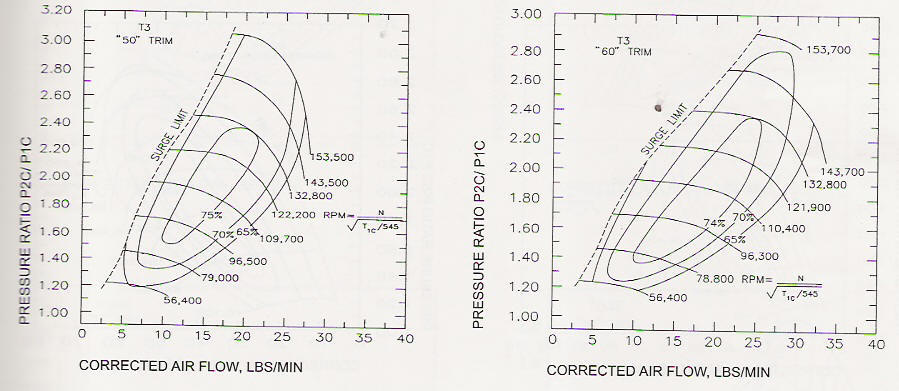
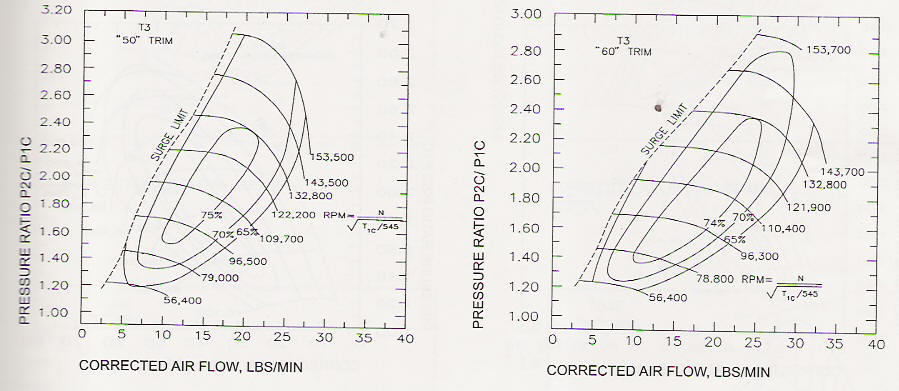
Just checked my Turbonetics catalog and a T3 "60" trim which is a
similar size
to the stock 2nd gen turbo goes to 154,700 max RPM.

Did you have any small leaks in the turbo intake manifold that you know
about? Unlikely but that would increase the turbine RPM. Also if
the compressor
is undersize for the amount of engine combustion air required
that too will
drastically increase the turbine RPM.

As I said however I don't believe this is the root cause of failure.

Paul Lamar
I think we are crossing our numbers.  In your original post above, you said
15,000 not 150,000 which you imply above that you meant.  I'm not sure which
figure you used for the calculation.

154,700 max RPM (implying somehow that 154,327 is OK and 154,985 is too
much - based on experiment).  But at only 32" MAP and 12500' it should be
much less (don't have the maps in front of me).  There were no significant
leaks.

Either way we are in agreement.

Dave Leonard
I made a mistake which Gary caught. I meant 150,000 RPM.

Absolutely true Dave for a well matched turbo. The RPM should be half
of 150,000 RPM if the turbo charger is well matched for continuos duty.
If not the turbo can over speed. Particularly at high altitude.
I suspect it is running off the right side of the map.

Here are a couple of T3 maps. Ironically a bigger compressor might help (I think).
A turbo tachometer would help us match the turbo.

Paul Lamar

The Rotary Engine NewsLetter.  Powered by Linux.
ACRE NL web site. http://home.earthlink.net/~rotaryeng/
Copyright 1998-2004 All world wide rights reserved.