Tracy Crook wrote:
     Not a significant factor in this discussion but for the discussion
of any centrifugal pump (air, water, whatever) it should be remembered that
the load on the pump increases with mass
flow. In other words, the turbo would slow down if there were a
leak in the intake manifold down stream of the turbo.  Load on a centrifugal
pump is at minimum when the backpressure is
     highest.  Sounds counter-intuitive, but true.

     Tracy Crook
Mark wrote:

This is oversimplified. Power required is dependant on mass flow and
pressure ratio and efficiency.

The case of an bleed leak, the change in power required will largely depend
on where you operating on compressor map before the leak occurs.

Power required by compressor is = mass flow X change in enthalpy /
efficiency

and

Change in enthalpy = inlet temp (°K) X specific heat capacity of air X
(Pressure ratio ^ 0.286 - 1)

Because the IC engine between the compressor and the turbine will buffer the
system, the turbine will not immediately react to a compressor bleed leak.
The turbine will continue to supply the same power until the reduced
pressure ratio causes lower chamber filling, and thus a reduction in exhaust
gas mass flow.
____________________________________________________________________________
Example 1.
We are running a high boost and a moderate leak occurs.

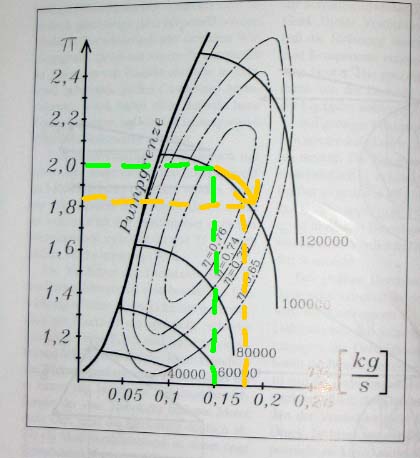
The Green dotted line shows a compressor operating steady state at 100000
rpm delivering 0.15 KG/s of air at 2.0 pressure ratio.  If the manifold
downstream of this compressor leaka, the mass flow will increase and the
pressure ratio decrease, following the line of constant RPM. Lets say the
pressure ratio drops to 1.8, then the mass flow increases to 0.17 Kg/s.

Lets look at the power required....
Before the leak occured:
change in enthalpy = 288°K (inlet temp) X 1000 J/kg/K (Specific heat of air)
X 2.0^0.286 -1
                                  = 63145 J/kg

Therefore the power the compressor was absorbing was:

Power = 0.15Kg/s (Massflow) X 63145 J/kg ( change in enthalpy / 0.76
(efficiency)
             = 12.46 kW.

The turbine is delivering about 16.7Hp to the compressor.

The leak occurs and the pressure ratio drops to 1.8, mass flow increases in
the form of the leak (the orange dotted line)...

Power require by the compressor is now:

change in enthalpy = 288°K (inlet temp) X 1000 J/kg/K (Specific heat of air)
X 1.8^0.286 -1
                                  = 52722J/kg

Therefore the power the compressor is now absorbing is:

Power = 0.17Kg/s (Massflow) X 52722 J/kg) change in enthalpy / 0.74
(efficiency)
             = 12.11 kW.

In this example, the leak unloads the compressor, and the extra 350W that
the turbine delivers will accelerate the system until a new equilibrium is
established.  Soon thereafter, the exhaust gas flow from the IC engine will
reduce and everything will deccelerate.
____________________________________________________________________________
__
Example 2.
We are running high boost but on the compressors efficency sweet spot, and a
major leak occurs.

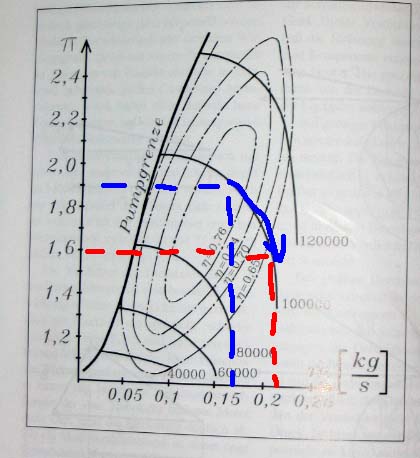
The blue dotted line shows a compressor operating steady state at 100000 rpm
delivering 0.17 KG/s of air at 1.9 pressure ratio.  If the manifold
downstream of this compressor leaks, the mass flow will increase and the
pressure ratio decrease, following the line of constant RPM. Lets say the
pressure ratio drops to 1.6, then the mass flow increases to 0.22 Kg/s.

Lets look at the power required....
Before the leak occured:
change in enthalpy = 288°K (inlet temp) X 1000 J/kg/K (Specific heat of air)
X 1.9^0.286 -1
                                  = 58031 J/kg

Therefore the power the compressor was absorbing was:

Power = 0.17Kg/s (Massflow) X 58031 J/kg) change in enthalpy / 0.76
(efficiency)
             = 12.98 kW.

The turbine is delivering about 17.4Hp to the compressor.

The leak occurs and the pressure ratio drops to 1.6, mass flow increases in
the form of the leak...

Power require by the compressor is now:

change in enthalpy = 288°K (inlet temp) X 1000 J/kg/K (Specific heat of air)
X 1.6^0.286 -1
                                  = 41435J/kg

Therefore the power the compressor is now absorbing is:

Power = 0.22Kg/s (Massflow) X 41435 J/kg) change in enthalpy / 0.65
(efficiency)
             = 14.02 kW.

The compressor load has increased by over a kW (nearly 1.4HP) so the system
will deccelerate until equilibrium is again established.

Again, shortly thereafter the exhaust gas mass flow will drop off and the
whole system power will drop.

Mark Wrathall
The Rotary Engine NewsLetter.  Powered by Linux.
ACRE NL web site. http://home.earthlink.net/~rotaryeng/
Copyright 1998-2004 All world wide rights reserved.