Paul Carey wrote:
Hi Paul

Received my billet eccentric shaft from New Zealand, and the part looks
good. You will see the rotor bearing flanks are smaller in that the 10mm of
metal adjacent is missing - like the 12A shafts I believe. This was done to
lighten the shaft for racing.

The thing that has bothered me, is that the engineer that made it stated
that the shaft needed balancing. Talking to some experienced rotary guys
here, they say that only the factory can really conduct proper balancing,
and not many people attempt it, and the veracity of their claims cannot be
verified. Any thoughts on this Paul? The fact that the shaft is lighter - is
that a concern? I believe the rotors and counterweights have to be balanced
somehow all together.

Regards Paul

Paul Carey
Aero Group Pty Ltd
226 Railway Parade, Bayswater WA 6050
P.O.Box 119, Maylands WA 6930
Ph: (08) 9371 5205  Fax: (08) 9371 9644  Mob: 0418 959 892
www.aeromanagement.com.au <http://www.aeromanagement.com.au/>
Looks like the accessory end driving the supercharger is much stronger with
that spline. Do you have some sort of diaphragm between blower and engine
that can fail in the event of a back fire?

Yes if the shaft is lighter the balance weights need to be adjusted.
It is not that hard if you know the math.

Paul
The trick is knowing the mass and CG of the eccentrics. Considered the
eccentric a large solid cylinder with holes drilled in it. If it were not
for the holes the CG would be in the cente of the cylinder. The lightening
holes move the CG position towards the center of the e-shaft. It is a little
tricky to figure the CG position. If you send me the diameter of the rotor
journal and an accurate drawing of the hole positions and diameters I'll see
if I can calculate the CG and weight of the eccentric.

The other thing we need to know is the exact density of steel used. Most
steels are around .3 pounds per cubic inch. If you take the small part of
the shaft and immerse it in a calibrated beaker of oil you can determine
the exact volume. Once you weigh that part of the shaft you will know the
exact density of the steel used.

Once we have this info we are home free.

The mass of the eccentric must be added to the mass of the rotor, seals and
any contained oil. As I recall there is a college professor on here by the
name of Mark Alden (I think). Mark teaches Physics in Perth somewhere as I recall.
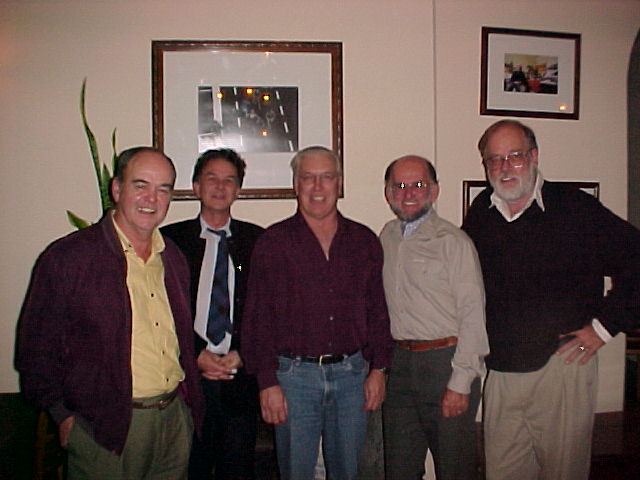
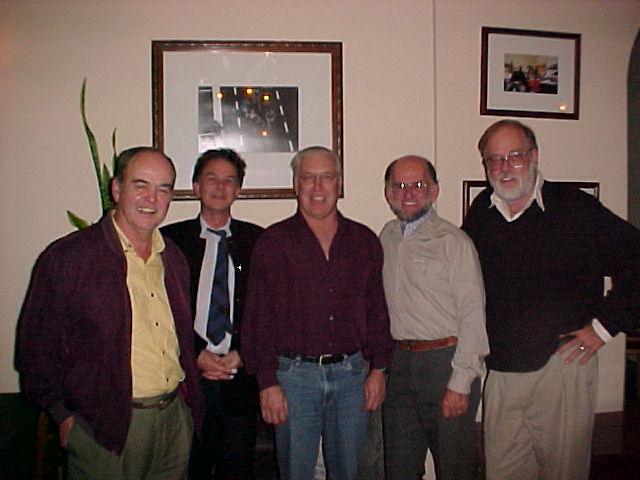
Dave Mccandless may be in touch with him. (Dave, he was at the rotor head dinner
in Perth. Second from left in this picture.)

I don't hear from him very often but he might be able to help you.

Another way of doing is is use an accelerometer and spin the shaft with
the rotors on it.

Paul Lamar

The Rotary Engine NewsLetter.  Powered by Linux.
ACRE NL web site. http://home.earthlink.net/~rotaryeng/
Copyright 1998-2004 All world wide rights reserved.