Jerry Hey wrote:
First,  I want to thank Tracy and Laura for their hospitality in
hosting the Rotary Round Up.  It was great to actually meet so many
people who I only knew via the internet.   I learned a lot.

Richard Sohn, who impressed me greatly with not only his  fabricating
ability but also with his approach to problem solving, said that, when
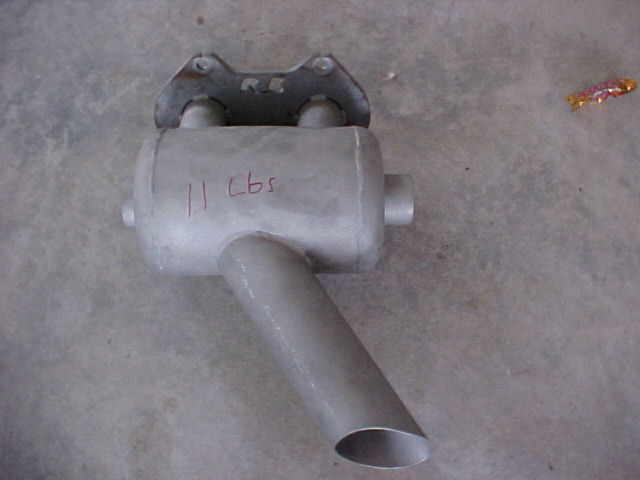
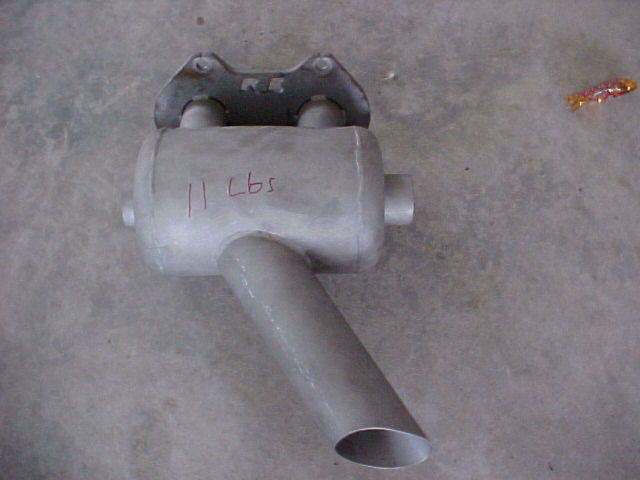
using a muffler (simple tangential) that has a lot of volume, the
tailpipe diameter can be reduced because as the exhaust gasses expand
and cool inside the muffler,  they they are diminished.   If this is
true, what size pipe would  be required for a two rotor at 7500 rpm?
Of course,  variables such as  volume of the muffler and the how much
the exhaust gases are cooled, complicate a simple answer. Still  I
would appreciate anyone's thoughts. Do you agree in principle with his
theory?   What are the auto racers doing?    I presently am using a 3
inch tailpipe because I wanted to make sure there was zero back
pressure.  But a smaller pipe would  be a lot easier to live with if it
would do the job.

  Jerry
Good question Jerry. (P1 x V1)/T1 = (P2 x V2)/T2
Therefore all other things being equal the area of the exhaust pipe
will be inversely proportional to the difference in exhaust temps.
The reference area is the total area of the two pipes coming out of the
engine going into the muffler.

The temp  T is in Kelvin as I recall which is absolute temp. Someone on here probably
can look up the conversion from centigrade or Fahrenheit to Kelvin for us.

Lets say the temp out of the engine is 500 K and the temp out of the exhaust
is 400 K than the area of the down pipe would be 4/5 of the total area of
the exhaust pipes. Lets say the exhaust port pipes are 2" in diameter so total
reference area would be 6.28 square inches. (pi x R^2) X 2. 4/5th of that is about 5 square
inches. Dividing by pi gives 1.6. The square root of 1.6 is  1.26 which is the
radius of the down pipe or 2.52 inch diameter. It all depends on the ratio of
the absolute temperatures of course. A long pipe will also have a pressure loss
before it gets down to atmospheric. In other words the pressure at the start
of the pipe will be higher than the pressure at the end of the pipe.

Check my assumptions, formulas  and numbers.

Paul Lamar

The Rotary Engine NewsLetter.  Powered by Linux.
ACRE NL web site. http://home.earthlink.net/~rotaryeng/
Copyright 1998-2004 All world wide rights reserved.