Jerry wrote,
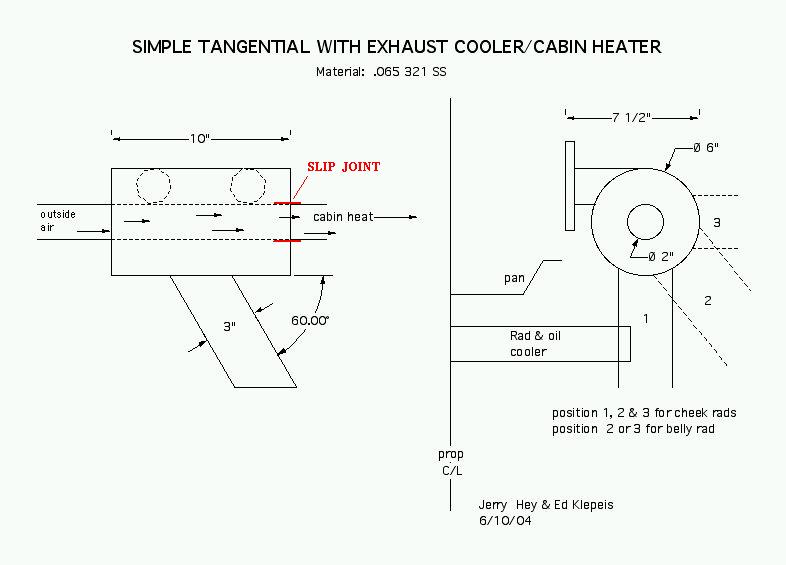
Bob,  the large exhaust opening is being eliminated.  However,   it
is
possible to inspect the cool tube, even to pressurize it  to check
for
leaks, if one wanted to do so.   The cabin heat thing was always an
afterthought. I like the idea but no one needs to follow my lead.  I
will put a temp probe on the cool tube to see how hot it gets.   If
it
stays below 1600º it will NEVER burn out.     Jerry
Mark wrote,
Burn, maybe not, but crack and fail...the jury is still out. You need
to get
some hours on this. Preferably on the ground

I have seen enough of GE, P&W and RR's turbine hardware to know what
severe
thermal cycles and sonic vibration can do to metal hardware. Please
do not
connect this to your cabin.

Mark Wathall
I would not expect 321 to crack and fail in thermal  cycles  below 1600
degrees.  I don't know how
hot the cool tube will become but if it does not reach 1600 degrees
then no problem, ever.    Jerry
It is not so much a question of temperature as it is of differential expansion.
If one part of the muffler is real hot and another cooler that causes
thermal induced stress. Without sophisticated FEA computer programs it is very
hard to predict what will happen. That is why you need to test it extensively
before you use it to supply heated air to the cockpit. Also the rotary puts out
these supersonic shock waves that tend to destroy exhaust systems.

The bottom line is it is very dangerous to use this for cockpit heat.

BTW I think you can make it live longer by putting a slip joint in the aft
bulkhead where the cool tube goes through it. that should allow the center
tube to expand and contract independently of the housing.

Paul Lamar

The Rotary Engine NewsLetter.  Powered by Linux.
ACRE NL web site. http://home.earthlink.net/~rotaryeng/
Copyright 1998-2004 All world wide rights reserved.