You can always design a better airplane for liquid cooling.
The P51 is the most famous U.S. example.

The vast majority of the time that is not going to happen.
There is an  exception. Chris Cosman and family are in the process as we
speak.
Now I don't know yet what they are planning along cooling lines however.

BTW Chris do you have a web site address for me. I don't think I have it
on the ACRE NL list of links.

Paul Lamar
Of course you can, but with the FW/BWB you also go in a more efficient
design than even the P-51 was. FW where only done by the Germans back then
and the war didn't go in their favor ( or the German airplane builders).
Northrop missed at least one important design point in his designs (that's
the reason why his wing never caught on). However Alan Shaw got it mostly
sorted out.
I know it is hard to change a Ford-man to a Chevy-man, but if you already
into designing a new Renoracer, you might as well look into that direction -
if for nothing else to confirm that it is not the better solution.
Watch it - sometimes things turn out different! ;) I looked into ACRE to
confirm, that the Wankel is not really good for anything........and I am
convinced that it is THE machine today :))

Thomas J.
I think the main reason the B2 succeeded is there is no fuselage and
tail assembly to reflect radar energy.

Flying wings are not all peaches and cream. To be stable they need
part of the aft cord to provide down force with the CG still ahead
of the center of lift. In other words not all of the wing surface
provides  lift. They have relatively more skin friction drag. That is a
point most people over look. This can be mitigated somewhat by
allowing the flying wing to be intrinsically unstable
and using computers to keep it from diverging such as done in the F16
and probably the B2. Lateral control is achieved basically by dive flaps
adding drag at the wing tips. Another problem is high landing speed.
It is near impossible to provide high lift devices without complicating
the over all system greatly. Rutan pushers have the same problem.
The result is an airplane that is not as efficient as you might
at first think.

Conventional Blended Wing Body aircraft were tried right after
W.W.II and it was discovered the increased frontal and surface area did not totally
compensate for the reduction in fuselage C sub d. Again the realty was not
up to the promise although the BWB airplanes looked real cool.

I can recommend a book by Sighard Hoerner Fluid Dynamic Drag Lib. Cong. # 64-19999
that investigates some of these concepts. It also has a must read chapter
on Drag Due to Internal Flow Systems that mainly deals with radiator
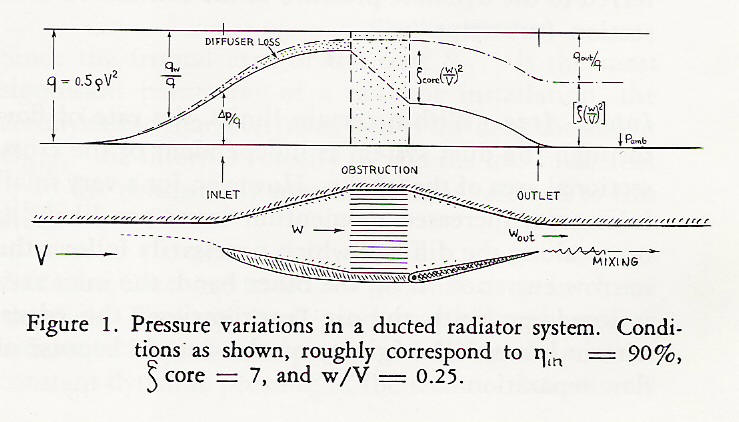
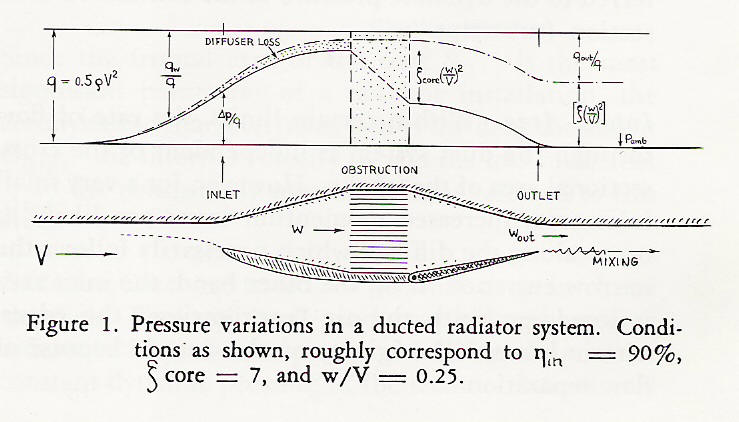
installations. For an example here is a typical pressure loss diagram
for a radiator in a scoop/duct system. V is the forward velocity of
the aircraft. w is the velocity of the air into the rad. And W sub out
is the velocity of the air out of the rad. BTW The shape of the inlet
AND outlet ducts shown here is not optimum according to K&M.

What Hoerner did not mention in this context is (P1 x V1)/T1 must equal
(P2 x V2)/T2 where P is the pressure V is the volume and T the temperature.
I am sure he assumed you knew that.

The momentum loss through the core is fundamentally what you want to minimize
by using a thin, large frontal area, modern heat exchanger. Therefore a cooling
system that looks like this is not suitable for our purposes. Too much length
and too much volume within the aircraft dimensions would be required.
Unless of course you are designing a P51 type system. In that case you need
to deal with the increased frontal area of the P51 type scoop. A fact Hoerner
has not addressed yet in this part of chapter. He deals with that later.
...snipped
PS: Any news on the V8 powered directdrive pusher Unlimited on your
airport?
No I have not. It will be a couple of years before Reno happens again.
Unless I get down to Montgomery field I don't expect I will hear
anything anyway. At this point in time I expect they have quit working
on it for awhile.

Paul Lamar
I failed to mention that this cooling system shown here has no provision
for the required boundary layer air bleed. Never the less it was used
on several W.W.II British and German fighter airplanes and was less than totally
successful.

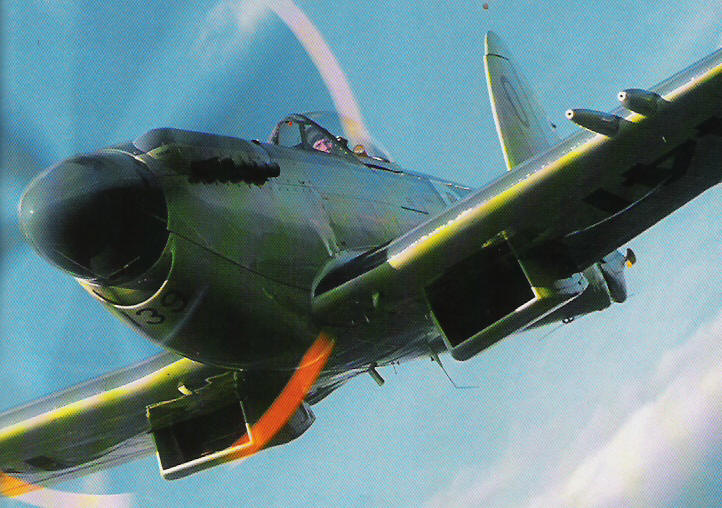
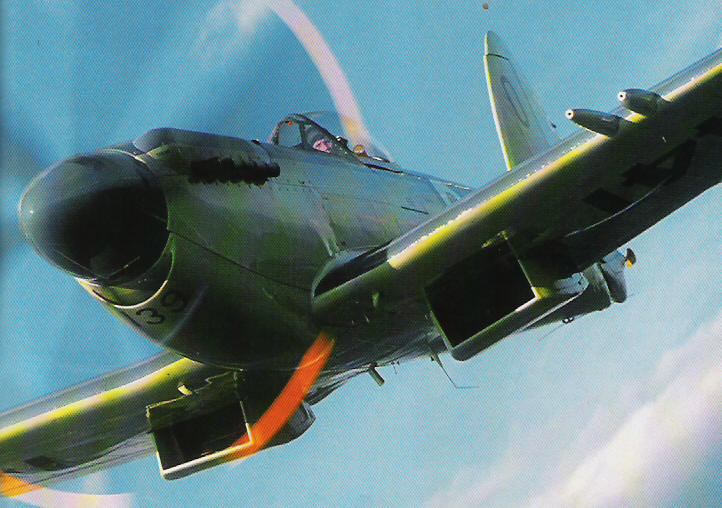
The size of this system got excessive on the post war RR Griffin powered
Seafire making it not much faster than a RR Merlin powered Spitfire
despite the much higher HP. As you can see, without sufficient length
ahead of the rad core, it was not possible to implement a proper K&M trumpet
shaped diffuser so it was necessary to enlarge the scoop opening to obscene
proportions. The boundary layer problem is less important in this particular
application due to the closeness to the leading edge of the wing. However
hardly a low drag cooling system.

Paul Lamar

The Rotary Engine NewsLetter.  Powered by Linux.
ACRE NL web site. http://home.earthlink.net/~rotaryeng/
Copyright 1998-2004 All world wide rights reserved.