George Lendich wrote:
Please read this and suggest improvements.
Ask any question no matter how seemingly dumb.
That is the only way I will know if it is understood.


Paul Lamar
Paul,
I've got a question and it's something I wondered about previously.

The 'open to the air stream' back side of the radiator configuration.
I'm wondering if the radiator is at the bottom of the engine, is there any
high pressure in that area, similar to the underside of the wing.

A high pressure area would  restrict air flow through the radiator.

Another concern is that a cowl flat represents a restriction in itself as
it's shaped similar to a wedge shaped outlet which , as you say, is not
conducive to good air flow and caused a restriction to the radiator and is
close to the radiator and not the 10 inch distance as you prescribe as being
highly desirable.
George (down under)
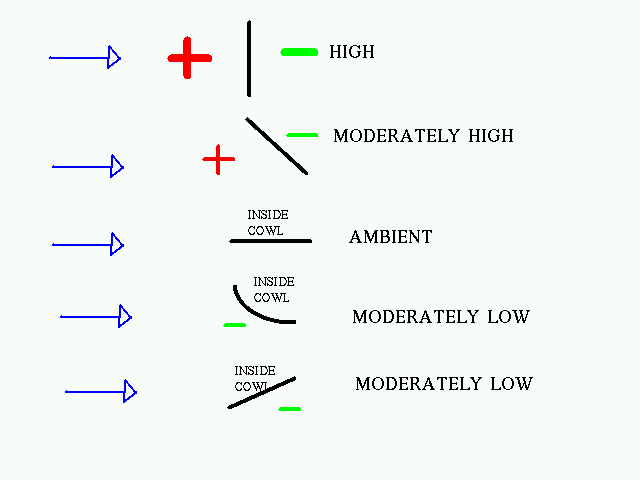
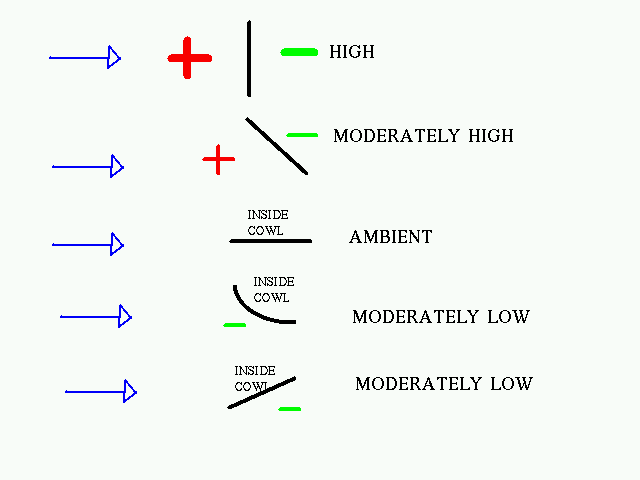
Yes a high pressure area under the cowl is possible. However it is highly
configuration sensitive and angle of attack sensitive. I'll try to do a few
free hand sketches here. Static pressure is what ever the pressure is at
the altitude you are flying at. Generally speaking it is about 15 psi at
sea level. It causes no lift or drag as it acts equally all over the surface
of the airplane. Total pressure is static + or - dynamic pressure. Dynamic
pressure is generated when on an object is moving through the air. A flat
plate held perpendicular to the 100 MPH air stream will generate about .18 psi
all over its surface. A high drag situation.

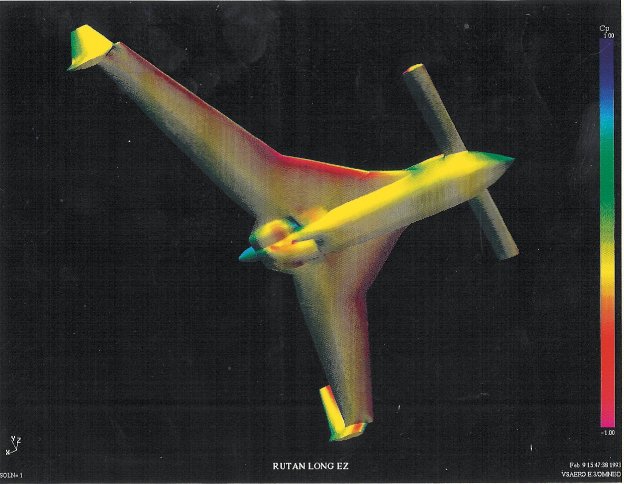
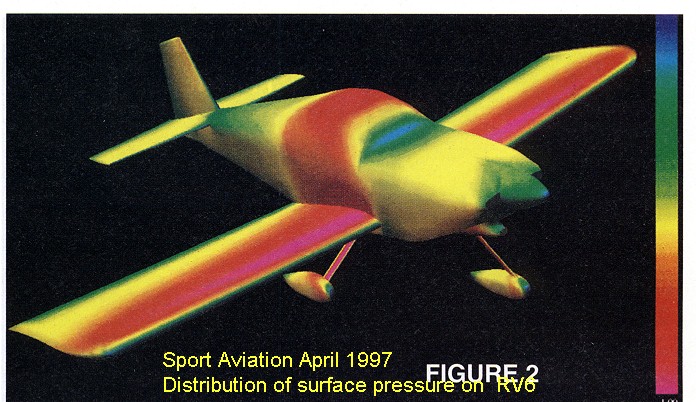
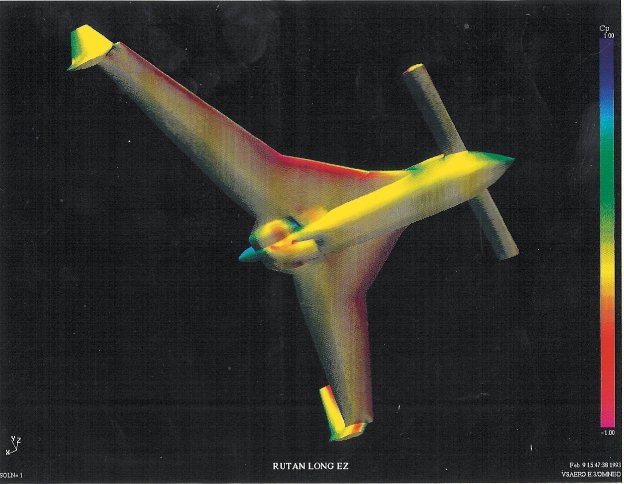
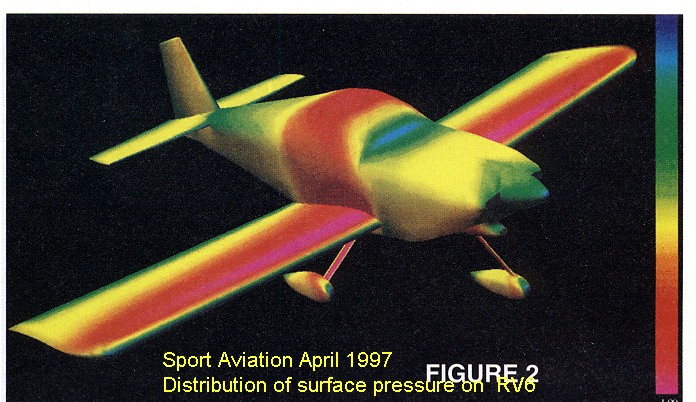
When air is forced to flow over a curved surface a low dynamic pressure
area is formed. A 100 square foot wing with supporting a 1500 pound airplane
at 100 MPH will will have a total dynamic pressure over its upper and lower surface
of 15 pounds per square foot or .104 psi. 2/3 rd of that lift comes from
the top so that would be only negative .068 psi. (The remaining lift comes from
high pressure on the bottom of the wing or positive .036 psi.) This negative (lift)
pressure on the top of the wing is roughly what dynamic pressure we will see
on a curved surface.

The bottom of a curved cowl is just such a surface so you may see up to
minus .068 psi on the front bottom of a curved cowl. Most cowls have a
curved surface followed by a flat bottom. On a flat bottomed cowl at zero
angle of attack you may not find any dynamic pressure at all. At a typical
climb angle of a few degrees you may see a slight high pressure area under
the cowl.  In other words it is mostly 15 psi or static pressure. Now if
there is a screen down there and air is allowed to flow out of the rad and
through the screen the dynamic pressure on the screen would be positive. Since
the cowl surface is horizontal in this area no drag or thrust will be generated.

The reason the pressure on the top of the screen is positive is because of the speed of
the air flowing through the rad. According to my test with a horizontally
mounted automotive rad fed by a wedged shaped diffuser on the front side
of the rad the air velocity through the rad is about 40% of forward velocity.

This means the positive dynamic pressure on the top of the screen will be about
4.16 pounds per square foot or positive .028 psi at 40 MPH. This is the
potential pressure under the cowl surface if we remove the measuring screen.
In other words it is going to overwhelm any positive pressure on the bottom
of the cowl due to a slight angle of attack of the airplane it self.
Obviously it is providing a slight bit of lift on the nose of the airplane.

If we can redirect the flow aft without losing too much velocity or adding vertical
surfaces in front of the opening we can convert it into a bit of thrust or
at least mitigate somewhat the additional drag due to the cooling system in the
first place.

Paul Lamar

The Rotary Engine NewsLetter.  Powered by Linux.
ACRE NL web site. http://home.earthlink.net/~rotaryeng/
Copyright 1998-2004 All world wide rights reserved.