"Kent, Russell" wrote:
Paul Lamar wrote:
Way back in the early 30's when NACA was just getting started
they commissioned the National Bureau of Standards to study
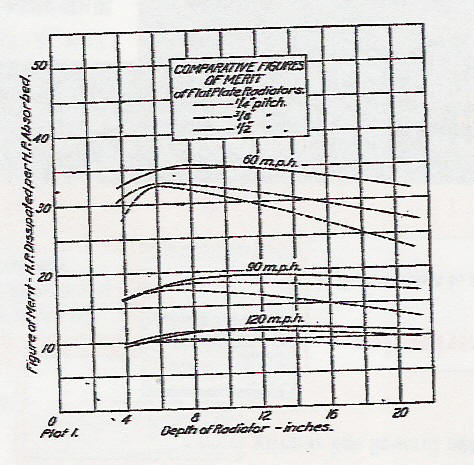
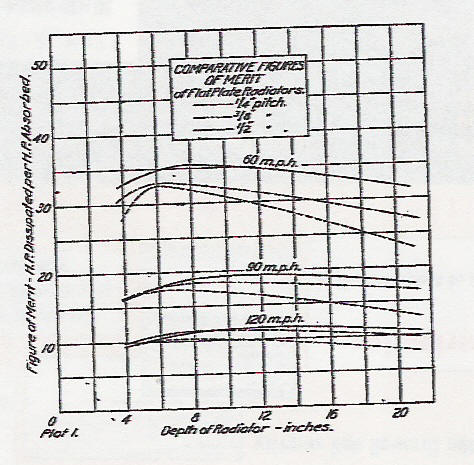
radiator design for aircraft use. NACA Report No. 86
Properties of Special Types of Radiators by S.R. Parsons.
They coined a term they called "Head Resistance" and assumed
there were no ducts or diffusers. In other words the radiator
was stuck below or above the engine out in the air stream.
Air flowing through the rad was the same as aircraft forward
speed.
Shame on you, Paul, you know better.  There will be external diffusion
ahead of the radiator, causing slower, higher pressure air to flow
through the radiator.

Russell Kent
That is factored in by the way they ran the test in the wind tunnel.
They noticed the effect by varying the spacing between the hollow
plates from 1/4 inch to 1/2 inch. 1/2 inch gave better results. No doubt
the study was flawed in several respects. It was also a strange mixture of theory
and experiment. I am just saying the concept might have potential and should be
revisited. What you are seeing here are probably Reynolds number effects.

Also by installing such a heat exchanger in a modern diffuser the effect of
air speed can be minimized. There is also not much chance of anybody coming
up with the wherewithal to optimize this design unless NASA gets involved.
However they seem too high and mighty.

Paul Lamar

The Rotary Engine NewsLetter.  Powered by Linux.
ACRE NL web site. http://home.earthlink.net/~rotaryeng/
Copyright 1998-2004 All world wide rights reserved.