No. The pumps we use run off of a Detroit diesel 8V92 with about 450 Hp
turning a 12 inch impeller. They are good for putting out 1500 GPM at 150
psi. 5 inch ports in and out. It'll do a lot of cooling.

We had a battalion chief burn his hand when we ran a pump for awhile
without circulating the water through the pump. It'll boil water pretty
quickly. He put his hand on one of the port caps and burned himself.

Brian Trubee
------------------------------------------------------

Paul, Brian
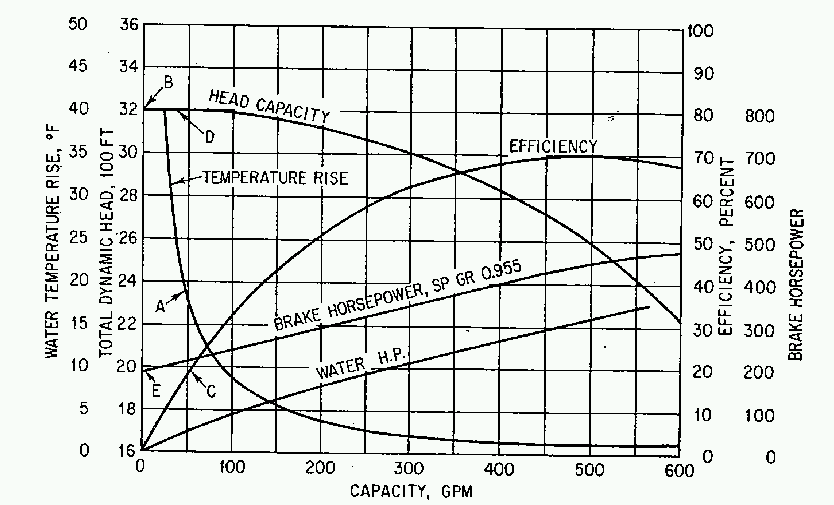
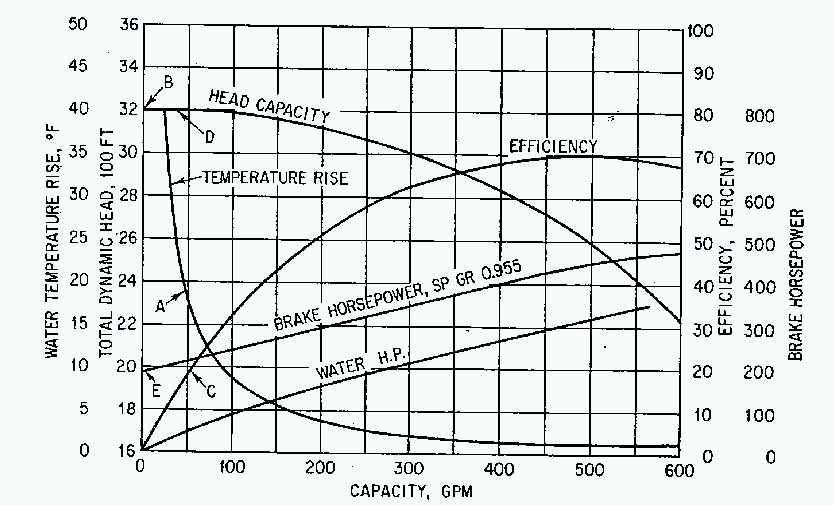
Here is a chart that I sent some time ago, that shows generally how a
centrifugal water pump works efficiency wise.

The behavior of the pump on the Mazda will be the same, just the scale of
the axis will be different.

Note Curve D, that is the head capacity as a function of flow rate. At zero
flow, the maximum head is produced, and this drops off as the flow
increases. Curve E is the input power to the pump, and the lower curve is
the horsepower that is put into the water (moving it).  At zero flow, you
are putting 200 horsepower (for this pump) into the water, and producing NO
water horsepower, therefore the energy goes into heating the water.  As the
flow increases, the head capacity decreases, the efficiency rises, and the
amount of pump power that goes into making heat decreases.

If the pump horsepower is increased (which happens when the mazda engine
turns to a higher rpm), then the efficiency of the pump at a given flow rate
will decrease, and more of the energy goes into heating the water. This is
how a water-brake dyno works. Spinning the pump faster than about 6000 rpm
probably just increases the power absorbtion, without increasing the pumping
efficiency.

Bill Schertz
KIS Cruiser # 4045>
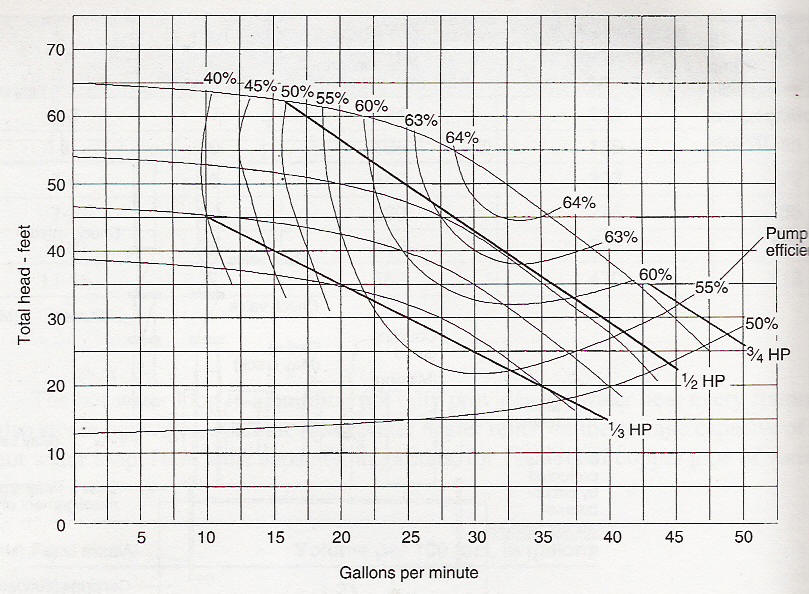
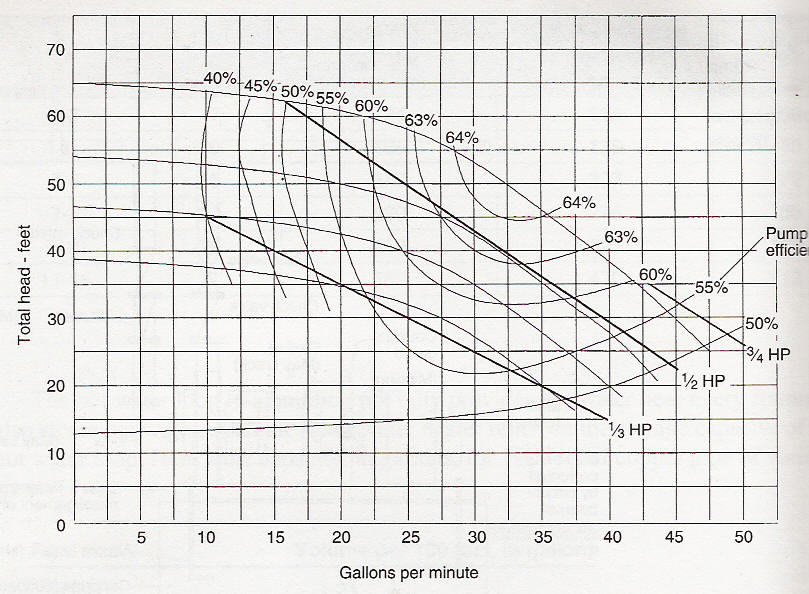
That is interesting Bill. Here is one I found a little closer to what
we are doing. It came from a book called Basic Engineering for Builders.
The HP quoted is the net HP out of the pump motor. Not the electrical power
into the motor.

Looks like I was being optimistic about pump
efficiency. If you take the average pump eff. as 50% the DC electric pump
overall eff. would then be .8 (motor eff.) times .5 (pump eff.) or 40% overall.
20 amps at 13 volts input HP of .35 HP then becomes .14 net HP to move
the water. I think we need to explore the effect friction in
the rad and plumbing has on the HP requirements. When I was seeing 18
psi across the pump it did not make sense that the 110 volt 30 amp circuit
breakers were blowing nor did it make sense it took 2.1 HP using
the 5 HP water pump dyno motor.

If you look at a situation where both the source of the water has the
same head as the destination head it makes sense that some HP will be
required to move the water faster than gravity alone would achieve.
Obviously one cannot go on head alone.

I am also going to calculate the water velocity in a typical radiator tube.

The jury is still out on this HP situation. Hopefully I will get
my dyno engine running this spring and get some pressure drop
data through out the entire cooling system.

Paul Lamar

The Rotary Engine NewsLetter.  Powered by Linux.
ACRE NL web site. http://home.earthlink.net/~rotaryeng/
Copyright 1998-2004 All world wide rights reserved.