A kind person loaned me a Mezier electric water pump to run some
numbers
on. I want to thank you for that.

First thing I noticed was the 20 AMP fuse in the 12 gage motor
wiring. Whoa! Wait a minute! That is a limit of 20 amps times 13
volts>> or 260 watts
or .35 HP. As soon as you put some back pressure on this pump
either>> the impeller will cavitate or the fuse will blow. The
stock pump>> handles
ten times that amount of HP or around 3.

Then I took it apart and saw the unsophisticated toy impeller
and>> decided
testing it was a waste of time. A stock Mazda second gen
impeller looks>> like rocket science along side this toy. I
expected a much better>> design
based on the questionable advertising claims.

The inlet and out let holes are limited AN -12 or 3/4 inch ID.
No way in hell are you going to get much flow through 3/4 inch
holes>> both
on the inlet and the outlet. That is .44 square inches and the
usual>> water plumbing is 1.5 inch or 1.76 square inches or four
times more>> flow area. No way to increase the size of this
plumbing.>> In order to test this pump I would need to adapt the
3/4 inch plumbing>> to the 1-1/2 plumbing of my water pump test
rig. Not worth it!!!>>
Using this pump in a high powered aircraft engine risks cracking
the>> rotor housings due to local if not over all overheating.
Paul Lamar
Case closed, I hope. How can anyone who has been around the
last two> years consider this pump? Jerry
Lots of people are betting the farm on this pump?
Bulent
Wow! For the life of me I don't quite understand why I cannot get the
physics principles across on this pump. What am I doing wrong? Why
don't people understand me?

It is ironic that James Watt invented the concept of HP while
pumping water out of a mine. He found that one horse, using a large
bucket, a rope and a pulley could lift 1000 pounds of water 33 feet
per minute out of the mine.

I wrote a basic program today to calculate the absolute minimum amount
of HP required to pump X amount of water against Y pressure.
"Head" and pressure are interchangeable. In other words 30 psi back
pressure is like pumping water to the top of a seven story building.

Why might you ask is this the case? Well a container one foot square
(one cubic foot) holds enough water to weigh 64 pounds. The bottom of
the container being one foot square is 144 square inches. Therefore
each square inch on the bottom supports .4444 pounds of water. Putting
it another way that is.4444 psi. Since the typical back pressure we
have seen on a complete cooling system can be as high as 30 psi.... 30
psi divided by .4444 is 67.5 feet.

In other words to pump water against a back pressure of 30 psi is the
same as pumping it straight up 67 feet. Now I ask you, do you really
think this puny electric pump can pump 30 gallons of water per minute
to the top of a seven story building from ground level?

OK 30 gallons of water weighs 240 pounds. We are lifting 240 pound 67
feet straight up in one minute. Putting it another way that is 16,080
pound feet per minute. Since James Watt proved that one horse could
lift 33,000 pound feet per minute it takes 16,080/33,000 or .487 HP to
do the job. That is the absolute minimum amount of HP to do the job
assuming a 100% efficient pump. No if ands or buts. No getting around
it. It is a FACT. No lie. It is not just a good idea it is the law!

Now, as I pointed out above, an electric motor is about 80% efficient
and a centrifugal pump at best is 70% efficient. The over all
efficiency of the electric water pump is therefore  .7 times .8 or .56
efficient. You can quibble with these numbers but they are not far off
with the possible exception the mechanical efficiency of the
centrifugal water pump may be much lower than 70%. From the test we
have run so far on the Mazda pump I suspect that is indeed the case.

This mean you are going to have to double the HP number calculated
above.

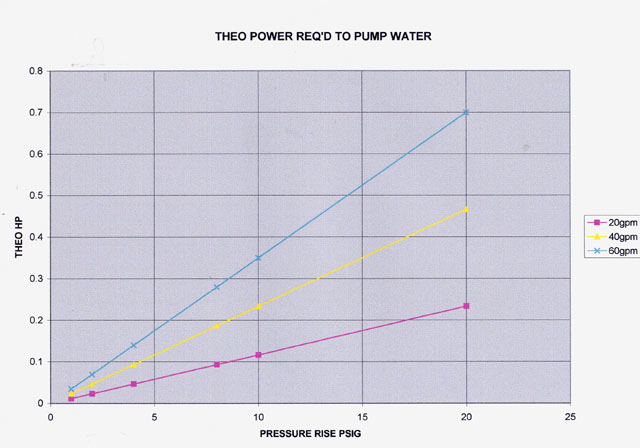
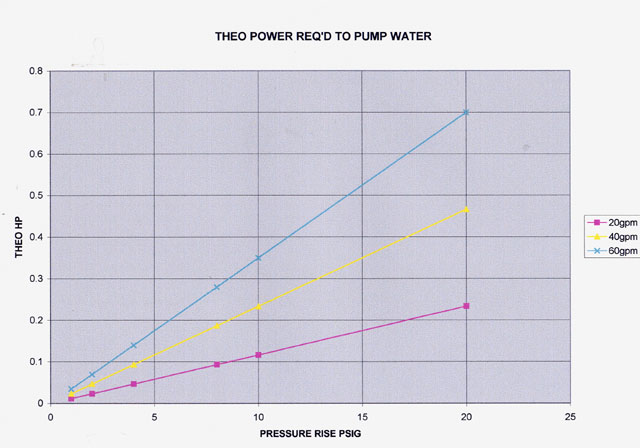
Here is a table of the amount of power it takes to pump X amount of
water against Y pressure. The last number indicates the current
required by an electric water pump to achieve these numbers. The HP
number is the minimum HP mentioned above and the watts and amps are
corrected for the electric pump efficiency.

If you want to examine the BASIC program let me know and I will upload
the source.

Are there any questions about the calculations? Have I made any
errors?

Paul Lamar
Hi Paul,

Where is the requirement to pump 30 GPM against a head of 30 PSI
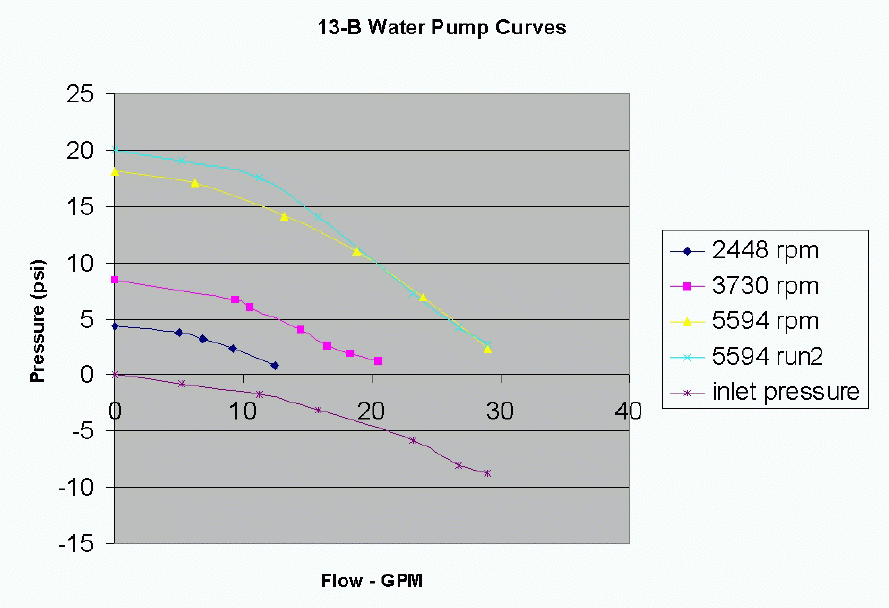
documented?  In looking at Bill Shertz data, the highest pressure he saw
at 5594 RPM was 20 PSI at zero flow.  The physics is not in question,
but possibly the assumptions about the operating conditions are.  For
example, note the operating point at 30 GPM where the pressure across
the pump is about 11 psi. The mimimum HP required to accomplish this is
0.18 HP.  (leaving out the effeciency question.)

  GPH = 30
       PSI   head ft     HP      Watts    Amps

       11.1      25      0.18     271     20.9

BTW, that is supposed to be GPM instead of GPH isn't it?

Bob White

--
http://www.bob-white.com
N93BD - Rotary Powered BD-4 (soon)
Yes thanks for catching that.... GPM.
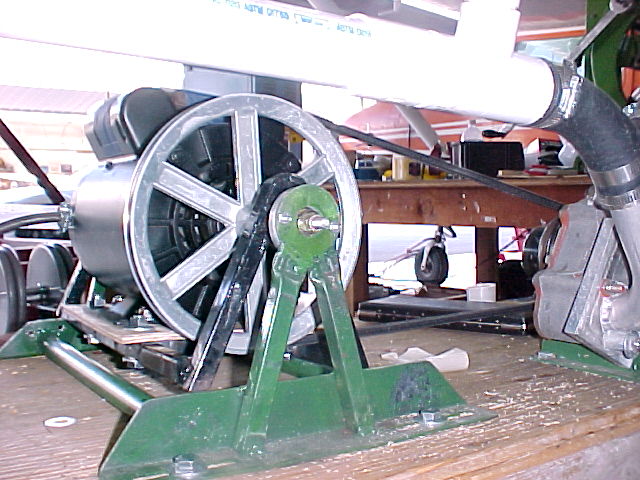
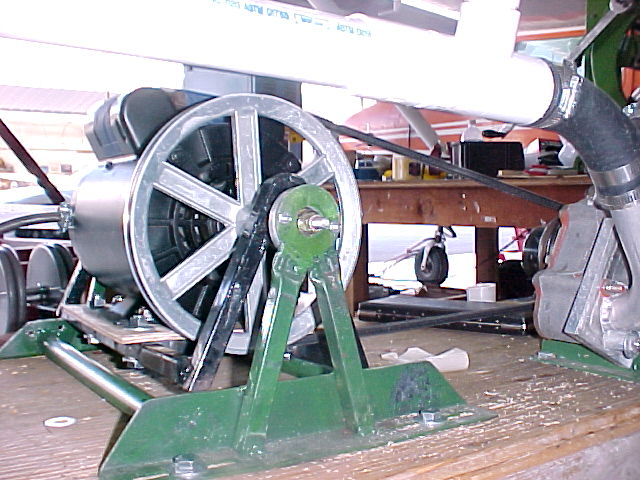
We did a lot of test of our own. Using the 5 HP motor rig with an eight inch pulley on
the motor with pump RPM up to 7000 RPM. We measured pump RPM directly
with an optical tach.

30 psi was just used to illustrate a point.  Also arbitrarily chosen  as the
upper limit in the program. We don't yet know what
the over all pressure drops will be but I will say they will vary greatly
by what kind of heat exchangers you choose. Two pass verses single pass
for one example. Also how they are plumbed if more than one.

Here is Vances chart for the same HP consumption as shown in my table.

Here too is the last message on the test we did with the eight inch
pulley and my cast housing which is a copy of the Mazda housing.

The second message was done with a different earlier rig and the new cast housing.
No HP measurements unfortunately as I was using the 2 HP mill motor. I was
blowing 110 volt 30 amp circuit breakers around 5000 RPM just like Bill was.

That is why Vance and I obtained a new 220 volt 5 HP motor. At the time Bill and
I  both thought this was rather strange as it was not accounted for entirely by the
HP required  to pump against the head. I can only conclude we were losing HP due to
the friction of the water moving through the pipe. Vance and I noticed that a
considerable amount of heat was being generated in the water particularly around
the restrictor valve.

BTW Bill's rig was an open loop system  from bucket to bucket while we  used a closed
loop, pre pressurized, system in all cases. A pressurized closed loop system
is more typical of a hot engine. The test I will do on your EWP will be the open
loop system.


Paul Lamar

_____________________________________________________________________
Subject:             Water pump dyno. Final HP data
       Date:             Fri, 12 Dec 2003 02:18:59 -0800
       From:             ACRE <rotaryeng@earthlink.net>
 Organization:             ACRE
     I ran the pump at 7000 RPM today using the eight inch pulley. Max flow
     was about 55 GPM at a 5 psi pressure differential across the pump.
     The fish scale read 2.9 pounds. This worked out to over 2.1HP !!!

     If it were electric driven that would be 1567 watts or 131 amps
     at 12 volts 100% eff. At 80% eff. it is 163 amps!!!!!!!!!

     My guess is the pump is starting to
     cavitate but I am not sure. Vance witnessed the test and we both
     feel if you are running a 2.85:1 PSRU ratio you should use the Racing
     Beat smaller E-shaft pulley to slow the pump. Other wise the pump
     will be pushing 8000 RPM on takeoff

Great info Paul. An interesting side note. I spoke with Steve Weinzierl who
did the current Powersport drive some time ago, and
he said the max flow they could get from the stock pumps WAS ta da ... 56 gpm.
This flow rate was right at the edge of
caviation. The speed was approximately 7000 pump RPM, They were unsure of
the required HP. I am actually suprised that the HP
requirement was that LOW. The Meziere pump, which will flow more, is listed
as requiring as much as 3.5 HP to produce 65 gpm.
The max closed circuit pressure is shown at 30-35 psi. It seems like
you are getting "good data". Bill Jepson
I am not entirely happy with the valve that is in there but I am anxious
to get the flow meter and pressure gages on the dyno engine and get some
actual pressure drop data on the block and rad.

Me and Vance have spent enough time and money on this test rig.
Now I have to find another use for that 5 HP electric motor. I guess I could
put it on my old CC mill :) What I really need is a Do All with a bad motor.

Paul Lamar

The AirCraft Rotary Engine NewsLetter.  Powered by Linux.
ACRE NL web site. http://home.earthlink.net/~rotaryeng/
Copyright 1998-2003 All world wide rights reserved.

__________________________________________________________________
Subject:             New pump test at 20 psi pre pressure
       Date:             Mon, 21 Jul 2003 08:31:57 -0700
       From:             ACRE <rotaryeng@earthlink.net>
 Organization:             ACRE


Bill,

Here is the data you requested.
The data is at 4300 RPM for the new water pump. 20 psi  pre pressure.
Pressures in psi. Pump outlet, flow meter, inlet respectively.
Flow in gallons per minute.

flow      p1   p2     p3
closed    18   17     5
15        18   18     6
20        18   17.5   6
25        18   17.5   6
30        18   17     6
35        18   17     6
40        18   17     7
45        18.5 17     9
50        19   17.5   11
55        19.5 17.5   12
75        20   17.5   14

Stopped   18.5  18    19

Pressures are a bit higher than the stock pump but in the same ball park.
It does not have the 1/8 to 3/16th bleed hole like the stock
pump. Could be added by a small external line.

Same characteristics of a closed loop car cooling system.
Pressure has little to do with flow over a wide range.
That is why the bleed hole does not seem to hurt the flow all that
much in the stock pump.

It might be there to prevent cavitation at high speed if the lower
rad hose collapses. I suspect this might be what happened to Perry's pump.
The bleed hole got blocked with trash. Or it could be there to circulate
a bit of water in the block when the rad is plugged up.

On second thought looking at these pictures again  the system could
have simply been run low on coolant for awhile at high RPM.

Paul Lamar

The AirCraft Rotary Engine NewsLetter.  Powered by Linux.
ACRE NL web site. http://home.earthlink.net/~rotaryeng/
Copyright 1998-2003 All world wide rights reserved.