That was an interesting picture - since it was a submarine, the
purpose
may very well have been noise. A tip shroud rotating can be
handled
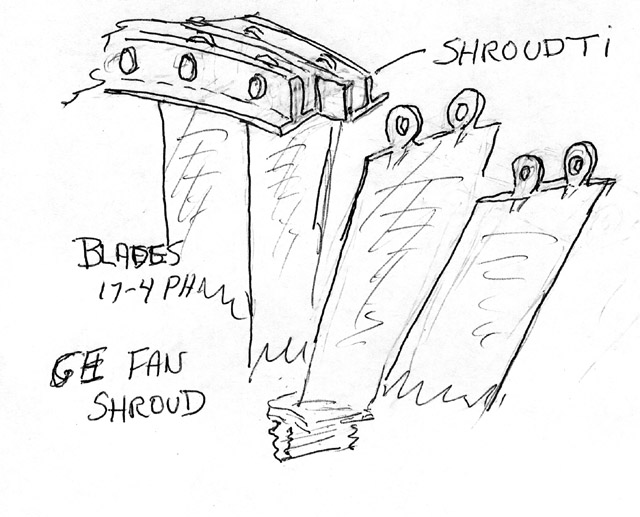
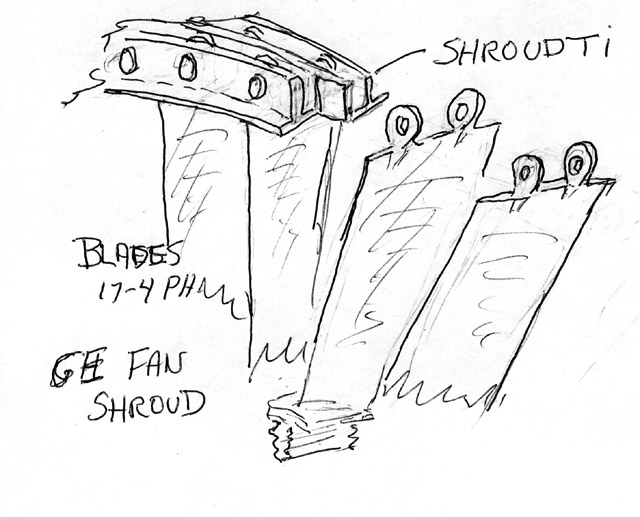
quite nicely with current marerials. On an early ducted fan at GE
we used a segmented tip shroud of titanium as a part of the
labrynth
sealing of the stage. It did not use hoop, but was completely
carried
by a pin and clevis configuration at the tip of the 17-4ph blades.
Carbon fiber in hoop can support a rather high centrifugal load.
Vance
-> Larry Hendrix wrote:
Vance,
Both the picture and your comments are quite interesting, but I could
not
follow all of your details.  Do you have any pictures of that GE fan
assembly, or references that I might find on the 'net?
Thanks,
Larry
george wright wrote:
Vance - are you referring to the GE lift fans that were tip driven by
turbine exhaust?
To answer several questions - I set up an excell spread sheet to compute
hoop stress for several different diameters - but all with the same tip
speed - 900 ft/sec - near top value for most props (and compressor blades
in most turbines by tne way). Funny thing - stress was the same for all
diameters at that tip spee - about 60ksi for carbon density (well
within allowable for filament wound uni). Stress goes up as the square
of tip speed, and is linear with material density. This is pure hoop
with no assist from the blades.
Advantages would be reduced tip loss and noise. reduced personell
risk (visibility and less chopping threat, damping for high aspect
ratio blading. There would be little impact on static thrust, but less
loss in top speed as compared to a stationary duct.

The attached sketch - from memory - shows the GE configuration,
and this was on a modest bypass ratio, early development engine,
and was not on any production fans to my knowledge. The tip
turbine lift fans were a favorite of Joe Alford - one of GE's
top idea gurus, and also did not make it into any production
systems to my knowledge. The seperation between turbine
and fan sections was accomplished by inegrated platform
"wings" - and this was also the case on the reverse case of
the aft fan "bluckets" - which did make it into production for
some Convair fanjets.

The contoured shroud configuration fan is ideal for blimp
applications, with improved low speed thrust, and a high
degree of protection for the ground crew. Many of these are
pivoted on drives similar to boat out drives, so they can
be pivoted for a wide range of thrust lines such as lift
and reverse.
- Vance
What about the increases skin friction of a rotating shroud.
Seems the HP consumption would be considerable because of the high
speed. A little bit additional drag at the tip results in large
increase in HP consumption due to the very high speeds.
Marc De Piolenc already mentioned this.

Paul Lamar

The Rotary Engine NewsLetter.  Powered by Linux.
ACRE NL web site. http://home.earthlink.net/~rotaryeng/
Copyright 1998-2004 All world wide rights reserved.