paul malcolm booth wrote:

G'day Paul,
        At LAST I can contact you,- found your e-mail address on Tracy C's site,- why isn't it on yours? (or did I miss it?).
        I'd like to thank you for the best site on the web,- the most comprehensive & informative by far.
        We are working on our own 4-place version of Steve Rahn's "Vision" to be powered by either a 13b or a Renesis motor which I believe to be far more "bullet-proof", than Lycs., etc. The
question mark is obviously against the PSRU,- we'll see which of the available units has the best score on the board when we get that far.
        We have an interest in a turbo mainly as a means of quietening the beast,- any thoughts? Also your inlet castings look very interesting when the time comes.
        At the moment we are trying to finalise our cooling ducts and it is here that I have a couple of queries:-

               !/.  Your website used to have a diagram, part D of which suggested the lowest drag configuration to be a NACA intake duct under the belly, radiator in rear fuselage & outlets under
the horizontal stab. The accompanying table compared this with other configurations as having less drag & more cooling. Now I think you are advocating a nose inlet, rad. under engine & outlet under
firewall. From my reading it seems this arrangement cannot achieve sufficient inlet or outlet duct lengths to minimise inlet opening,- also would not the prop. cause problems?

               2/.Your excellent "How To Cool Your Rotary",article mentions:- figures x,y,z,r,s & table a, but I have never found them,- PLEASE tell me where they are. In particular what is meant by
"bell shaped"?

         Our current leaning is towards a belly (or two fuselage side), inlet opening a long "bell shaped"(?), inlet duct allowing a 25/30% of rad. dimension opening & a rear fuselage exit 78% of
inlet area. Any comments?.
          Based on experiences posted on the web it appears that Dave Atkins' recommendation of 300sq.in.rad. area (for 160-180hp ?), is close to the mark,- therefore 400sq.in. for a 240hp Renesis
shouldn't be too far out and would allow realistically sized ducts.
          Were you ever able to get Heat Balance figures for the Renesis?- Mazda HQ in Australia didn't know what I was talking about when I rang them!

          By the way are you familiar with the cooling ducts etc. on the 1939 British "Napier-Heston Racer", built to attack the World Speed Record? Brilliant, but it apparently overheated then the
War intervened. (I'm originally a Pom/Limey).

           Again Many Thanks for the site, we'd really appreciate your comments on the above & I'm sure we''ll have many more questions as we progress.

                                          Very Best Wishes,
                                                                        Mal Booth.
Thanks for the complements.

We have discovered that NACA ducts don't work very well with rads.
Not inless you can suck a lot of air out of the back side somehow.
Kays & London came up with a wedge shaped diffuser no longer than the rad
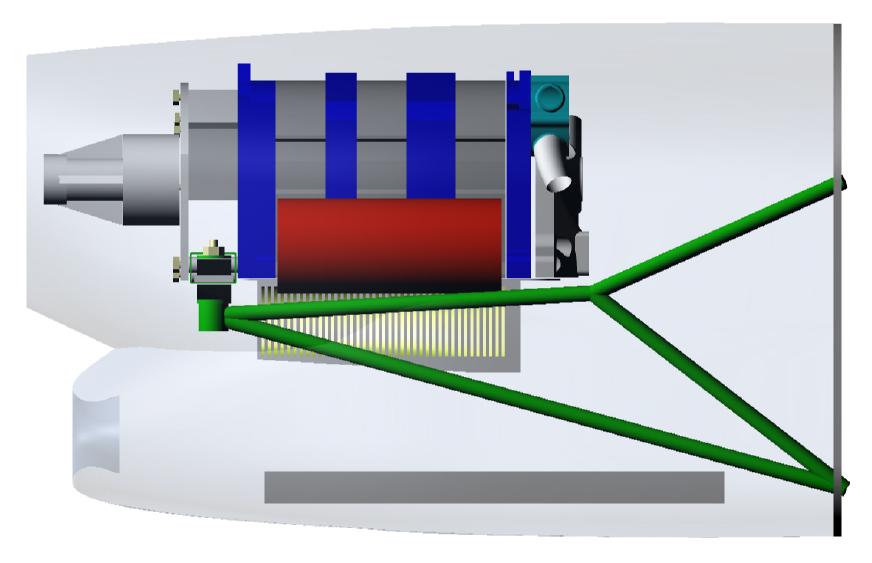
ideal for a rad under the engine. Prop blast can help at climb speeds.
Those tables were from the Kucheman and Weber book Aerodynamics of Propulsion.
As far as I am concerned they are impractical for rads mounted under
the cowling. The duct length requirements are too long. I need to update
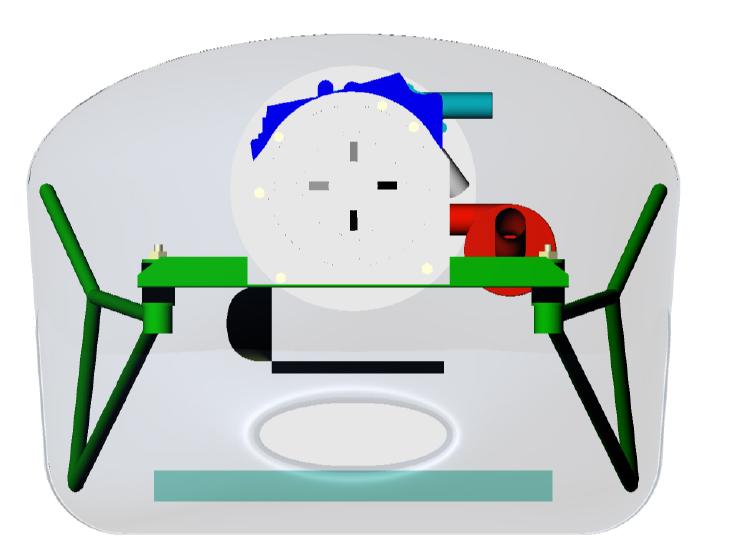
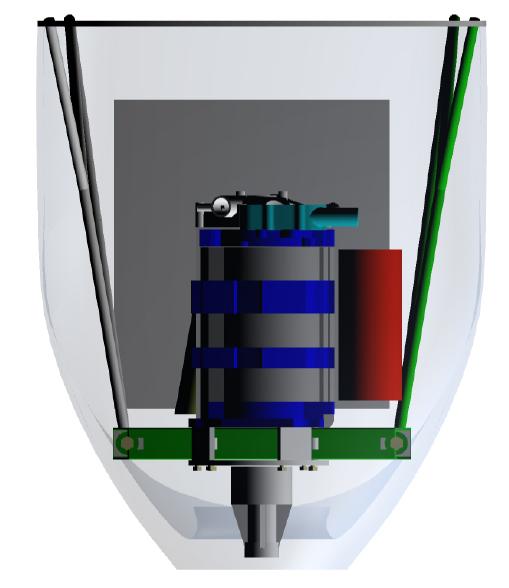
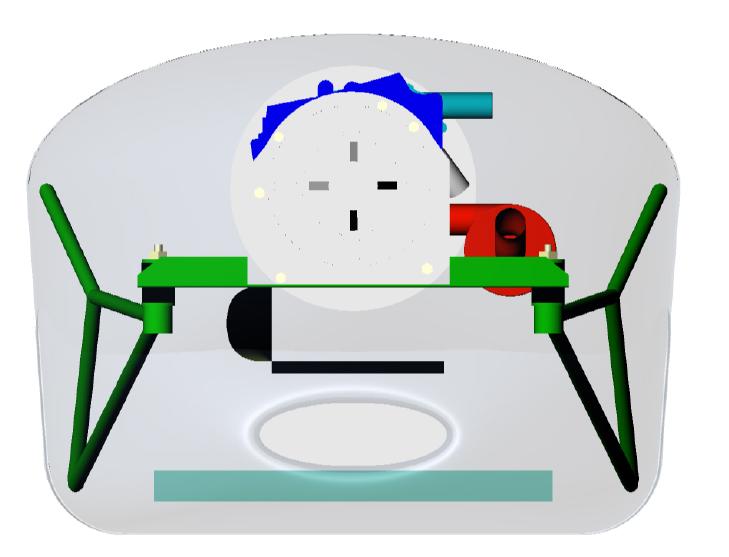
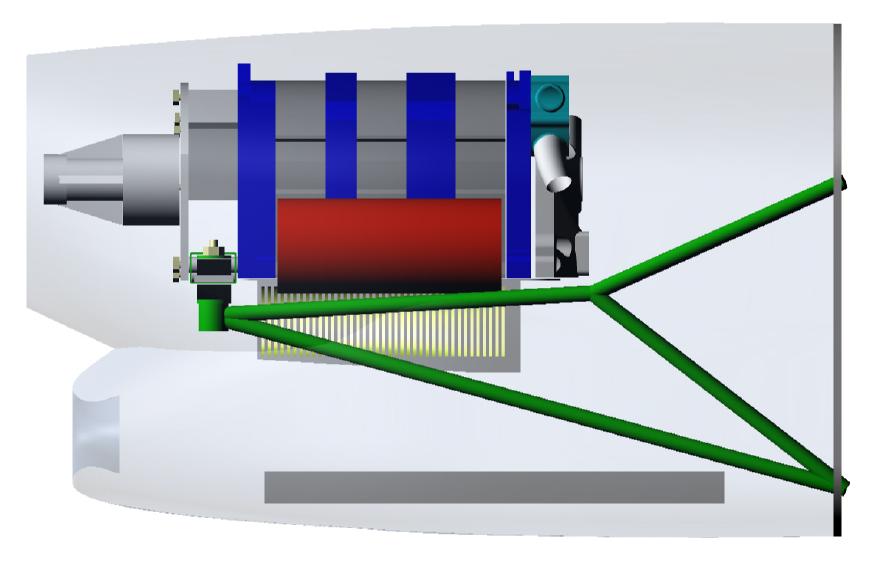
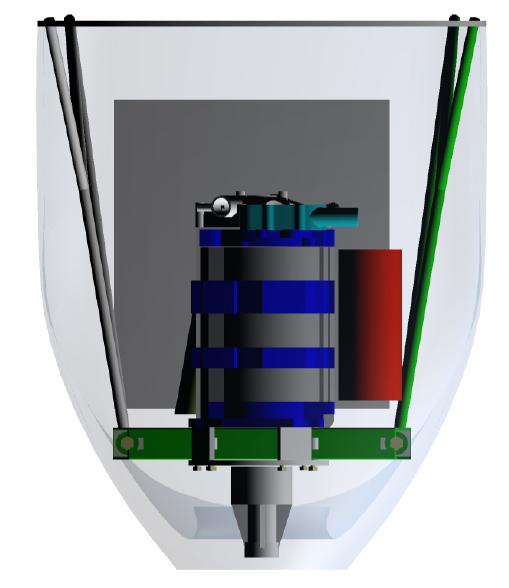
that article. This is our latest thinking on a rad arrangement.

Tracy's web site is listed on our web site. You have to scroll down to the about 2/3 rds.

I am sold out on the inlet castings unfortunately. No plans for more anytime
soon. Perhaps if I heard from ten people I would do another batch.

What Dave Atkins is saying about rad sizes is about right. What he  neglected to
tell you is the thickness. 300 square inches and 2 inches thick is about right
on the money at 600 cubic inches.

No heat balance numbers for the RX8 engine yet. It is better as we are seeing
a 200 F drop in EGT's and slightly better RX8 over the road MPG. 27 MPG at a steady
55 MPH and 25 MPG at a steady 70 MPH. Latest number on the 13B are a BSFC of .47.
My guess is the RX8 engine might be .46 or .45.

Not familiar with the cooling ducts on  Napier-Heston Racer.


Paul Lamar

The Rotary Engine NewsLetter.  Powered by Linux.
ACRE NL web site. http://home.earthlink.net/~rotaryeng/
Copyright 1998-2004 All world wide rights reserved.