Jerry Hey wrote:
I exchanged a few e -mail with Rolf and, as always learned a lot.
One
thing I had not really focused on is that the reason the Leman intake
runners are two inch is because that is the size of the port.  If that
correlation is important then I should have a 1.5 inch runner.

As far as tuned intake runner lengths,  Rolf drew a distinction
between
"ACTIVE" runner length and the length of the whole system. The idea
is
that the tuned length should be of one size so that the air moves
through it at a constant speed all the way to the p port.   Before the
tuned length,  larger tubes can be used to add length as the
installation requires.    I have drawn such a system.  Rolf has not
seen this drawing  yet and he might want me to make changes.
Regards,
Jerry
This will be tuned at two different RPM's. One RPM is related to the
length and diameter of the pipes from the plenum to the ports and the
other related to the length of the larger pipe going to the plenum.

As an electronic analog this is a series tuned tank or band pass
circuit.
In this implementation the second pipe is so short and fat it will be
tuned to a RPM range out of a normal operation of the engine. A similar
system is used in the RX8 motor except the second pipe is longer and
tuned
to the proper range. The RX8 injectors of course are someplace else.

Since the tuned length of a runner is related to its diameter the
smaller diameter
pipe needs to be even shorter than 17-18 inches. My guess is a tuned
length
of about 15-16 inches is about right. The center line length of the 180
is
about 7.8 inches. Add two inches where the pipe comes straight out of
the
port and you have 9.8 inches. Add 6.2 inches for a straight section and
the plenum is right on top of the motor.

Also a smaller diameter pipe has a somewhat smaller tuned range. (Higher
Q)
To broaden the HP RPM range the second 2" pipe can be about 19 inches or
15 inches
depending on whether you want to move the HP curve up or down. shorter
will
give more power on the top end. Longer will broaden the curve downward.
The peak power will suffer however.

Good luck getting the mixture the same in front and rear rotor.

Due to the smaller pipes the HP generated will not compare to the two
inch Russell manifold. The area of a 1.5 inch pipe is about 1.76 square
inches.
The area of a two inch pipe will be about 3.14 square inches.
The air velocity in the smaller pipe is almost double so the skin
friction
drag in the pipe will be four times higher roughly.

You have enough meat in your P-ports to ultimately open them up to an
area
equivalent of a two inch pipe.

Paul Lamar
BTW I thought the whole idea of the Russell was to get a low profile
for your manifold to fit under the cowl. I suggest you get or make a stock
cowl
to be sure everything fits.

Paul Lamar
Paul,
I gleaned these snippets of info from different sites and wondered if they
could be of any use.
A: Tube length effects the RPM for Torque peak.
Higher RPM - Intake and exhaust pulses get shorter.
Short runners for max HP and high RPM.
Long skinny runners for low end torque.
B: Distance between the intake valve to the intake opening in inches = 79200
divided by RPM for max torque peak.
C: Too large a runner diameter will be negative to performance as it slows the
velocity to an extent that it can't maintain the fine atomisation of the
fuel droplets.
Smaller diameter runners maintain the velocity, however too small and the
engine is starved.
Does that help in any way !?
George (down under)
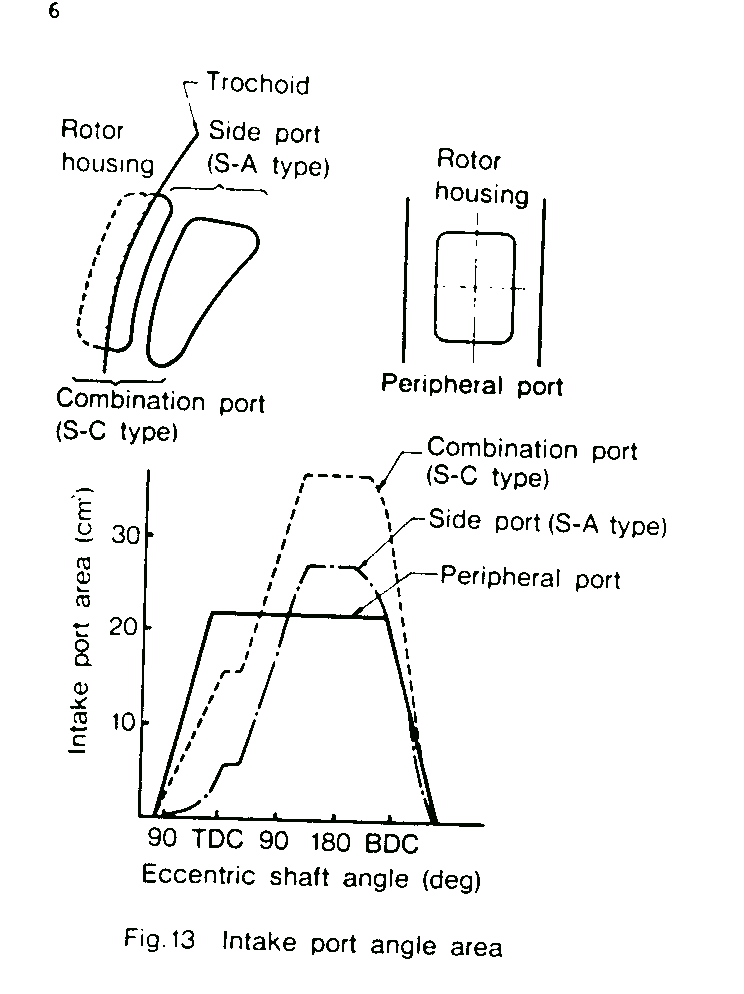
B: There are a couple of differences. Four cycle, one cyl. piston engine intake's pulse half
as often as a one rotor engine and the duration of the pulse is half as long.
Also the shape of the curve defining the intake valve opening is a half sine wave.
On a p-port rotary it is more rectangular. This means there is a better impedance
match to accelerate the column of air in the piston engine intake runner. For an
electronic analogy.  A lot like a large slow turning propellor verses a small
high RPM prop. In this case the rotary is the large "prop".

C: We are always dealing with high intake velocity as we as we are always
near the top of the HP curve.


Paul Lamar

The Rotary Engine NewsLetter.  Powered by Linux.
ACRE NL web site. http://home.earthlink.net/~rotaryeng/
Copyright 1998-2004 All world wide rights reserved.