Here is how to relate piston engine tuning to rotary
engine tuning. Basically the equivalent rotary port timing to a
piston engine is the rotary opens its port roughly half as often so
the runner length is roughly twice as long. Roughly speaking the
piston engine port is open 90 degrees while the rotary port is open
roughly 270 degrees. For all practical purposes the rotary port is
always open 80 or 90% of the time while the piston port is only open
about 25% of the time. The same port  feeds three rotary combustion
chambers but the piston port only feeds one combustion chamber.

The thing that frequently fools the piston engine guys is going to a
smaller runner lowers the RPM at which peak torque occurs. This they
like as they need torque down low. In fact it actually narrows the
torque band slightly.

If you were experimenting on a dyno the only adequate way to tune
the engine properly is with three different diameters of runners and
three different lengths of runners. That is nine combinations. Other
than the car manufactures none of the after market tuners are doing
this to my knowledge. I am certain Mazda did it with the Lemans
engine and choose 2 inches as the largest dia. pipe they could get
in there.

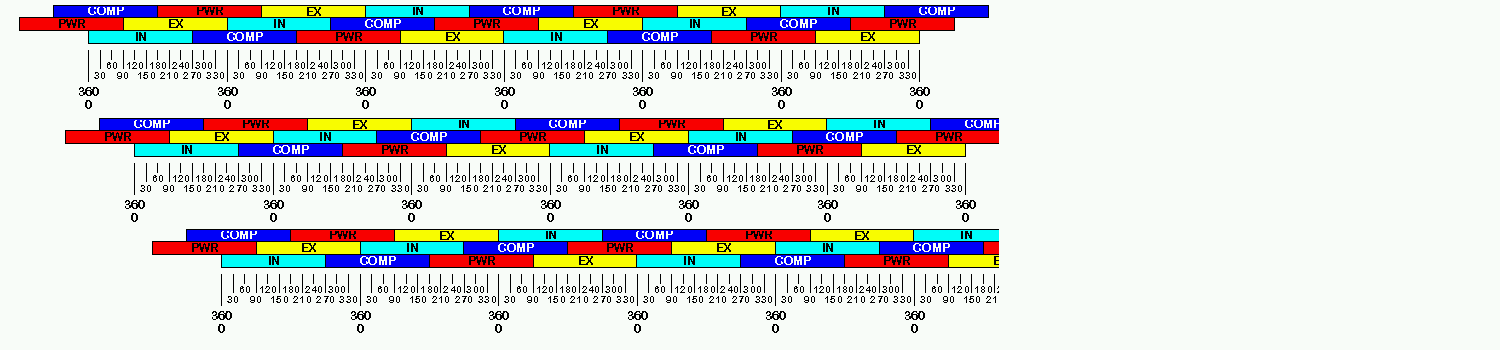
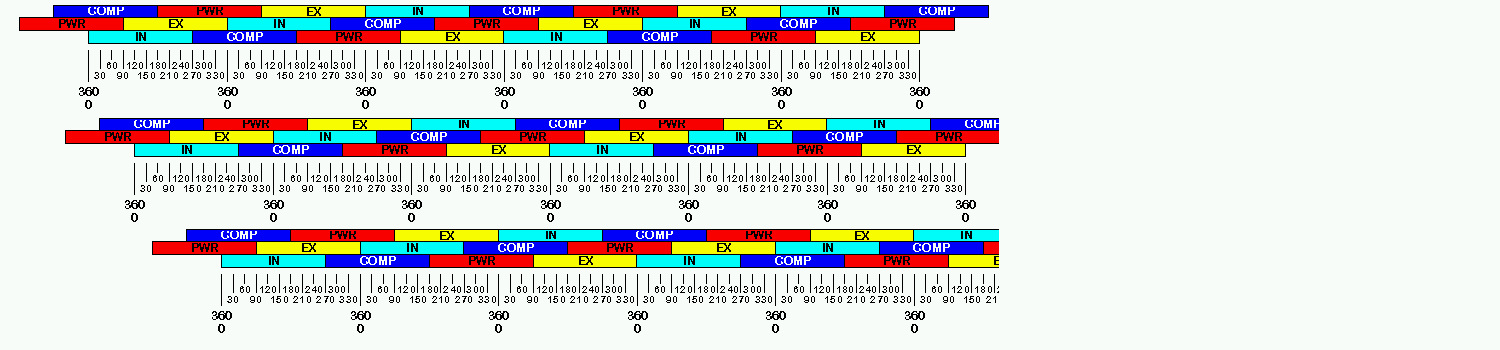
The chart below only shows six possible combinations and no pipes at
all.


Paul Lamar
Can ram air be ignored since it is the same in all combinations?

I will build two intakes for side by side testing.   Problem is I don't
have a dyno.   Static performance should tell something.    Jerry
Which two have you decided to try?

I don't know what you mean by "ignored". It is like flying below sea level
:)

Static performance will only tell you what the HP is at static RPM. Not what
you want to know  unless you fly out of short fields all the time.

In fact good static performance probably implies less than good performance
at climb or top speed.

Paul Lamar
"Giffen A. Marr" wrote:
How does the chart change for a 3 rotor? I assume that the port timing would
now be split between the 3 rotors.
Giff Marr
Which chart is that Giff. The Bill Marvin Timing gif?
Assuming that is what you are talking about I cut and pasted it
to a 3 rotor form with the rotors equally spaced around the eshaft
at 120 degrees.

If you think the two rotor is smooth you should feel a three rotor :)

Paul Lamar

The Rotary Engine NewsLetter.  Powered by Linux.
ACRE NL web site. http://home.earthlink.net/~rotaryeng/
Copyright 1998-2004 All world wide rights reserved.