Douglas Fir wrote:

Paul

Check out this URL on how Scandia did turbo compounding. The graphics are
identical to Caterpillar.

http://www.westwardscania.com/trucks/NTR/technology/turbocompound/how_does_
it_work.asp?ComponentID=43343&SourcePageID=56704#2>

What is interesting is that the second turbo runs up to only 55,000. It
appears there are basically only two sets of step down helical gears at  5:1
ratios. There is a hydraulic coupler which has within, I can imagine, some
spinning discs in oil.  Vary the gap or bypass pressure and hence control
friction between the plates and the slippage. Sounds a little bit like the
torque converter in an automatic transmission.  Much easier to deal with
than a CVT.  Might be able to use MOBIL 1 as well:)

For a 2 rotor compounding 20 to 30 Hp back is starting to look
sexy.   270+ HP with two rotor. P-ports are starting to look more attractive
as well because they breath so well.  The inefficiencies of complete
combustion are more than made up for by the robust exhaust and ability to
devote the turbo exclusively to turbo compounding.

A wastegate might be needed at idle or when starting though.

Doug in Japan
Paul,
This is something like Cat. and Scandia are using.  Now where to find one
small enough.   Notice they can be designed to stall under any given speed.
go to this site.  A brief description can be found.
http://thrashercharged.com/tech_htm/torque_convertor.shtm
Time to sleep for me.  ZZZZZZZZZZ
 Doug in Japan
I think the V-belt drive to the nose of the 3 rotor will serve the function
of the fluid coupling. Scania, CW R3350TC and Cat all use gear drive so they
need the fluid coupling.
Paul Lamar
Paul

Time to eat some more humble pie.  I slept on the idea last night and came
to the same conclusion for the belt, but managed to find a inexpensive
garden tractor electric clutch. Go kart clutch is another option. Just a
moment ago I just got a email in from 'the source'  Read it and weep:)

 "Hi Douglas,

 Your system makes only exhaust pressure up .
 So, it makes large number of exhaust gas circulation
 in the period of over lap port timing..
 And it reduce volume of intake air .

 I recomend your system need no over lap port timing.
 That is all side port RE.

 You can easily test it.
 Choke the exhaust pipe of RX7 and RX8.
 Push those of  trottle pedal.
 Higher engine rpm is the better one.

 Yours faithfully,

  Hisanori"

In essence what he is saying is that turbo compounding without boost in
engines having port overlap, (13B, 20B. all P ports), is going to reduce the
amount of oxygen available for combustion by carrying too much exhaust gas
into the next cycle.  So I guess some boost is needed. He seems to recommend
the all side port Renesis IF we turbo compound without the accompanying
boost.  Fine for most of you except I need a lightweight 3 rotor.

I am beginning to feel like a pin pong ball.  Hey but who said it would be
easy?

Paul perhaps I can convince you to put a potato in your RX8 exhaust pipe,
step on the throttle and tell me what happens.....No?...  Well its just an
idea.  Afterall it was fun to do (to other peoples' cars) when we were
kids:)

Doug in Japan.
You must make sure nobody is standing behind the car if it does start :)

Actually it is not that simple. If that was the case nobody would
be making 800 HP out of a turbo 13B as the HP required for the compressor
for these kinds of boost levels puts a considerable back pressure on the exhaust.

The fact of the matter is the intake pressure is usually higher than
the exhaust pressure so the gases flow from the intake side down and out
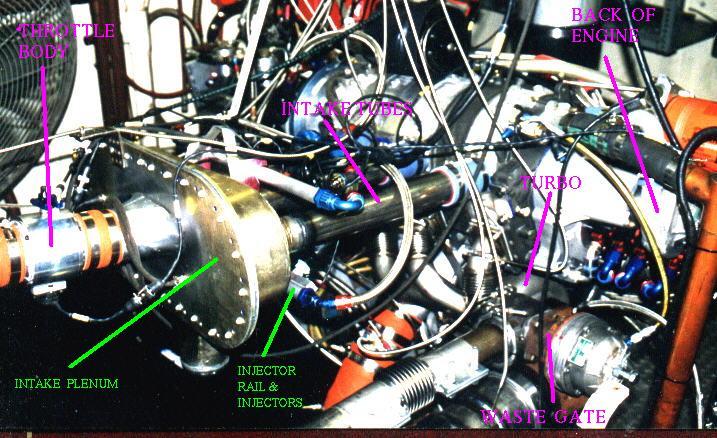
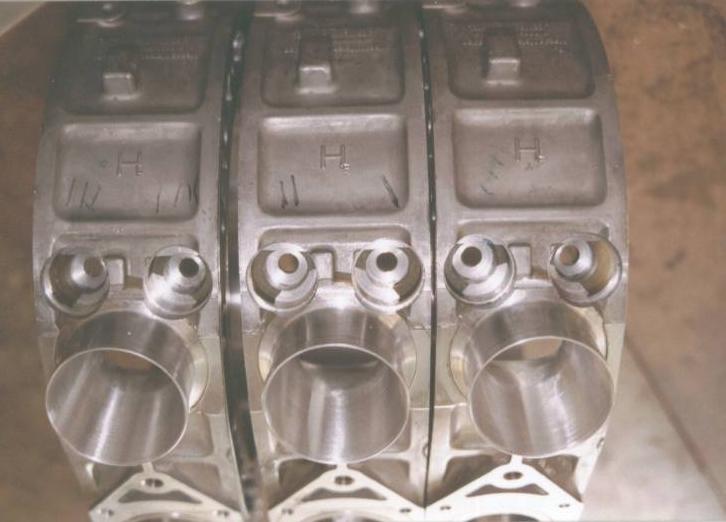
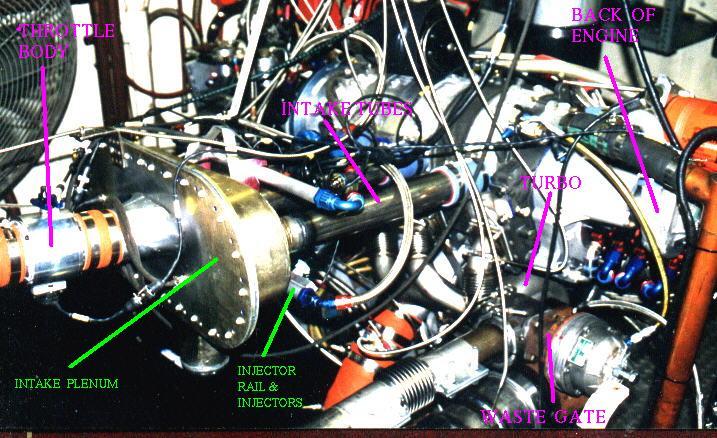
the exhaust pipe. Here are some pictures of a turbo three rotor P-port engine
now developing 1200 HP on the Racing Beat dyno.

Having said that I agree a side exhaust port might be better for turbo compounding.
How much better is the big question.

Paul Lamar

The Rotary Engine NewsLetter.  Powered by Linux.
ACRE NL web site. http://home.earthlink.net/~rotaryeng/
Copyright 1998-2004 All world wide rights reserved.