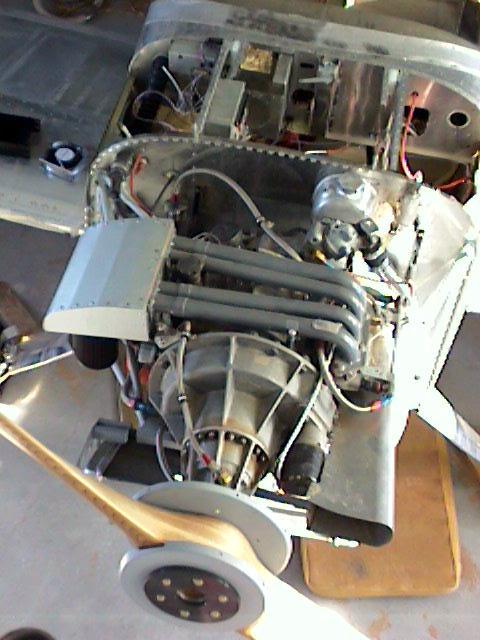
François Badoux wrote:
Hi Paul,
The PSRU ratio is 2.8235:1

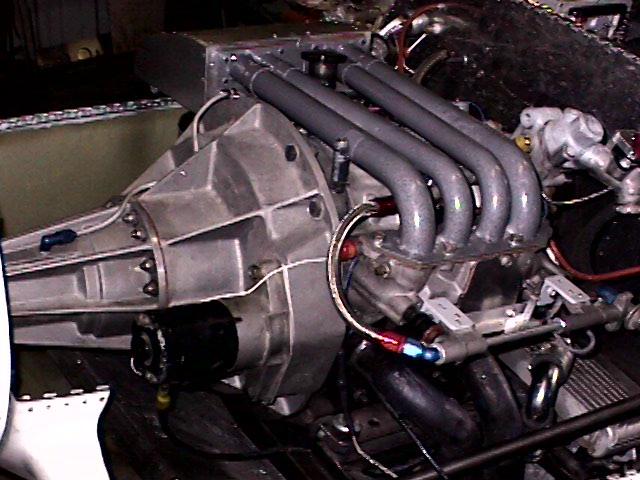
We also hypothesized that the original Mecanair runners were too long so
we checked several lengths.  We found out they were just right.  I attach a
graph of volumetric efficiency vs runners'
length. It doesn't include the latest data we got yesterday but which
didn't change the message.
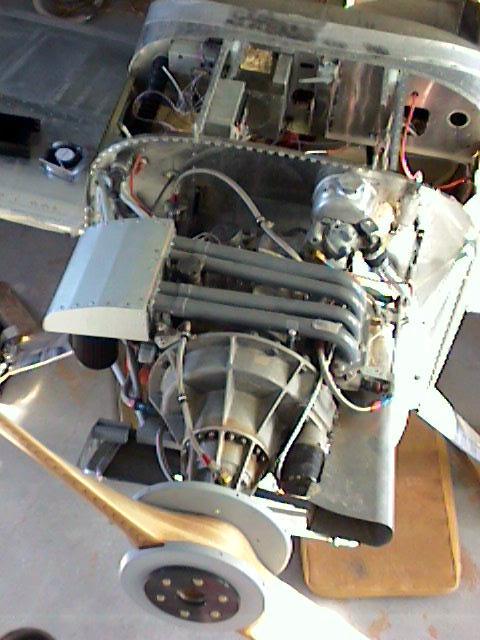
- TT means the length of the tubes we have on top of the engine.

- To these lengths, you have to add the length of the runners going from
the plenum of what we call intake manifold 1 (on the cold side of the
engine) to the junction with the tubes, and the length
of the "elbows" of manifold 2, on the hot side, all the way to the air
intakes on the side housings.
- PL is the total length of the Primary intakes (those going into the
intermediary housing), SL is the total length of the Secondary intakes
(those going into the front and rear housings).
- All lengths are in mm

- The pressure is MAP at WOT
You can see that the original length proved to be the best for power and
happens to be also the best for BSFC (well, I think... I have to check this
with Gordon).  Its peak is also almost ideally
placed. We tried yesterday to shorten the runners by 40 mm to shift the
peak to 2200 RPM (best power). We achieved that but the peak was sensibly
lower than both the red and light blue curves.
PLEASE, take notice that this data is correct for the Mistral manifold and
MIGHT NOT BE APPLICABLE to another manifold design.
The absolute value of VE might be understated as we believe that our mass
air flow meter is incorrectly calibrated (reading too low air flow values),
but it doesn't affect the message.  Do you have
an idea for easily calibrating a mass air flow meter?
Another piece of data I can release:
- Injecting 100% of the fuel charge in the middle runners (those going
into the intermediary housing) gives best BSFC (0.46 lb/hp.hr).  Injecting
100% in the outside runners gives second best BSFC
(0.485). Any split of the fuel charge is suboptimal (50:50 gives 0.535).
Peak power is unaffected. So we use only the inside injectors, keeping the
outside ones for redundancy purposes only.
This data can be released. hope it'll be useful.
Best regards, Francois
Wow that is interesting. Only one has the characteristic shape of the tuned
runner and that
is the 30.5 inch version. I am a bit confused by your messages. Is this
the total length from port to plenum? Perhaps you are getting reflections
from the joints. These curves are very flat for a tuned runner.
Are all four runners the same internal diameters? Perhaps we have some
sort of harmonics going on as well.

...Yes, the total length is from port to plenum. No, all runners are not the
same diameter.  The inside runners are 36mm and the outside ones 42mm. I am
very glad those curves are flat, we therefore have better volumetric
efficiency over a wider range of RPM.

BTW how was the VE measured?

...We put an air mass flow meter (coming from a BMW car) on the intake duct.
Its reading is corrected for temperature.  Then it is just calculation to
get VE as a function of RPM.

Perhaps your plenum is acting like a dynamic chamber. Try a really big one.
If yours is too small all of ours are also too small.

... Right, we believe our plenum is too small.  Over the holidays, Gordon is
going to manufacture (out of composite for testing) a new manifold with a
larger plenum and different geometry of the leads for smoother air flow.
We'll see how it performs in early January.  Anyway, we are not planning to
invest a lot more time researching this subject as we believe we've already
got a pretty good manifold.  We are getting the 190 BHP we advertised... and
a couple more.  Also, the engine is beautifully smooth and responsive.

Regards,  Francois

Paul Lamar