<< Well, the HP is a monster too so fuel burn always goes up with HP.
 > >If I remember I'll ask Jim Mederer what BSFC he is getting with his
 > >1200 HP turbo p-port 3 rotor. We don't care about idle in our Reno racer.
 > >3000 RPM idle is 1052 prop RPM. Hardly enough to move the airplane
 > >up a slight incline :)
 > >Paul Lamar
If you were to plan to turbocharge from day one in the build up, you could
avoid raising the exhaust port closing point above stock. I would open the
exhaust earlier,
with a big radius at the opening line. As wide as stock at the opening line
up to no more than stock width ad mid point. The liners would stay in the
housing.

You could move the intake port very high so as to reduce to the minimum the
overlap duration, and build in a very late closing point.

Idle would not be a problem at all. My NA Pport idles much better than my
bridge ported engine. There is virtually no boost at all at idle so even the
overlap that is unavoidable in the Pport would have a minimal effect.

The kids have daily driver side port turbos up to 450 HP, and drag racing
engines over 650HP.

I know......30 seconds on a chassis dyno or a 10 second drag pass is of no
value in an airplane, but the advantage of building for a turbo from the start
should be considered.

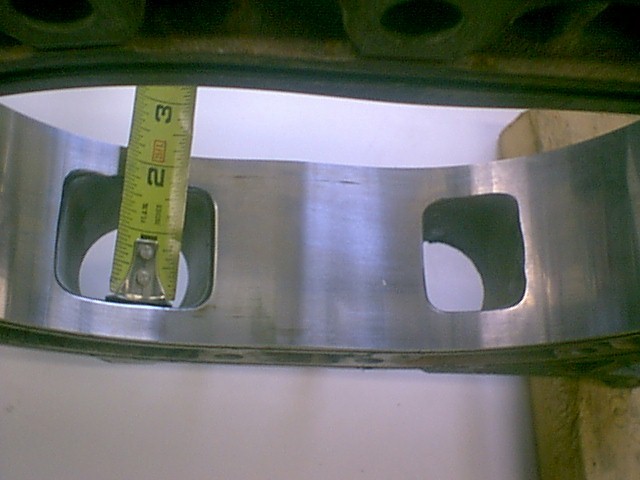
In this picture you can see that in the factory Pport, the exhaust and intake
are close to fully connected during overlap.

Lynn E. Hanover
The combustion chamber depression in the face of the rotor also connects the
two port together at all times. Its a wonder P-ports work at all let alone
generate more power. The instant pressure in both the intake and exhaust
determines which way the gases will flow. It would be nice if someone
bought some high speed pressure sensors so we could really see what
is going on.

Paul Lamar

The Rotary Engine NewsLetter.  Powered by Linux.
ACRE NL web site. http://home.earthlink.net/~rotaryeng/
Copyright 1998-2004 All world wide rights reserved.