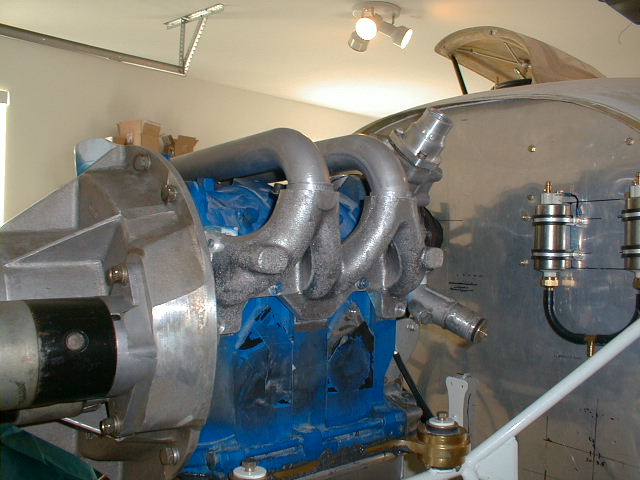
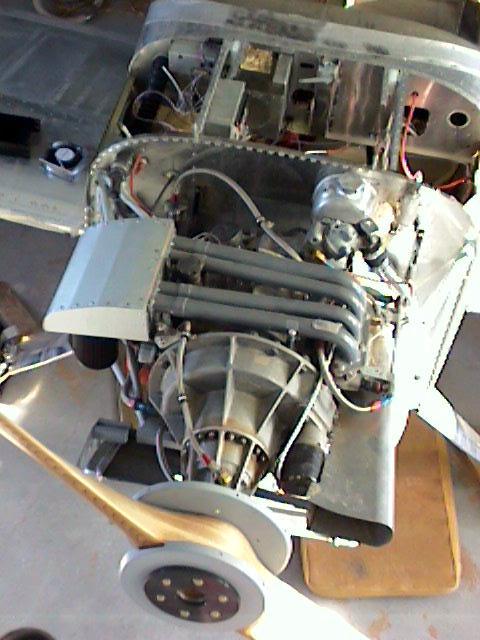
BTW how is your new intake manifold coming? Got any pictures?

Paul Lamar
Hi, Paul....you are correct....I was in error.  I was thinking the Racing
Beat aluminum end housings were rotor housings.  Please disregard my foot
in
mouth.

After final installation of all the "little things" such as adel clamps,
nylon ties, spiral wrap around now lengthened injector wires, etc,  I
fired
up the engine again today. Idle is a little rough around 1200 rpm's, but
smoothes out nicely around 1500 rpm's. Engine runs great from idle to
WOT.
Getting 5000 rpm static with my 3 blade 64 x 78 Performance wood prop.
The
best thing of all is....no more after-shutdown fuel drip like I had with
the
wrap-over intake manifold.  So far, I am very pleased with this setup.  I
know it may not be the best length for max power, but it certaintly
starts
easily and runs very smoothly,  eliminated my fuel drip problems, and it
fits very neatly into my cowling.  Hope to fly it within the next couple
of
days.  Here is a picture before I connected fuel lines and wiring.  Take
care.  Paul Conner
Wow Paul! quite a change. Good thing the new one is not dripping as it
is right over the exhaust. Other than dripping what other problems
did you have with the long manifold? Dripping is common with tuned
manifolds. Means they are working.

I can't tell from the picture but are there four injectors or just two?
I assume you are using Tracy's computer. That appears
to be a TWM throttle body so is it the same one you had on the long
manifold?

Well lets hope it works out well and we are looking forward to some
performance numbers. I know Dave Atkins has been flying a similar
system for several years but without Tracy's computer.

What did Dave charge you for the manifold if you don't mind my asking?

Paul Lamar
Hi, Paul...thanks for the comments....The problem I had with my wrap-over
manifold is that I could not advance the throttle beyone 1/2 without the
engine bogging down. After reaching approximately 1/2 throttle, the more I
would advance the throttle, the less rpm's I would get until it would quit.
I tried leaning and enrichening mixture, but no measureable improvement. I
could not get above 4200 rpm's static.  I left everything exactly as it was
(factory default settings on my MicroTech ECU) and installed Dave's intake
manifold.  Immediately noticed an improvement transitioning from idle to
midrange, plus I could now advance the throttle to WOT and got 5000 rpm's
static.
       I don't know why the longer runners didn't work well for me....I only
know that the only change I made was the intake manifold and realized a
dramatic improvement. As with the gentleman from Mistral, I could not live
with the after shutdown fuel drip. My summation is that the fuel coating the
long runners (that ran downhill towards the throttlebody) slowly found it's
way past the throttle butterfly and would drip around 1/2 teaspoon of fuel
after shutdown. Not comfortable with that.
     I have the MicroTech ECU and  the TWM throttlebody with two injectors
(none in block).  As for cost of the manifold, I purchased the whole Atkins
package which included manifold, throttlebody, injectors, 4 Bosch coils,
crank angle sender, MicroTech ECU with handheld controller, water temp
sensor, air temp sensor, plugs, ignition wires, etc, etc so you have a
bolt-on fuel/ignition package. Cost was $2900.00 which included the
manifold.  His longer wrap-over manifold costs $250.00, so I suspect the
shorter one is similarly priced. The short manifold looks amazingly similar
to  the one Bruce Turrentine just started selling.  Hope this info helps.
Paul Conner
I am not saying all this to disparage your effort in any way but I want
the new readers to have an historical background on the development of
the tuned manifold.

First of all your original long manifold is no way equivalent to a
typical long manifold due to the Y in the road. That Y in the road has
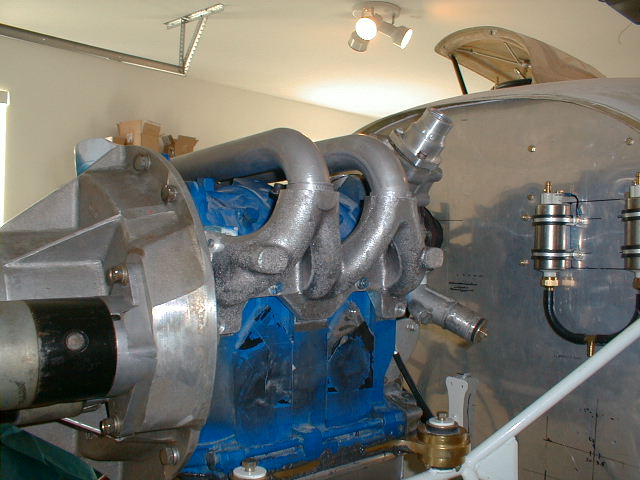
its own resonant conditions. See the picture below. As I recall we had a
discussion on this "Y" manifold on here way back.

It would not be fair to generalize and say all long manifolds don't work.
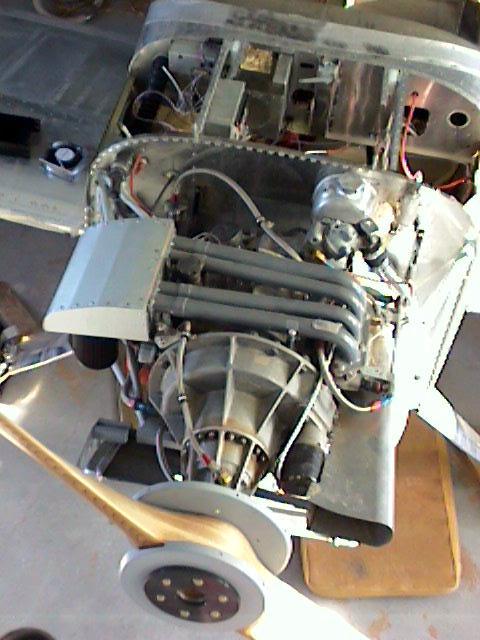
Chuck Dunlop has been flying his for years with no such problems. All
he says is it is not as powerful as he would like. See the second picture.
It is not bad enough for him to make the effort to change it however.

Too short untuned manifolds work but they are equivalent to bolting
the carb to the side of the block such as CW, early Tracy Crook and Mazda did up
until about 1985 when Mazda went to fuel injection on some late model 13B first
gen RX7's and 13B second gen RX7's. NSU used long tuned manifolds right
from the get go.

HP on the stock early 13B was 135 HP and jumped to about 146 HP about
1985 when the 13B engine was equipped with an early tuned dynamic chamber. About 1989
HP increased again to 160 HP when the second gen dynamic chamber tuned manifold
was introduced. This six port 13B NA dynamic chamber manifold ended about 1991
in the US. As far as I can tell no further NA engines were built until the advent
of the NA six port dynamic chamber tuned manifold 240 HP RX8 engine in 2003.
some of that large power increase was due to an increase in intake port area
of 17% and a 9000 RPM redline.

Bottom line is your engine will generate power somewhere in the range of
130 to 160 HP depending on the porting. We have some evidence of this as Dave Atkins
RV6 airplane appears to be slower (my subjective opinion) when compared to other
airplanes flying with tuned manifolds or aircraft engines. We almost found out exactly
one year when he entered the Sun 100 but withdrew before the race with rudder
control failure. Unfortunately Dave never entered the Sun 100 race again nor does
he race at JackPot Nevada much closer to home. I wish he did as his racing would
result in improvements in his products as he is a very competitive guy.

Further evidence of this is the HP Al Gietzen is obtaining on his Dave Atkins
supplied 3 rotor with a similarly designed manifold. With out looking it up
as I recall it was around 240 HP 3 rotor or about 160 HP in two rotor form. Al is
comfortable with this as that is about what his airplane was designed for.

The up side to a too short manifold is the almost flat torque curve. What
that means is it will be much easier to match a fixed pitch prop to the
HP characteristics of the engine.

As to the fuel drip back in the 60's when I was fooling with world class race
cars our 800 HP V8s with four down draft dual throat Weber carbs had a fuel
mist hovering several inches over the tuned intakes when the engine
was at full chat on the dyno. It was soon realized that this fuel
mist was shearing off at speed in these open roof Group 7 cars hurting
the MPG  so a large snorkel was added on the Chaparral 2D. Any raw fuel
accumulated after the engine was shut down was simply captured in a built in
pan and drained off with a small hose. Anybody flying a rotor craft with a Mazda
rotary engine will tell you the same thing. I have seen this myself at
Benson days prior to Sun and Fun each year. On a rotary it is not a
good idea to let the raw fuel drain into the intake as it could
cause hard starting and seal sticking. It is an absolute no no
in an RX8 engine as it is guaranteed it won't start regardless if
the apex seals stick or not.

Having said all that my recommendation is do nothing and fly your airplane
for awhile before you make any other changes including the prop. If you
do make a change in the manifold later just remember that you will also
need a different prop pitch unless the prop you have now is under pitched
or matched to your current manifold. Not likely. If it is over pitched you can
always get more power by changing the manifold to a tuned design so you won't
have to buy another prop.

Paul Lamar

The Rotary Engine NewsLetter.  Powered by Linux.
ACRE NL web site. http://home.earthlink.net/~rotaryeng/
Copyright 1998-2004 All world wide rights reserved.