Paul Lamar wrote:
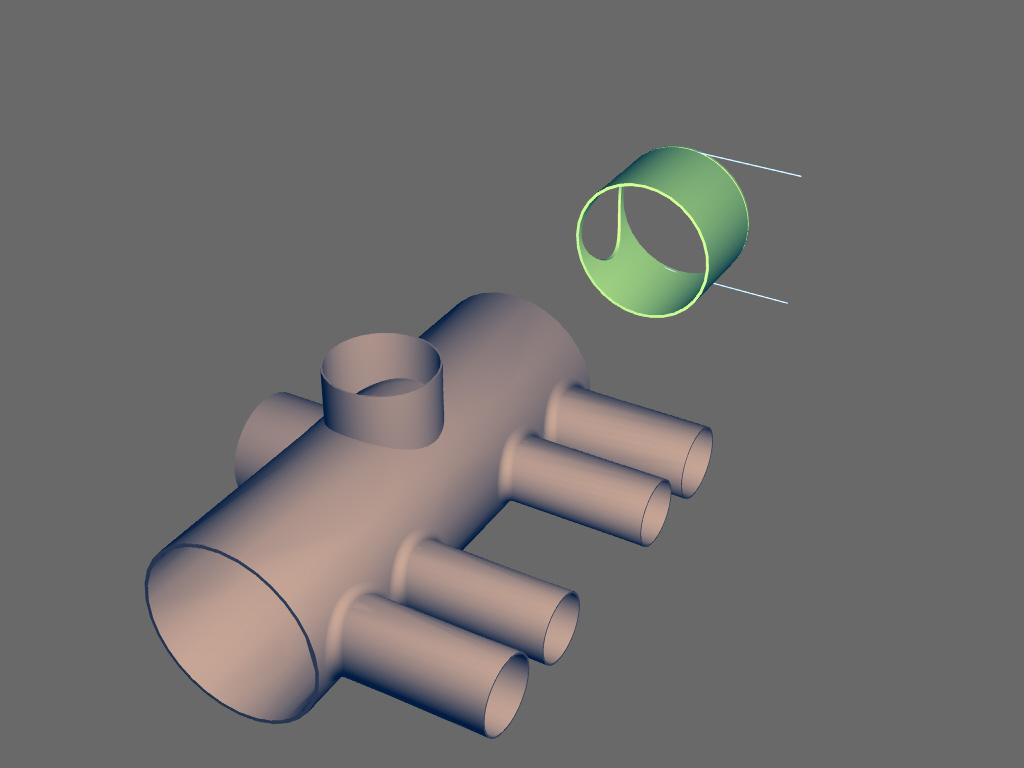
This one truly does it all. combination throttle body, plenum,
alt air valve and ram air valve. it is about six inches in diameter
and with a bit of tweaking I might be able to get it down to
five inches in diameter and still have a 3 inch ram air port and
three inch throttle body.

This is a classic sleeve valve. The inner sleeve rotates and is
controlled by cables and a wheel on the instrument panel. This
one wheel controls the throttle and the alt air selector.
Ram air comes in from the top. Alt air comes in from the side.

The ends are capped of course and this is designed to work with
side ports and four or more runners. Best place for throttles
in P-ports are close to the block. Not applicable to P-ports.

Nothing that can do all these functions will be simpler or
lighter in weight than this. Easy and cheap to make in the bargain.

Here is the five inch version. Really tricky. The break through was
five throttles instead of only one when in the alt air position.
Don't ask.

The inner sleeve starts out closed with the three inch hole pointing
straight down. Rotate it clockwise 90 degrees and you are wide open
throttle on alt air. Rotate it another 90 degrees and you are wide
open throttle on ram air. To close the throttle rotate it 180
degrees counter clockwise.

Even easier to do if you don't need alt air.

Is anybody interested in this other than me? I am thinking of
having a pattern made and a bunch cast up. Next iteration will
be 4.5 inches in diameter and will have injector holders. At
wide open throttle this is superior to a butterfly and as good
as a slide throttle.

Casting seems the only practical way of making it but a composite
mold is not out of the question.
Russell Kent responded:
Hold on a minute there, mister.

OK, first, let's make certain I understand: you're using this rotary
valve as both the air source selector *and* the engine throttle,
correct?  (If not, then the remainder of this post is perhaps moot.)

I like the way it automatically goes from off, to filtered, to ram
air,
and back. It "automatically" uses filtered air when the plane is
likely
to be near crap on the ground.  But it isn't obvious how one would
"throttle back" and yet still keep the ram air source. Perhaps ram air
isn't useful if one is throttling back, though.  D'Oh!

Second, I think you can forgo all of the slotted holes in the valve
for
the runners.  Just make the valve cover the two air sources.

Third, instead of actuating the valve from the end caps (where I
assume
you're going to put the cable connection), slot the outer housing and
actuate it from very near the intake nipples.  Put a pair of large
snap
rings on the inside to keep the valve positioned, or maybe just put
two
slots in the housing and pin it that way.

Fourth, I assume you're going to make a semi-transparent Rhino
rendering
showing the fuel rail, injectors, and intake runner bell mouths.  I'm
not assuming too much, am I?  :-)

Finally, as for casting it, can you not find two close fitting large
diameter (5") tubes?  Might need a pair of slippery O-rings (Teflon?),
but as you're found of saying: a small air leak in the intake is not a
problem.
Paul Lamar replied:
"Just make the valve cover the two air sources." I don't follow
you there Russell.

I searched for the tubes and 5" thin wall tubes are hard to find.
Extrusions would be great but expensive if not off the shelf.
I meant that the inner rotating valve, which you have rendered with not
only the large bore central opening to control which air source
(filtered versus ram) is used, but also with long smaller bore slots for
each of the runners.  The long slots in the valve over the runners do
not appear to be of any use; the slots merely prevent the valve from
occluding the runner openings.  If this is a false understanding, please
correct it.

Basically, take the plenum/manifold you have now, and put a much shorter
rotary valve in it to cover only the central section of the interior of
the plenum/manifold.  Slot the plenum manifold circumferentially to
provide holding pins and a way to attach the actuator cable.  Or maybe
even better would be to put two circumferential bumps on the manifold,
and then cut away a very small part of the bumps to fit holding pins and
the actuator cable to the valve.

Think about how traditional 55 gallon oil drums are shaped.  Imagine
that is the plenum/manifold.  Slip a snug tube inside the drum.  Cut
away each of the beads on the drum for about 2 inches around the
circumference.  Screw some pins into the tube so that the tube cannot
move longitudinally, but with low enough heads that the tube can rotate
freely.  On one pin, attach a spring to the pin, and anchor the spring
to the drum, so that the spring tries to rotate the valve to the full
open (all ram air) position.  Manually rotate the valve
counter-clockwise (stretching the spring) to the fully closed position.
Attach a cable to the pin in the other bead on the drum.  That's your
throttle cable: pull to close, release to open.  Cable breaks?  Throttle
snaps open to full.  Spring breaks?  Throttle stays where it is unless
pilot pulls throttle.  If throttle cable is relatively stiff, pilot may
be able to open the throttle by pushing on the cable.

Russell Kent
OK I follow you Russell. I considered that early on since the inner sleeve
rotates 180 the slot would weaken the outer housing or complicate
the manufacture but I'll take another look at that.

Paul Lamar
OK Russell here it is. The control wires are fed in through tangential holes in the
outer plenum. I think short studs inserted from the out side can serve
to guide the sleeve valve part.

I think I have come up with a way of making it. Wrap 1/32" teflon sheet sticky
side out around a mandrill and cover it with epoxy GRP or CRP. Anybody can do
it at home. Force it off the mandrill when cured. Teflon liner helps. Cut all
the big holes. Glue on all the  pre molded port barbs. Super light weight.

The sleeve valve can be rolled up out of 1/8 inch thick 6061 O sheet and seem welded.
Stick in lathe and make a finishing OD cut and the groove for the control wire.
Support in lathe with its own mandrill. Cut big hole.

Your done. Super trick does everything TB/plenum.

Paul Lamar

The Rotary Engine NewsLetter.  Powered by Linux.
ACRE NL web site. http://home.earthlink.net/~rotaryeng/
Copyright 1998-2004 All world wide rights reserved.