François Badoux wrote:
Hi Paul,
The PSRU ratio is 2.8235:1

We also hypothesized that the original Mecanair runners were too long so
we checked several lengths.  We found out they were just right.  I attach a
graph of volumetric efficiency vs runners'
length. It doesn't include the latest data we got yesterday but which
didn't change the message.
- TT means the length of the tubes we have on top of the engine.

- To these lengths, you have to add the length of the runners going from
the plenum of what we call intake manifold 1 (on the cold side of the
engine) to the junction with the tubes, and the length
of the "elbows" of manifold 2, on the hot side, all the way to the air
intakes on the side housings.
- PL is the total length of the Primary intakes (those going into the
intermediary housing), SL is the total length of the Secondary intakes
(those going into the front and rear housings).
- All lengths are in mm

- The pressure is MAP at WOT
You can see that the original length proved to be the best for power and
happens to be also the best for BSFC (well, I think... I have to check this
with Gordon).  Its peak is also almost ideally
placed. We tried yesterday to shorten the runners by 40 mm to shift the
peak to 2200 RPM (best power). We achieved that but the peak was sensibly
lower than both the red and light blue curves.
PLEASE, take notice that this data is correct for the Mistral manifold
and MIGHT NOT BE APPLICABLE to another manifold design.
The absolute value of VE might be understated as we believe that our
mass air flow meter is incorrectly calibrated (reading too low air flow
values), but it doesn't affect the message.  Do you have
an idea for easily calibrating a mass air flow meter?
Wow that is interesting. Only one has the characteristic shape of the
tuned runner and that
is the 30.5 inch version. I am a bit confused by your messages. Is this
the total length from port to plenum? Perhaps you are getting reflections
from the joints. These curves are very flat for a tuned runner.
Are all four runners the same internal diameters? Perhaps we have some
sort of harmonics going on as well.

BTW how was the VE measured?

Perhaps your plenum is acting like a dynamic chamber. Try a really big
one.
If yours is too small all of ours are also too small.

Paul Lamar
Paul - I realize this is an old posting, but your comment that only the 30.5
inch
length looked like tuning. I felt that the other humps were equally valid so
I ploted them as a factor of engine rpm. Each turn of the E shaft has an
inlet
pulse so the basic cycles per sec is rpm/60. The yellow line on the plot is
theo 1/4 wave at 1100fps sonic velo,The blue, with 8 inches added to the
length
the 1/4 wave is close fit to the measured data (red). This could indicate
that
some feature in the manifold was acting like an added 8 inches, or possibly
we are seeing offset from Doppler effect of the average flow velocity. the
peaks are not high (more like bumps) suggesting a rather low eff "Q".
In any case, it makes for interesting study, and suggests a possibly
rather simple resonance system - Vance
Interesting.

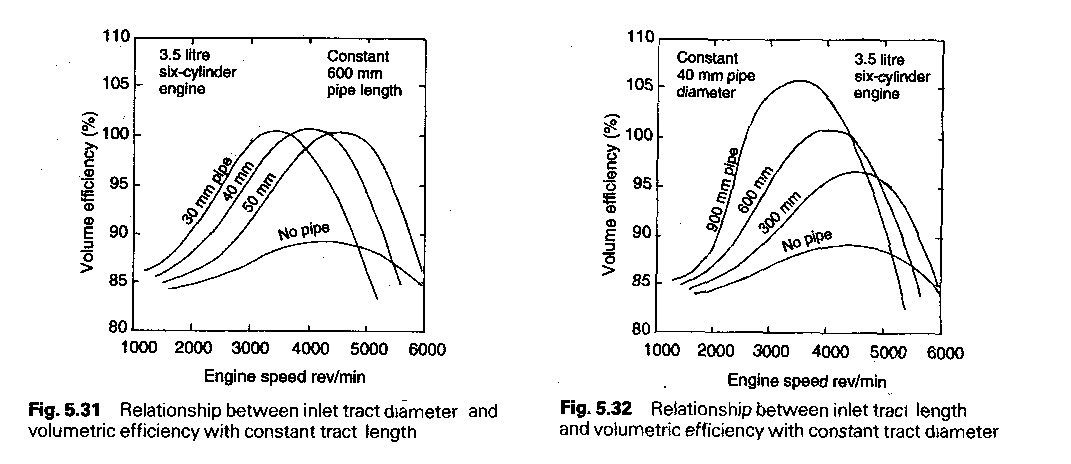
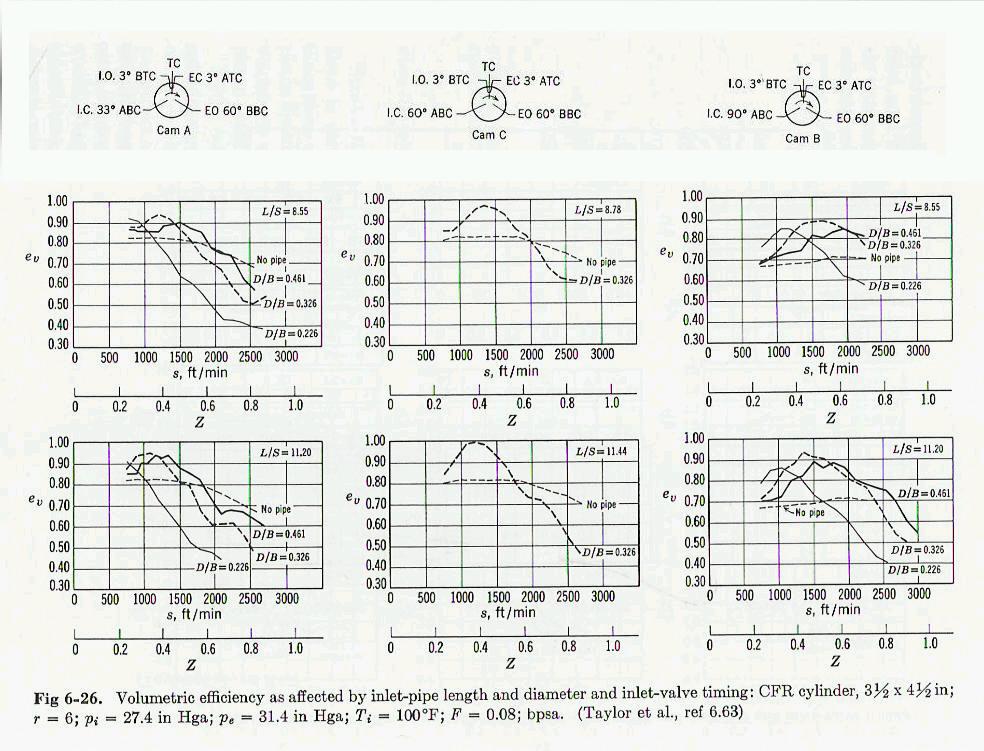
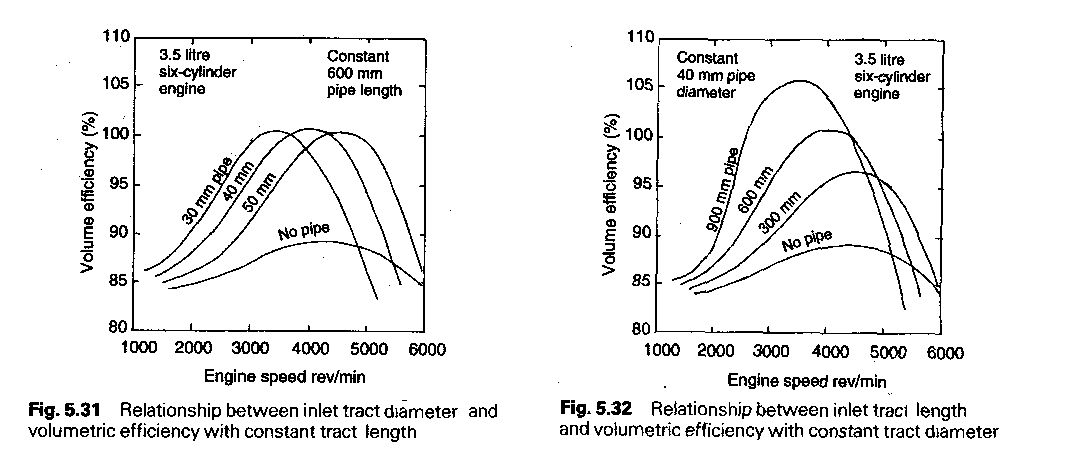
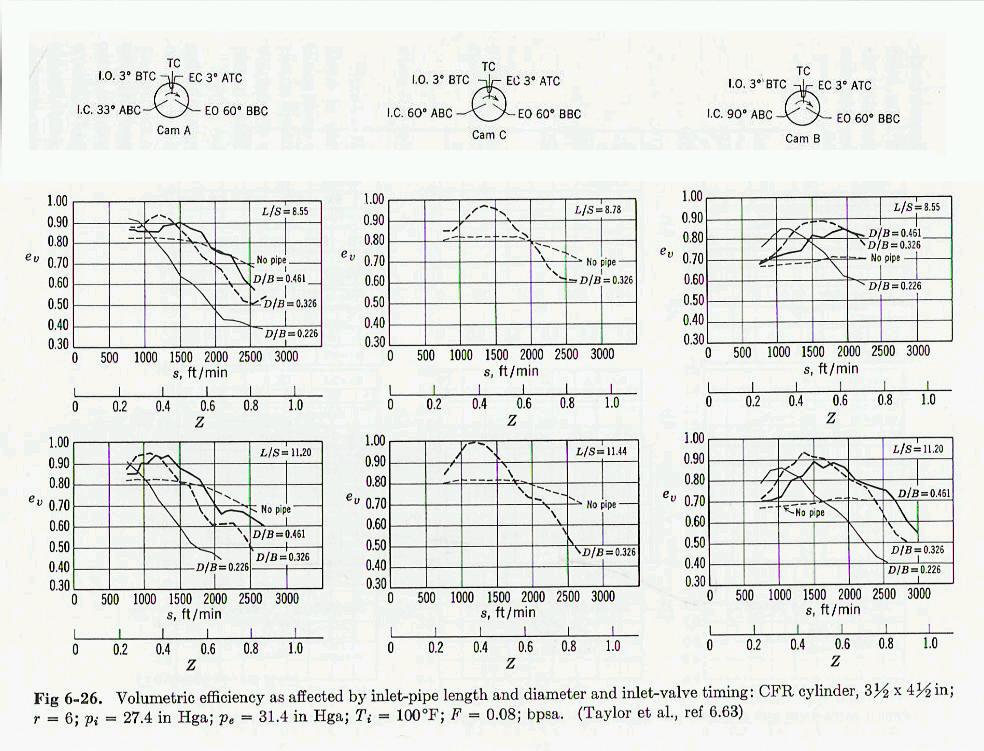
I, like Taylor, am now a bit skeptical of organ pipe theory as applied
to internal combustion engine intake systems. Taylor's old work, Heinz Heislers
recent publications and Mazda's work on the Le Mans engine all correlate rather well.

BTW  Piston engine tuning appears to require runner lengths several times
as long as the rotary engine tuning.

The Mistral data suggest several different resonant systems
all tuned at different frequencies are working together. As such and as you
say the Q looks rather low. One of the possibilities is a runner of
smaller diameter when combined with a runner of larger diameter, both
the same length, will be tuned at different frequencies. Combined
they will unnecessarily broaden the curve  and lower the peak HP.

That of course implies; if all these systems
got their act together (so to speak :)) at  the same frequency the Q and HP
would be far higher and would be in a narrower and more useful HP band
centered around 6000 to 7000 RPM.

Francois promised me some torque curves so that should add a bit if evidence.

Paul Lamar
I think what I am trying to say here is that organ pipe theory maintains
that all pipes of the same length have the same resonant frequency.
The data from Taylor and Heisler maintain diameter is a factor
in the tuned frequency.

Paul Lamar

The Rotary Engine NewsLetter.  Powered by Linux.
ACRE NL web site. http://home.earthlink.net/~rotaryeng/
Copyright 1998-2004 All world wide rights reserved.