Francois,
I don't know if this helps, but I agree with you on the side ports, I
also
think they are restrictive and not just for the reason of surface
area,
That's why I like the P-Port 'direct inlet' - better breathing.

I'm not trying to convince you of anything - just a suggestion!
George (down under)
I agree with George on this Francois. You are building your own rotor
housings
and end housings why mess with side ports? Aluminum end housings are
much
easier to make if you don't have ports in them. Here is an Everett
Hatch engine
with aluminum end housings and P-ports. Super simple. 200 HP is
absolutely no problem
at all and the intake manifold is simpler and cheaper.
Francois is concerned about apex seal life with the PP.  I'm not sure
why.  Do you have any data in your archives about this Paul?  I'm okay
with however Mistral goes, I'm just happy to have a solid company
building all aluminium engines.  I'm especially happy that he is going
to sell us parts.  Thank you Francois.  Let us know pricing and
ordering details as soon as possible.  I think you should sell parts to
the automotive aftermarket as well, it should help increase your
production volume.  We can always develop an aftermarket STC a
Peripheral Port kit for the Mistral engines.

Hans Conser
I have no hard and fast data but I suspect the apex seals will run cooler
as they get a chance to be blasted by cool air. Side port seals run
500 F. As far as the affects of the port opening itself... it is no worse
than a peripheral exhaust port.

So far Mistral has not committed to aluminum end housings. I could be wrong.
What I saw at OSH was a new rear housing cast in iron.

BTW how many people would be interested in an aluminum end housing if they
cost $1500 each?
$1000 each?
$500 each?

As far as design is concerned I still think the two piece is the way to
go. Cheaper, more reliable and over haul able as the hardened steel insert
can be replaced or ground and re nitrided. It needs to be tried.

Paul Lamar
Mistral decided against PP for the following main reasons:

1. While a blast of cold intake mixture will cool the apex seals indeed, we
believe that thermal shock (the seal is being brushed by hot exhaust gases,
than by cold mixture a fraction of a second later) is more detrimental to
the seals' life than a more constant temperature, even if it's a bit higher.
This is an hypothesis of ours.

2. A peripheral port extends over about 80% of the width of the seal.  When
the seal rides over the port, it is therefore supported only by a few mm on
each side.  This induces a mechanical instability that wears the seal, as
well as the housing surface "downstream" from the port.  A peripheral
exhaust port is already bad enough.  A generally even larger intake port is
worse.  Why do you think Mazda went to side ports?  Why do you think Mazda
was able to increase substantially the RPM redline on the Renesis?  Because
the seals ride on a perfectly smooth surface (except, of course, the
relatively tiny spark plug holes).

Having said this, Mistral may do PP versions of its engines in the future,
especially for racing purposes where life expectations are measured in
hours, if not minutes.

Mistral's early side-housings are indeed cast-iron.  However, Mistral IS
COMMITTED to Al side-housings.  The development of long-lasting (3,000
hours) Alside-housing is however FAR from evident.  We'll go Al if we are
able to solve their existing short life-expectancy problems.  We believe it
is a 12-month, several 100-thousand dollar development.

Francois
I know why Mazda went to side ports. It has to do with combustion stability
at low RPM low loads. The RX8 engine is impressive in its ability to
pull a loaded car away at idle.

All this was driven by car duty cycles where the car engine
spends a lot of time idling and putzing around down. Unburned hydrocarbons
and low power BSFC are the name of the game when it comes to cars.
I doubt the RX8 side port is any better than any other porting method when
it comes to high power BSFC. Tracy Crook confirmed in-the-air-BSFC was no better
than his old peripheral exhaust port engine.

I have an extensive SAE paper on the side exhaust port subject written by Mazda.
SAE 950454 "The Characteristics of Fuel Consumption and Exhaust Emissions
of the Side Port Rotary Engine". It is kind of incidental that the ports
are 30% larger in area and the top RPM is up allowing more HP at
the top end.

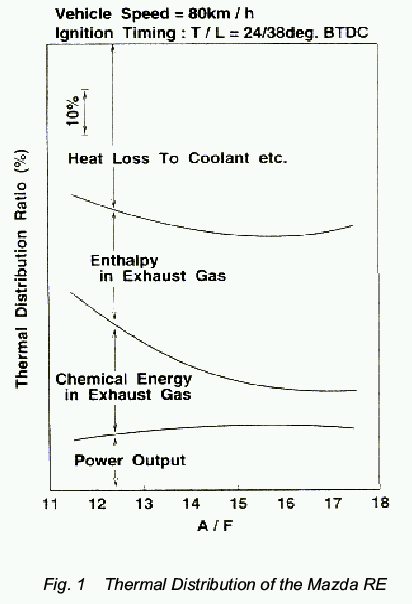
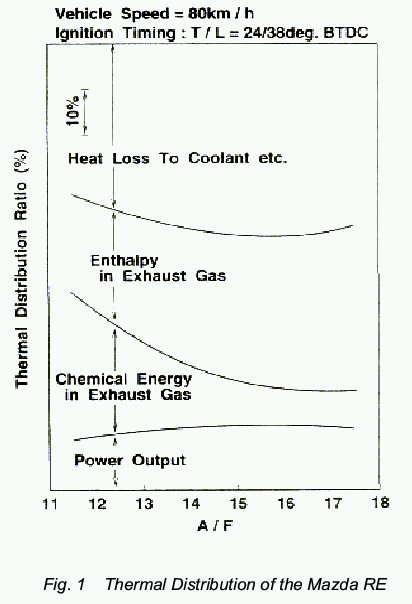
This heat balance chart is the driving force to improve the rotary
BSFC at low power. Note the car speed in this chart IS 80 Km per hour
or roughly 50 MPH. A car at this speed is lucky to need 25 HP.
Note the high percentage of chemical energy in the exhaust at
rich air fuel ratios.

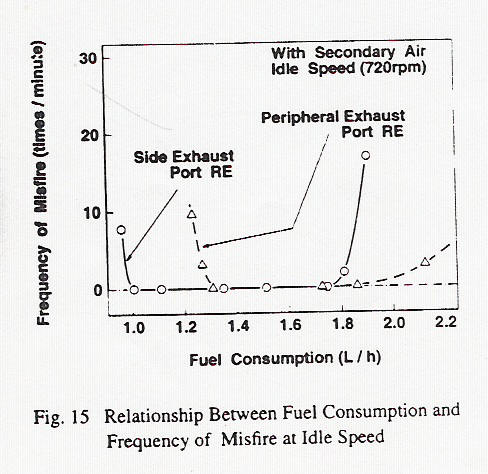
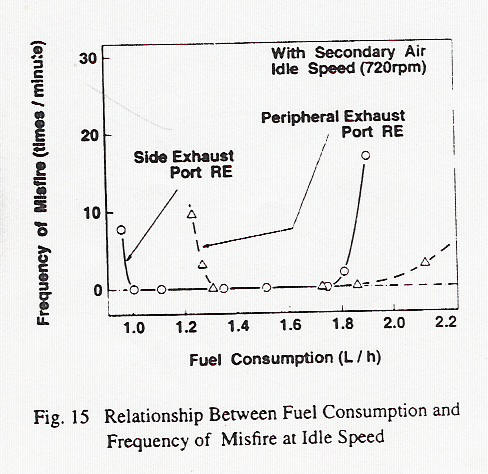
The second chart is fuel consumption verses frequency of mis-fire at idle.

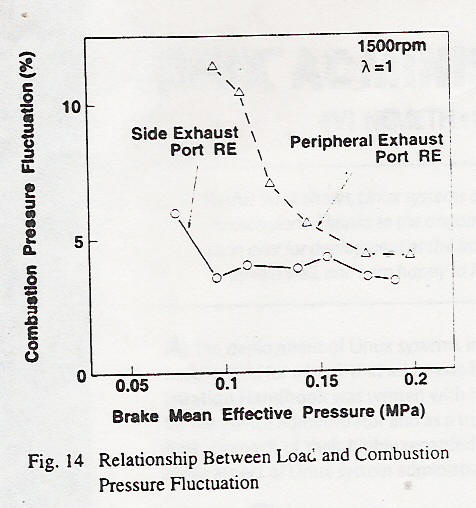
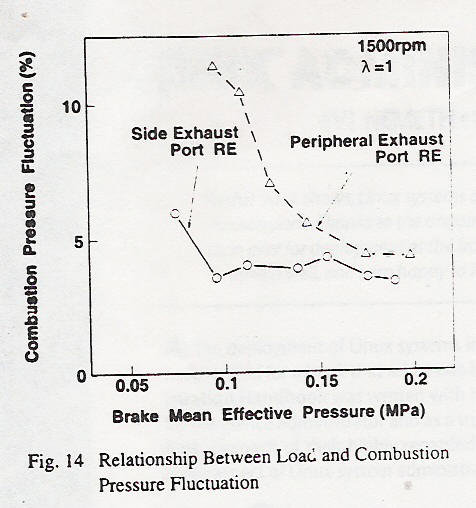
Third chart is load verses combustion pressure fluctuations at 1500 RPM.

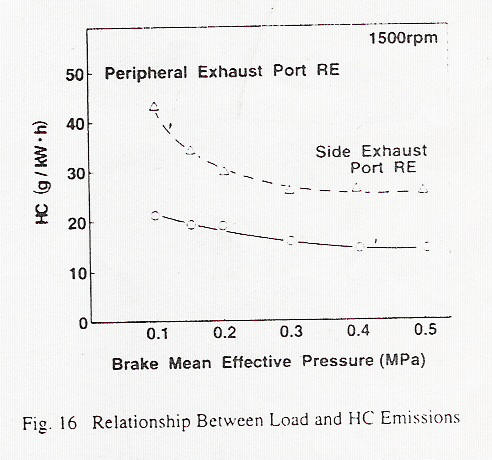
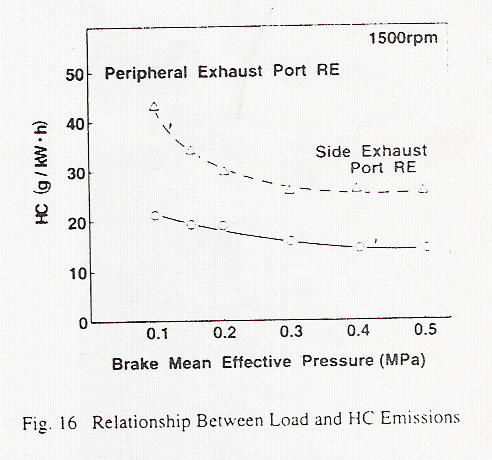
Fourth chart is load verses HC emissions at 1500 RPM.

In contrast to all this. At high RPM the rotary is close to a continuos
combustion engine. Much like a turbine.

We would be better off injecting compressed air into the squish area
on a continuos basis at high power. More on that soon.

P-port engines don't wear any faster than side port engines.
Mazda examined the wear of the Le Mans p-port engine after the race
and the wear was within manufacturing tolerance. In other words they
were unable to detect any wear. This engine spent a large percentage of
its time at 8500 RPM full power for 24 hours. Many p-port engines
were raced in the late 70's and 80's. Many raced for ten or twenty
races without being overhauled while most piston engines were overhauled
after every race. There is absolutely no evidence what so ever that p port
engines wear any faster than any other kind of rotary engine.

If you are serious about long life and you are charging $20,000 for
an NA aircraft engine it better have ceramic apex seals. The wear on these
when used in p port or side port engines is near impossible to measure.

Combination steel and aluminum end housings will last just as long as the
stock combination steel and aluminum rotor housing used by Mazda. It is just
a matter of investment to copy the technique Mazda uses for manufacturing
rotor housings. The thin raw steel liner is prepared by passing it through a
machine that forms ribs on one side of the metal. It is then rolled up
and seam welded to form the trochode(s?) shape. It is placed in the mold
and the aluminum cast around it. It is then accurately ground to final shape.
(I am the only outsider to ever see inside the Mazda rotary engine factory :))

The foundry that made my intake manifolds here in So Cal specializes
in casting steel inserts into aluminum castings. No big deal. They have
done thousands over the years.  Even I could afford to have it done if I
could also afford to make the dies that form the ribs in the steel. Also
the casting patterns and core boxes for the end housings are also expensive
but Francois has already paid for those.

Francois, What are you using for wear coatings on your rotor housing?

Paul Lamar

The Rotary Engine NewsLetter.  Powered by Linux.
ACRE NL web site. http://home.earthlink.net/~rotaryeng/
Copyright 1998-2004 All world wide rights reserved.