<< Matt Prather wrote:
 > >
 > > Maybe the lean mixture limit is being driven by inadequate/not optimized
 > > spark.  More spark energy, bigger gap, multiple discharge, better fuel
 > > atomization are things that could be looked at.  0.455 isn't bad,
however.
 > >
 > > Regards,
 > >
 > > Matt-

 > Maybe.  We'll try, we have a system which can adjust spark energy.
 > Thanks for the suggestion.
 > Francois
On the dyno the 13B with a mild bridge port keeps making more power up to 40
Degrees of advance. The dyno did not have an MSD like ignition system. The
problem was that they were trying for max power and were juggling the mixture
along with the ignition advance. So much above 30 degrees the additional power
came with a bunch of extra coolant heat.

I have heard that even the stock controller runs the advance way up during
off and part throttle operation, to reduce HC emissions. One of the many
problems is that while more advance gives more time for a more thorough burn, it is
too much for getting the max pressure at the proper crank angle. Later timing
gets the max pressure in the right crank angle, but the poor squish area leaves
mixture unburned near the apex seals. Curtis Wright used a separate chamber
to light an over rich mixture to, in some engines, light the very lean mixture,
or in others, to supply all of the combustion product to the engine.

A bit too exotic for the current situation, but there are steps to be taken
to improve what is available now. The universal first step in racing is the
addition of an MSD style ignition system. A capacitor ignition with (at low RPM)
multiple restrikes.

The plugs fire no matter what. Flooding, fouling, broken insulator, ground
electrode gone, doesn't matter. The plug fires. Now how could you pass that up?

Chrysler corp used MSD in the 70s/80s on what they called Lean Burn engines.
Now most performance cars have a version of this system installed as standard
equipment.

Suppose the leading plug was a 10MM like old Cosworths used and it fit in a
sleeve bushing that was also the business end of a high pressure fuel injector?


Smokey had a Mercury Capri with a 2 cylinder engine made from a Chevy block.
It had 104 HP and the exhaust system ran through the intake manifold. It had a
turbo but only enough boost to keep it from backfiring. It got tremendous
mileage and could start from a standstill in top gear without detonating.

 Detonation is charge temperature dependent, so this thing should not have
worked. Unless...................... there was no fuel in the superheated air
being compressed.

He let a lot of engineers drive it around (with him in it). He offered to
sell the technology to his friends at GM, but they wanted to know how it worked
first. No deal.

He described the construction to one GM guy and explained the exhaust inside
the intake, and the high temps he was trying for. The GM guy said bull ----
and put his hand on the intake of the running engine. He burned the daylights
out of his hand.

My guess was that it was direct injected, and ignited just a few degrees
before TDC.
The heat of a diesel but not the compression ratio. There is no free lunch,
so the HP Max and the great mileage could not have been at the same
RPM/throttle setting.

He also liked ceramic coated everything, even adding layers of water glass to
the water jackets inside cylinder heads to keep the chamber at high
temperature. No fuel droplets not burning in that engine. You don't have to be the
fastest GN car if you can skip a fuel stop.

If you have seen the TV adds for the goofy turbo spinner looking device that
fits into the tube from the air filter. Like a fan blade set with a lot of
pitch.

I think it would cost mileage if it did anything, because it subtracts energy
from the airflow. But, if there is some benefit from spinning the flow at the
intake/engine junction, rather than some distance upstream, perhaps a few VG
like items just at the port entrance. Just a thought. With all of you guys
building dynos we should have some answers soon.

Lynn E. Hanover
There appears to be a problem with fuel vaporization in the rotary. Injecting
the fuel from the end and heating the intake manifold during cruise would be something
to try. Turn the heat off for full power. A turbo charger ought to take care
of the problem as the air out of the intercooler is still over 100 F.

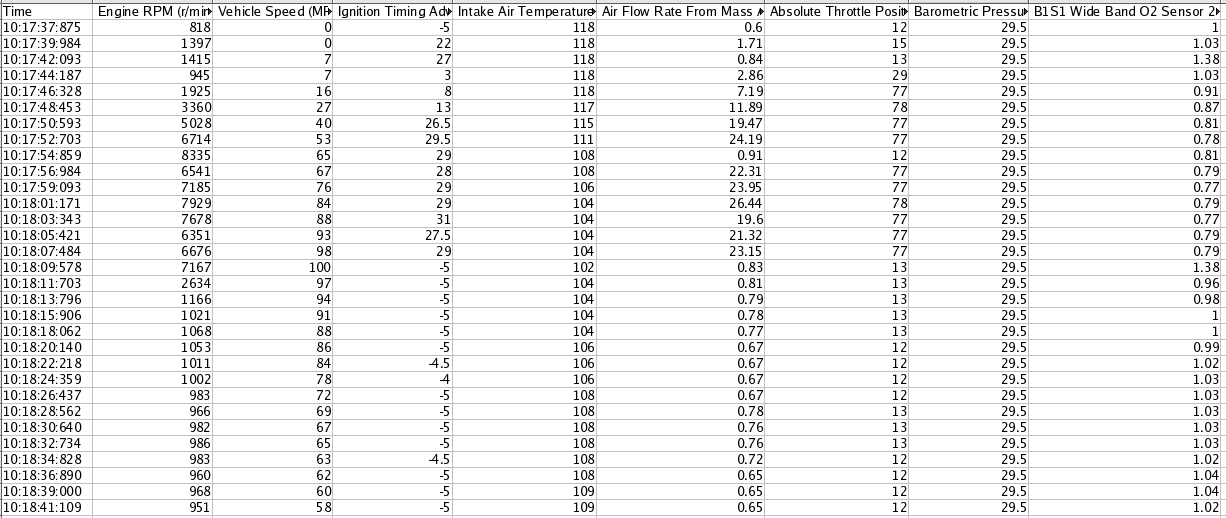
Note the intake air temp in this OBD II print out of the RX8 on a 100 MPH pedal
to the metal accell run. Note also the fly by wire throttle is only 77% open.
No telling what she would do at wide open throttle :)

Paul Lamar


The Rotary Engine NewsLetter.  Powered by Linux.
ACRE NL web site. http://home.earthlink.net/~rotaryeng/
Copyright 1998-2004 All world wide rights reserved.