The end product needs to have ceramic seals, even if you have to
make
a
set
that have the corner piece like the stock seals. I don't know
how
that
would
wear on the cast iron. They are one piece for racing.

Lynn E. Hanover
Lynn,
I did see the cost of ceramic seals on here a while back, then
figured
stock
cast iron would be good enough for my own application, but I agree
they
would be the 'bees knees' for Francois's ( Mistral) application.
Also solves the problem ( as Francois sees it ) for the P-port.

I think Francois has made a valid assumption on the wear of the
seals
on
the
P-port ( especially on larger ports) but he may be over estimating
the
extra
degree of wear on the port sizes and the RPM, we propose.

My opinion for what it's worth and I believe Lynn's extensive
experience
in
racing supports this.

Lynn what is the fit protocol for the ceramics - diamond grind the
ends to
allow X end play?
George (down under)
We'd love to put ceramic apex seals in our engines. It would take a
monkey
off my back, so to speak. But they would add a good $1,000 to the
cost
of
our engines... and a few people, you know... some guys here and
there...
have already commented that, if Mistral Engines seemed good, they
weren't
precisely cheap...  BTW, it's true, they are very good and worth their
price!  Be it known!  ;-)

What would be your choice, suppose you were to buy one of ours, if I
presented you with the following hypothetical deal:

- 1000hr warranty on the cast-iron seals (parts and labor) for a
selling
price of $xxx

- or 3000hr warranty on ceramic seals (parts and labor) for $xxx +
1200?
Francois
Francois,

Give'em the choice and let the market decide!

I believe your main market is Commercial anyway.

If I could also suggest a non-certified engine ( for experimental) like
Jabiru supplies, might also help sales along.
George (down under)
I agree George, I am more and more thinking about offering ceramic seals as
an option, packaged together with an extra warranty.

Yes, indeed, our main market for the certified engines will be commercial,
but also private individuals who fly a lot and can therefore admortize the
cost of the remotorization in 2-5 years.  We also hope to convince a couple
of OEMs.  BTW, one US commercial operator already put a deposit for a
CERTIFIED G-360TS which, he knows, won't be delivered before 2007.  Of
course it's only a good faith gesture as his deposit is fully reimbursable
for the moment. It's not going to help our bottom line this year but it's a
great show of interest and confidence which is boosting our spirit here in
Geneva.

Mistral will most likely keep an experimental line next to its certified
line.  They won't be fundamentally different though... just the pricing and
the paper certificates!  :-)

Francois
If I were buying a certified rotary for my certified airplane I would definitely pay
extra for the extended life. Not only does it cut overhaul cost in the long term
but it implies a more reliable engine. As I see it you have a unique
opportunity to compete successfully with Continental and Lycoming. I spoke
with a Lycoming sales manager at Reno and he said Lycoming would build
rotaries if the market demanded it. Continental was gearing up to produce
military gen set rotaries and the Cliton administration canceled the contract.
In other words they are going to do nothing until there is a market for
it. Unfortunately you may be the creator of that market. We are also
doing our bit to create a market.

Henry Ford said; "show me an innovator and I will show you a candidate for
bankruptcy." On the other hand having had 40 years experience in a couple of
businesses IMHO one of the secrets to success is creativity in all aspects
of business. Not just the product. PR too is another area where creativity
counts large. Racing is a cheap form of advertising. There are several
race venues here in the States. Not just Reno. I think you should enter
the Turbo Piper in the Sun 100 race this year. You won't be fast but
a lot of people will hear it and be impressed that you entered and finished
the 30 minute race. Mazdatrix has these large rotor decals you can plaster
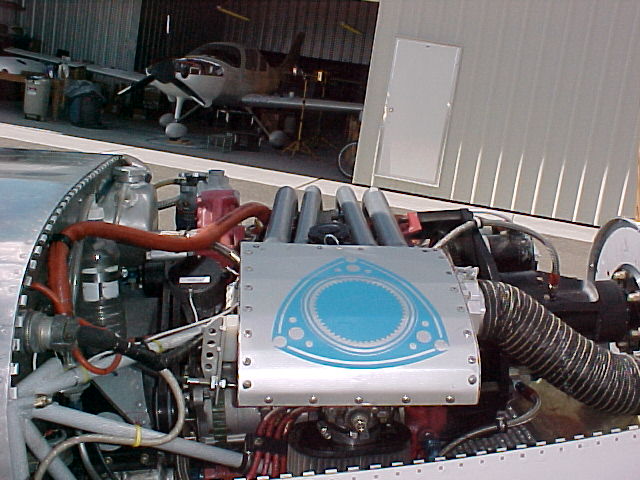
all over the airplane like this one on Chuck Dunlaps intake plenum.
That is Tom Parke's turbo 3 rotor Lancair ES in the background.
One mistake Tracy makes is not plastering these all over his airplane.

A few crossings of the Atlantic and or the Pacific would also be spectacular.
A press release announcing a break through 20% fuel burn reduction would get
wide spread free coverage in the press. Not just the aviation press. They
love anything Green.

Paul Lamar


The Rotary Engine NewsLetter.  Powered by Linux.
ACRE NL web site. http://home.earthlink.net/~rotaryeng/
Copyright 1998-2004 All world wide rights reserved.