frank barbot wrote:
Hello,
I am working on engine conception (and a part of production)
for
7
years, in
the past on gasoline and automotive and aeronautic
applications.
I am now working for Mistral engines, with a base of Mazda
rotary
engine
13B
for aeronautic application.
So i would like to participate to your discution as a
member.
I already do have a question.
The oil going to the head of rotor and apex seal coming from
the
"secondary
volumetric" oil pump, through oil injectors, is mixed with
air
coming
from
the inlet manifold. When is this flow usefull, what is his
fonction,
can
i
suppress this in certain condition ?
This question is very important for me, i am dimensionning a
new
lubrification system dedicate to our application on that
function.
Best regards
Frank BARBOT
Welcome Frank. I'll repeat what I just said to Francois.
I don't have much on the pneumatic part other than what is in
the
shop
manuals which is also not much. Mainly checking the one way
valves.
I think they function when the pressure is lower in the intake
chamber
than atmospheric. As far as I know no positive air pressure is
used
to assist the oil injection. Mazda main thrust on the design
is
to reduce the quantity of apex seal oil as much as possible to
reduce emissions. A small positive displacement pump may be
all
that you
need. Use a separate tank for the 2 cycle apex seal oil with a
low
oil
warning light.
Here is one I made quite some time ago. I used off the shelf
gear
pinion
stock for the rotors.
Paul Lamar
Frank,
I don't know if what I say will contribute anything BUT someone
on
this
discussion group ( I can't remember who) said the 'oil metering
pump' was
a
two stage pump with a small amount of oil in Idle and fully on
(100:1)
just
above idle.
This may be different for the later Series 6 and RX8 models as
they
are
electrically controlled metering and as Paul said the emphasis
was
on
emissions control. Personally I would measure the out put at
different
RPM's, while running the engine on pre-mix.
Now having said all that, a recent trip to my local engine
builder
mates,
informed me that they couldn't put an aftermarket engine
management
system
on a Mazda, without first replacing the 'oil metering pump' with
an
earlier
model manual pump- why! because there wasn't a Engine Management
System
manufactured to cater for 'oil metering'- why! because no other
engine
required this facility and it was a system for Mazda alone.
Is this the case with the Mistral Engine Management System?
George (down under)
Frank's job is to design the system for Mistral.
Paul Lamar
Mistral's DEM system can electronically manage electro-valves
precisely
metering the oil. Frank wants to know if he can do away with the
pneumatic
system in this set-up. I must admit we don't know as we have not
worked on
this system so far because it works fine... except that it's
bloody
expensive to manufacture and to install (we are talking of copper
or
steel
lines replacing Mazda's nylon line Paul "loves" so much for their
durability! :-) ).
Cheers
Francois (across the pond)
I looked it up in the RX8 Service Highlights manual. Ironically I
have
more info
on the RX8 than any other 13B. The function of the atmospheric air
supply
and the one way air valves in the injectors is to prevent the intake
chamber from sucking
oil out of the injection lines when the pressure in the intake
chamber
is below atmospheric
which will happen big time if the throttle is closed while the
engine is
still turning at significant RPMs. Definitely an emissions issue.
Probably
not a problem in an air craft engine. If the the oil is mixed with
the
fuel
before injection that too would solve that problem. In other words
no
direct injectors.
The PCM changes the electronic stepper motor metering pump according
to
engine speed, engine
coolant temp and the amount of intake air. The fail safe mode is;
the
injected
amount of oil is minimized and oil is injected only according to
engine
RPM. The failure
of the stepper motor can be sensed by the PCM. The PCM then limits
the
amount of
fuel and hence the RPM and the power the engine can generate. Again
a
fail safe
emissions issue since too much apex seal oil does nothing except
increase the
Hc emissions. In other words a limp to your car dealer mode :)
Aren't computers wonderful? :)
Paul Lamar
Ben Schneider wrote:
I don't know too much about them, but how does a 2-cycle oil injection
system work? (as on a snowmobile) Would something like that work, as
you
would still have a seperate oil tank, but it mixes with the fuel
before it
enters the engine. Perhaps more simple, and maybe less complicated?
Just a
thought.
Ben Schneider
I know very well were people are coming from with this practice of
mixing 2-cycle oil in the fuel tanks or to inject it somewhere in the fuel
lines.  It makes the complicated and expensive oil
metering system redundant and results in acceptable or even good
lubrication of the apex seals and running surface with what is probably the
best oil to avoid gum deposits in the seals' slits.
But let me set the record straight (at least from my point of view and I
recognize there are others), this practice has big and unacceptable
drawbacks for a commercial product IMHO:
1. Everyone is trying very hard to atomize and inject the fuel as well
as possible to get the best possible combustion and efficiency.  That means
keeping as much fuel away from the walls as
possible. This objective is totally in opposition with depositing a
layer of fuel-mixed oil on the trochoid surface.  In addition to 80-90%
(hopefully) of the oil droplets that would stay in
suspension and be rejected either burned or unburned with the exhaust
gases without having had any role in lubrication, you have 50% or more of
the oil which get in contact with walls that are not
the walls you want it deposited onto, because they either don't need
lubrication (rotor surfaces) or get it in another way (side-housing
surfaces).  It means that from the quantity of oil you
introduce, something like 5% only does the job it was intended to do.
Talk about a waste and talk about unnecessary emissions!  How much is one
supposed to mix?  2 to 4 ounces per gallon is the
recommendation if my memory serves me well? That's 10 times more than
what we use.  FYI, s piece of data from our Oshkosh trip:  Florida to
Oshkosh and back + a few flights around OSH, 19 hours of
flight:  1 (one) quart of oil used, total.


2. Worse: the oil that goes through the engine without playing its role
of lubricant is not some "innocuous" waste.  It sensibly increases the
propensity to detonate and it clearly contributes to
higher EGTs.


3. Picture yourself as a salesperson trying to convince a non-rotorhead
to purchase a rotary engine.  Now, you have to tell him or her that 2
different qualities of oil must be regularly added into
2 different tanks and, if one puts the wrong oil in the wrong tank, one
may seriously damage the engine. Oh yeah!  One more thing:  one of these
qualities of oil (the one you must add most often by
far) is generally not sold on airports. ...If you can do it, then
please let me know, I immediately offer you a job at Mistral Engines with a
great compensation package!
I know that using engine oil in the metering system is not optimal, but
the option is much worse IMHO, at least for a commercial product.
BTW, we have not observed, so far, any gumming of the seals whatsoever
in hundreds of bench hours.  Maybe it's because we inject the right amount
of oil?  We'll be especially careful to take this
aspect of things into account when we'll issue a final specification for
the oil, but I already know that it will be an oil brand and/or quality that
can be purchased in most FBOs.
Sorry for being vocal.
Francois Badoux
Not a problem being vocal. That's is why we are here. Lets put some
numbers on it.
One fluid ounce per gallon is the norm. That is one part in 128 parts of
fuel.
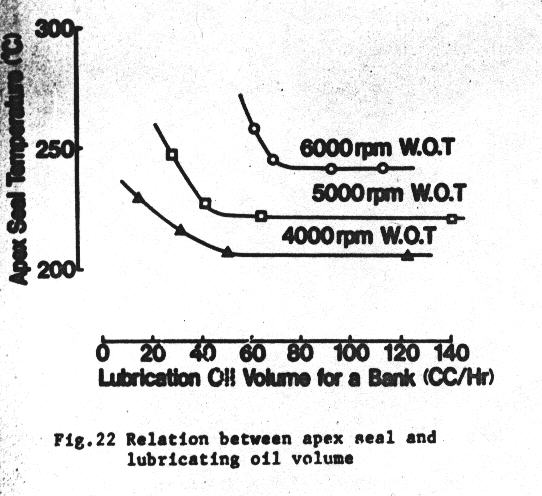
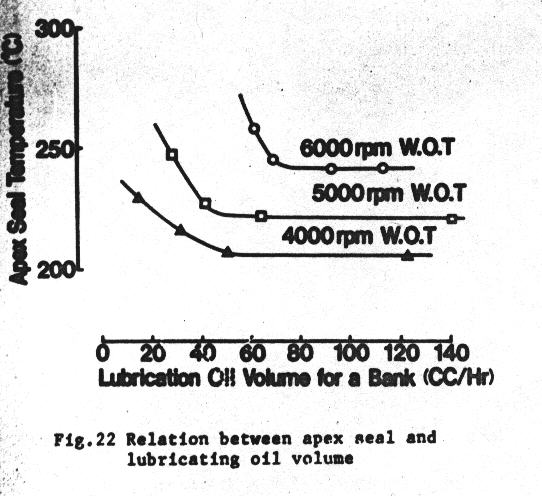
If you look at this chart from Mazda you need 80 or 100 cc per hour per
rotor
or say 200 cc per hour to keep the seals cool. Since there are about 33 cc
per
fluid ounce that is 6.6 fluid ounces per hour. At 13 gallons per hour that
is
about half an ounce of 2 cycle oil per gallon. Since the Mazda rotary
racing world
has tens of thousands of hours on one ounce mixed per gallon 50% getting
to the
apex seal is not that bad. Also I might add the only way the side seals
get
oil is from the apex seal oil. In theory, if the oil scrappers are doing
their
job on the sides of the rotors they get no oil from the crankcase.

In the early days Mazda introduced the oil into the carb float bowl. It
was only
later they added direct injection and after the emission regs became
draconian.
This weird rotor housing wear obviously was the result of a failed apex
seal oil injector. Mazda also spent a lot of R&D time on how the injected
apex seal
oil was distributed across the rotor housing surface which I can document.
Not a fait accompli by any means.

Racing Beat with their 1200 HP 3 rotor turbo charged rotary found that up
to four
ounces per gallon did not cause detonation. (One part in 32)

I am not saying you have to mix it manually with the fuel. I am saying you
will
get better results if you inject it into the fuel and not into the rotor
housing
directly. I know you don't like the idea of forcing the pilot to mix it
with the fuel.

Check my arithmetic.

Paul Lamar