One of the hidden advantages of the rotary is you can use an old
fashioned large diameter super charger directly on the e-shaft.
The classic direct drive low RPM aircraft engine required a
step up gear box between supercharger and crankshaft. No gears
required at all. Simple and very reliable with no wear points.

If turbo compound the blow down turbine is now divorced from the
compressor.
This is the configuration used by the CW R3350 TC.

Paul Lamar
Keith Moore wrote:
Paul:

Another thought;  use the exhaust turbine (90,000 rpm) to direct drive a two
pole generator and rectify to DC electric power.  Then power a DC electric
motor/generator connected to the rotary shaft (direct or by belt)

Perhaps you have seen Capstone located in Chatsworth?  Very interesting
tour!

Capstone Turbine was started by a couple of out-of-work engineers who
configured a Garrett turbocharger connected to a rotating magnet.  They then
added "air-bearings" (no lube and no wear), a burner and heat recovery HX.

Voila! - 30 KW at +30% efficiency, and very low emissions.
http://www.capstoneturbine.com/technology/techUnderHood.asp

Regards,

Keith Moore
LEZ
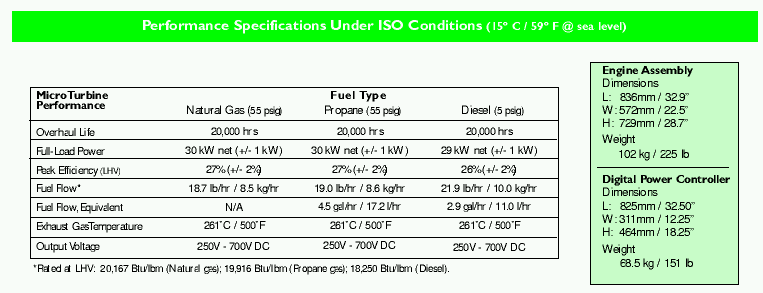
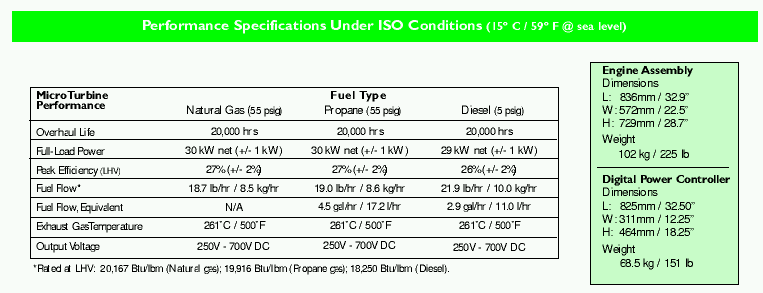
When you run the numbers it does not look that great 29 Kw = 39 HP
2.9 gallons per hour diesel fuel. BSFC = .56.
You are not done yet. You have to convert that electrical energy back
into mechanical energy. 80% motor efficiency is 31.2 net mechanical HP out
BSFC now goes up to .70. A rotary is one heck of a lot more efficient than
that. To top it all off the weight is 225 pounds for eng/gen and 151 pounds
for the controller for a grand total of 376 pounds and we still have not
weighed the electric motor. So typical of hybrid cars.

The last fly in the ointment is there are no details on the all important
recuperator.

Stock scam time.

Paul Lamar
Paul,

Perhaps not a stock scam but like Borman turbines with a similar item and
market approach, not small or inexpensive at all.  Now if this 30KW
generator was about was about a foot long and weighed less than 50 lbs you
would have my attention. Years ago with our alkaline fuel cell project we
found out that offering co-generation. ie water heating, was the only way
that the techology could be marketable. I suspect the same with this
approach. The effiecies at peak were 50% and with co gen. conservatively
over 80%.

A turbocompound diesel would do much better but won't be as sexy.
But again the perception of the market rules. Aren't aircraft APU working
along the same concept?

Doug in Japan
When people put the words "stock quote" and "stock chart" on their web site for
what appears to be a new invention a red flag runs up in my brain. I then
start to look at the physics very carefully.

Particularly when they are vague about certain engineering details such
as the recuperator AKA regenerator. Regenerators are the turbo compound
of gas turbines.  Regenerators work but they must be designed
right and they are bulky. The M1 Abrams tank uses a  regenerator in its
gas turbine engine but the BSFC is still nowhere near that of a diesel.
Chrysler built some cars 30 years ago with gas turbine engines with
regenerators. Those are probably the ancestors of the A1 tank engines.
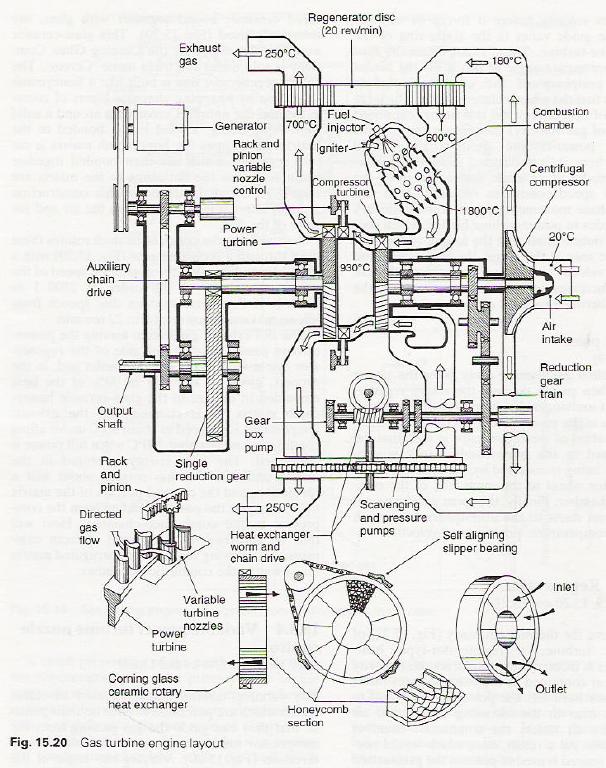
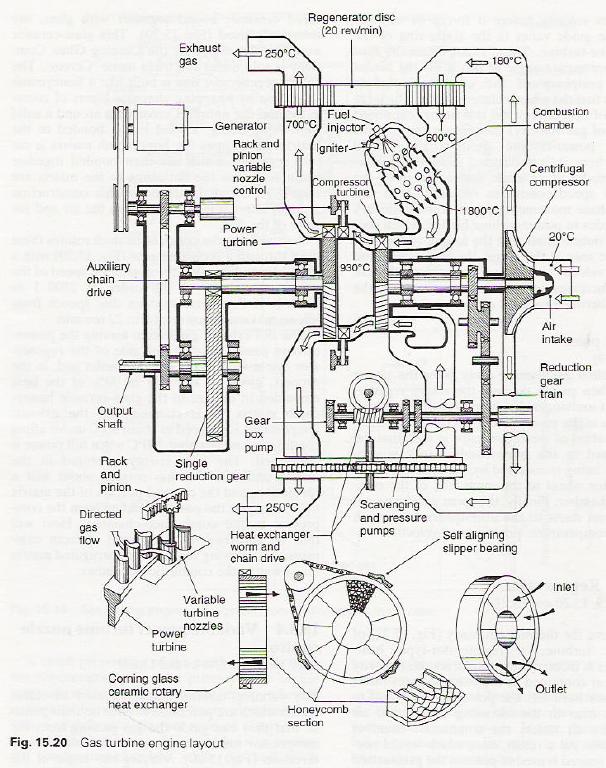
A big problem with these is the seal between rotating
regenerator and the high pressure air duct. Here is a drawing of such
and engine.

BTW notice the lack of a required intercooler in this turbine engine
adding to the efficiency of the engine but not enough to make it close to
a diesel.

This has nothing going for it over a wankel rotary gen set let alone
a turbo compound wankel rotary gen set other than the fact it will burn
diesel fuel. Francois is working on that. Efficiency of this device is
well below 30% not counting using the exhaust heat to heat water or other
cogeneration functions. Those functions can be implemented with any ICE.
A turbo compound wankel rotary gen set would be about 40% more efficient
at generating electricity.

Aircraft APU's do not use regenerators and high RPM alternators.
They gear the turbine shaft down and use conventional alternators.
If these things are as efficient as they say they are they would be widely
used in aircraft APU's. Perhaps it is the high total weight that
disqualifies them.

Paul Lamar

The Rotary Engine NewsLetter.  Powered by Linux.
ACRE NL web site. http://home.earthlink.net/~rotaryeng/
Copyright 1998-2004 All world wide rights reserved.