François Badoux wrote:
Paul,

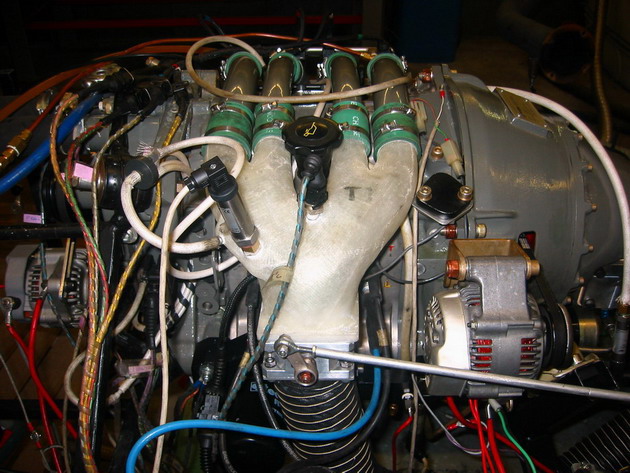
I send you in attachment a picture of the new (and final design) air intake
manifold which Gordon designed and which we just finished testing.  We are
going with this design in production.  It will be cast in magnesium alloy.
We found its advantages to be:

- 6% higher VE over the previous design which converted into 6 additional hp
- more compact profile
- cleaner, more elegant design
- Lighter
- considerably simpler and less expnsive to manufacture.

To give you a "historical" comparison of Mistral's manifolds, I send you
another picture showing 3 discarded designs.  From bottom to top:

1. Mistral's first fabricated manifold.  Way too labour intensive to go into
production.

2. Mistral's first cast Mg manifold:  worked fine (the Arrow is still flying
with the same one) but was not optimized for power and was very difficult
and expensive to cast (it was designed before I joined the project by a
young engineer with no industrial experience).  It was also with that
manifold that we found out that the location of the injector "yards" away
from the intakes simply does not work well at all (bad transients, bad BSFC,
exterior AND interior icing of the intake runners on the N/A engine, etc).
I know you are going to say that locating the injectors on the "hot" side of
the engine creates a fire danger.  That is true and we are addressing the
issue by enclosing the injectors and fuel rail into a closed metal box and
sucking any potential fuel or fuel vapour into the air manifold (see third
picture).  We are also protecting this box with a good heat shield.

3. The T2 manifold which Gordon designed and built over the holidays with
T1.  It works better than manfold 2 above but is 1-2% less efficient than T1
over most (but not all) of the RPM range, it is also bulkier and less
esthetically pleasing, don't you think.

Best regards,

Francois
I like your new manifold. Inline everything is good. Be just great cast in magnesium.

Get rid of the SCAT flex hose and use a smooth bore feed pipe
with a ram air scoop and you will pick up ten HP .... one to two inches
of manifold pressure at high speed.

The butterfly throttle looks of adequate size.

What is the long cylindrical thing on the left with the white wire
attached? Sensor of some sort?

It appears the new hot side is designed for the 2nd gen four port. You
will pick up a lot of port area if you go to the 3rd gen four porting.
That may require a new end housing pattern. If so forget it for
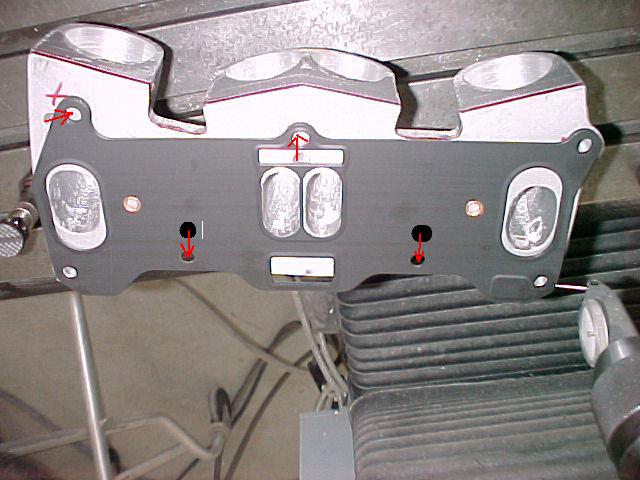
awhile and sell what you have. Here is a shot of a 3rd gen gasket
superimposed on a 2nd gen manifold casting.

Paul Lamar

The Rotary Engine NewsLetter.  Powered by Linux.
ACRE NL web site. http://home.earthlink.net/~rotaryeng/
Copyright 1998-2004 All world wide rights reserved.