This is not exactly what we are looking for but there are
some clues here.

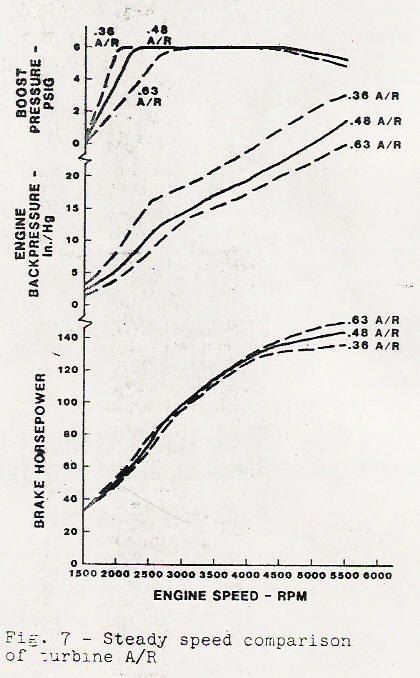
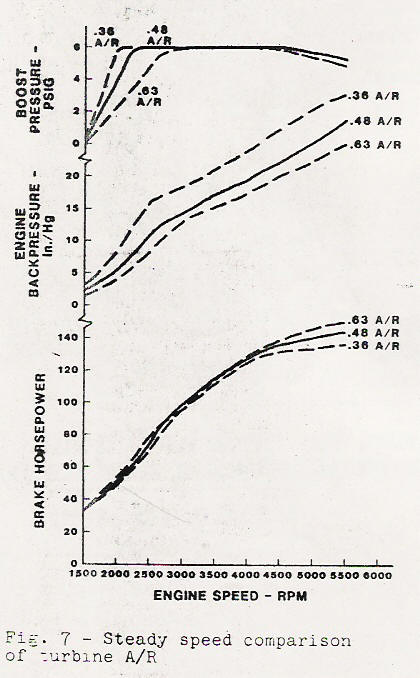
This is from SAE paper 821149 "The Effects of Turbocharger Design
and Installation on Gasoline Vehicles Transient Response" I provided
some of the instrumentation on the R&D reported in this paper.
Note the 20 HP loss in the overall steady state engine net HP out going
from a .63 to a .38 A/R. This is a T3 turbo charger. R, the radius
of the turbine, is fixed and A, the area of the nozzles, is changing.
Basically what is going on here is more back pressure and net HP loss
is being being generated by the smaller nozzle.

Just like electric motors you can get the same HP from a
turbine if you make a small one running at high RPM or a large
one running at low RPM. In this case the weight penalty is less
severe in the over all scheme of things. The larger turbine
will have the same HP loss with the same nozzle area but the
RPM will be less and the turbine torque higher. Consequently turbine
power will be nearly the same. Turbine power is the bottom line
for turbo compounding.

Paul Lamar

The Rotary Engine NewsLetter.  Powered by Linux.
ACRE NL web site. http://home.earthlink.net/~rotaryeng/
Copyright 1998-2004 All world wide rights reserved.