Lets see, a T3 wheel can be 2.319 or 2.559 inches in diameter. Using the
2.559
number that would bring the tip velocity down to 1470 feet per second.
Paul Lamar
snips..
Volume ratio 300cfm X (1600+460)/(100+460)=1104cfm/60=18.4cfs
2 2in pipes= .0436sq ft vel = 432fps scroll area 2.8 .019sg ft vel 968fps
spouting horsepower about 9 theo jet stream power
Vance
We are still not quite there estimating what is going on with the turbo charger
as the tip velocity of the turbine blade is 1470 feet per second at
130,000 RPM.

Vance made these calculations based on my guess of the amount of air
entering a normally aspirated 200 HP engine. I guessed 300 cubic feet per minute
at 7000 RPM.

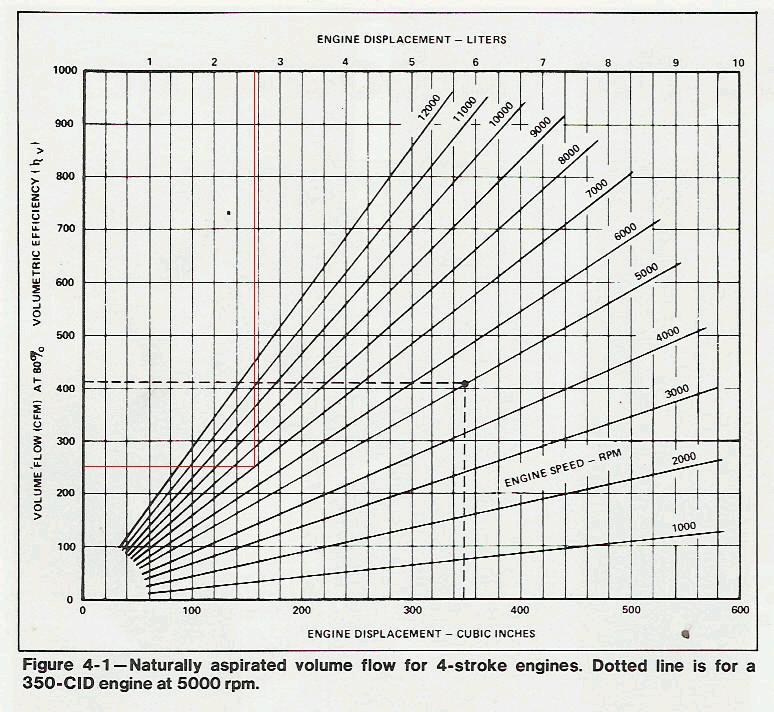
This chart shows a consumption of 250 CFM at 7000 RPM for 80% volumetric
efficient. A good normally aspirated side port rotary will show a VE of around
100% so my guess of 300 CFM was about right. However Francois was seeing
130,000 RPM on the turbo charger while generating considerably more
power. My guess was about 240 HP. Was that about right Francois?

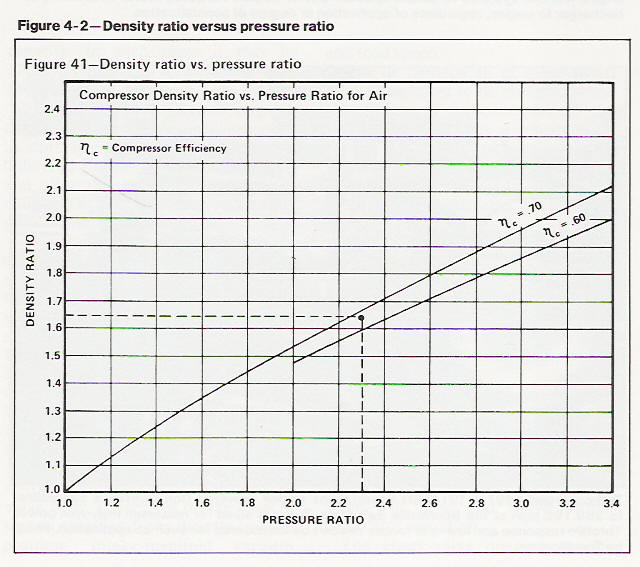
In other words the engine was using 240/200 more air or about 1.2 times
the air. That would make the density ratio 1.2.

More air in so more air out. This might mean the exhaust gas velocity
in the scroll impinging on the turbine blades was really 1.2 times 968
feet per second or 1160 feet per second. Getting there little by little.
We are now in the ball park.

Using the second chart (also from Hugh Macinnes) and working backwards that
looks like a pressure ratio of around 1.4. Or about 6 psi boost at sea level.

Check my reasoning and my arithmetic.

At altitude the pressure ratio could be higher and the turbine speeds
up at a rate of 2% for every 1000 feet. What altitude did you
see 130,000 RPM Francois?

Paul Lamar

The Rotary Engine NewsLetter.  Powered by Linux.
ACRE NL web site. http://home.earthlink.net/~rotaryeng/
Copyright 1998-2004 All world wide rights reserved.