Douglas Fir wrote:
Paul.

Vance's dissertation on the exhaust  properties was very enlightening. Here
are a few other of the more coherent opinions on 'turbocompounding' from the
Half Bakery website.
-------------------------------------------------------------
Like many others have said, it is FALSE to say that turbo's take "wasted"
power from the exhaust and use no power of [its] own.. If this was true than
your idea would be a great one. The reason that a normal turbo "super
charges" the engine rather than having a belt that adds power to the crank
on the engine are basic laws of physics. The same reason the perpetual
motion doesn't work (on earth). As long as you have resistance (friction) of
any kind, there will be a loss and not a gain. The reason for this is
because of exhaust back pressure. Try taking an 800bhp racing engine and
plum it through a stock Honda exhaust. It would probably blow the Honda
exhaust to shreds due to the back pressure, but before it blew up you would
realize huge power losses due to the restriction. Turbos get their power by
robbing it from the exhaust system thus causing back pressure. This is still
efficient and only screw, centrifugal, and scroll super chargers can match a
turbo in efficiency. They are also much more expensive than a turbo.    ??
??????    -DL
-------------------------------------------------
enro2, Aug 19 2004??
??????    The idea here is to use a positive displacement supercharger at
the intake, and an exhaust-driven turbine to add power back into the drive
train via a belt-and-pulley arrangement in place of the original centrifugal
compressor.    ??
??????    WWII aircraft had this fully baked. The P-38 Lightning is one
notable aircraft that used this method, and it was so successful that it was
declared top-secret and photos of the Lightning from any angle that showed
the turbine exhaust were prohibited. Although the system was geared, not
pulley-driven, the functional principle was the same. The B-17 engines also
had a similar system fitted, as did several other radial engines. It was one
of the mission-critical systems that allowed the B-17 and P-38 to extend
their range so far.    ??
??????
---------------------------------------------------------------

Interesting bit of info on the P-38s.  I didn't know that.
In conclusion, it seems like a engine can only be turbo-compounded if at the
same time it is being turbocharged.  Otherwise the back pressure increases
the load on the engine pulling down the rpms.

This applies whether the excess power (think of it as secondary power
output) from the turbine is going to a mechanical gearbox or a less
efficient mechanical-electrical-electrical- mechanical system.  Caterpillar
research shows that with diesels engines, the higher the rpm, the larger the
difference between the power curve needed for turbocharging the engine and
power output of the exhaust turbine. Paul could you post that graph?  It was
a in a PDF file introduced to you  a month back. That Delta HP, if you will,
between the power curves is all that is available to us to grab. Higher
elevations will help as the turbine speed can increase 2% for each 1000 foot
of elevation.  At 8,000 the rpms will increase 16%.  I suspect the Connie
airplanes fly a lot lot higher thus taken advantage of cooler air and lower
outlet pressures.

So with the engine design capable of being boosted to 300hp but operated
with a smaller amount of boost at 150 hp in midrange cruise at 8,000ft I
wonder what amount of 'excess' energy can we effectively bring back to the
shaft? 10Hp?

Doug in Japan.
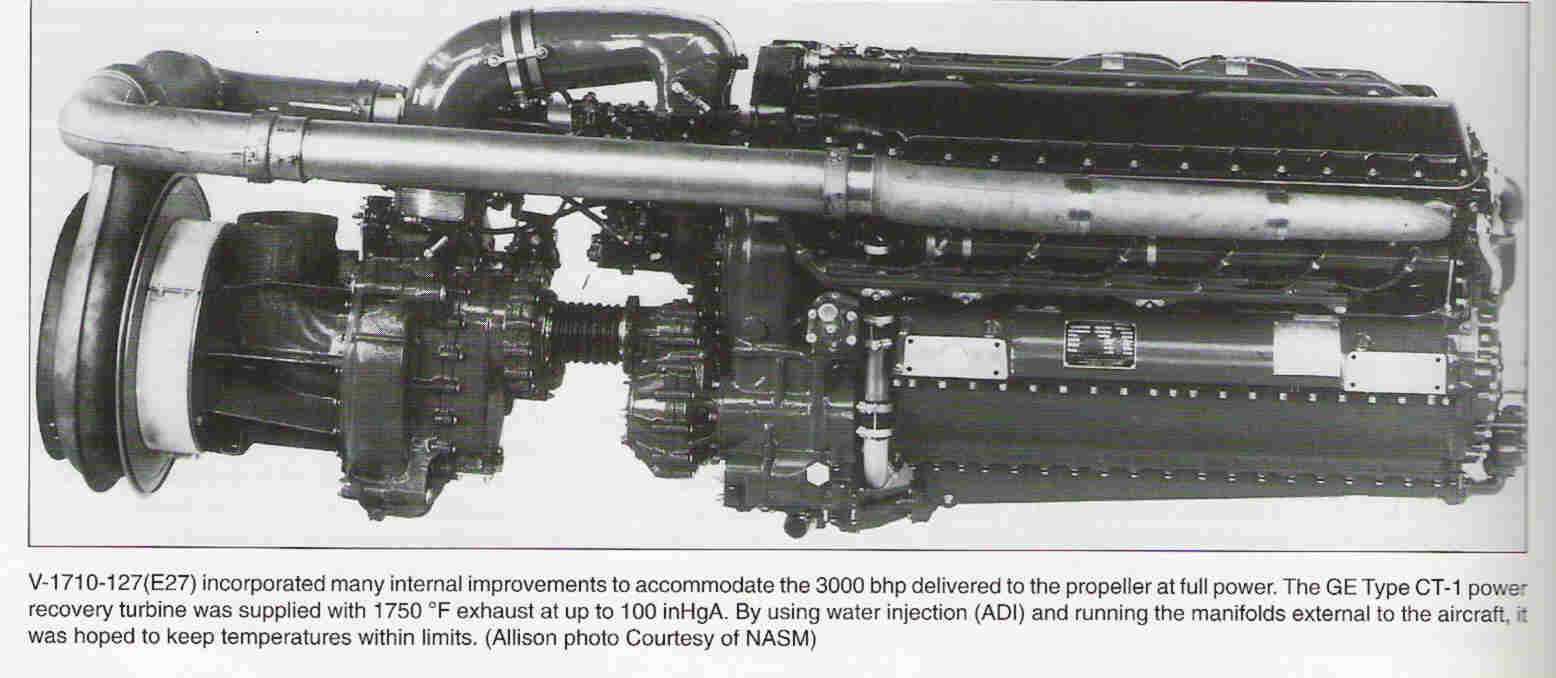
First the P38 never got the turbo compound although Allison did indeed
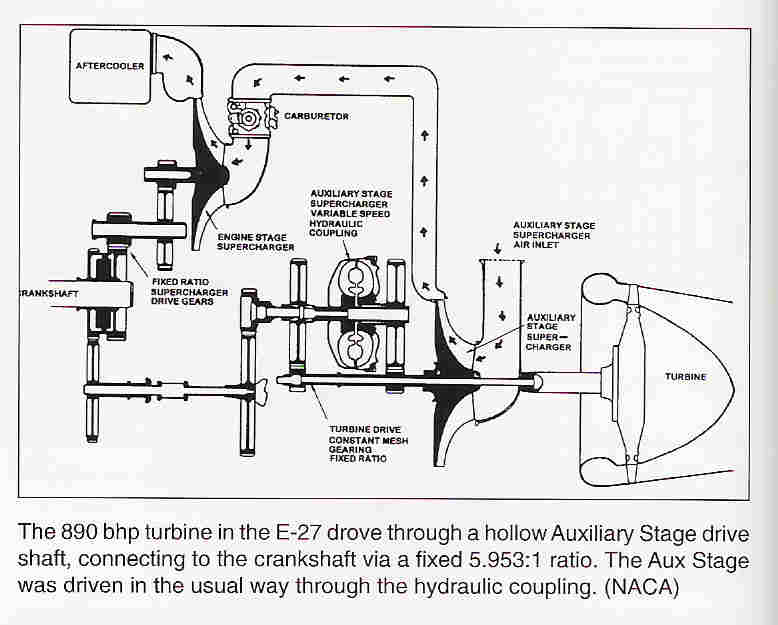
build an expiememtal turbo compound  engine before CW. Here is a picture.
I have very comprehensive book called "Vee's for Victory"  on Allison that
list every Allison V12 engine ever built and the serial numbers of the
airplanes they were installed in. That TC P38 is BS.

It is true that the R3350 was putting out 2800 HP supercharged so
the HP required from the engine to drive the supercharger was already
being used. The 20% increase was from the blow down turbines. the fact
of the matter is the back pressure needed to drive a turbo does not subtract
the same amount of HP from the engine that a supercharger does. I am still
working on getting some actual numbers on that. Apparently the large diameter
superchargers used in those days were more efficient than the smaller ones
we are now using. I am not sure about that yet. There is no doubt there is
a lot of potential HP in the exhaust. The question now is how much is
kinetic and how much is just plain heat.

BTW do you have the book called How To Make Your Own Alcohol Fuels
by Larry W. Carley?


"Vee 's for Victory

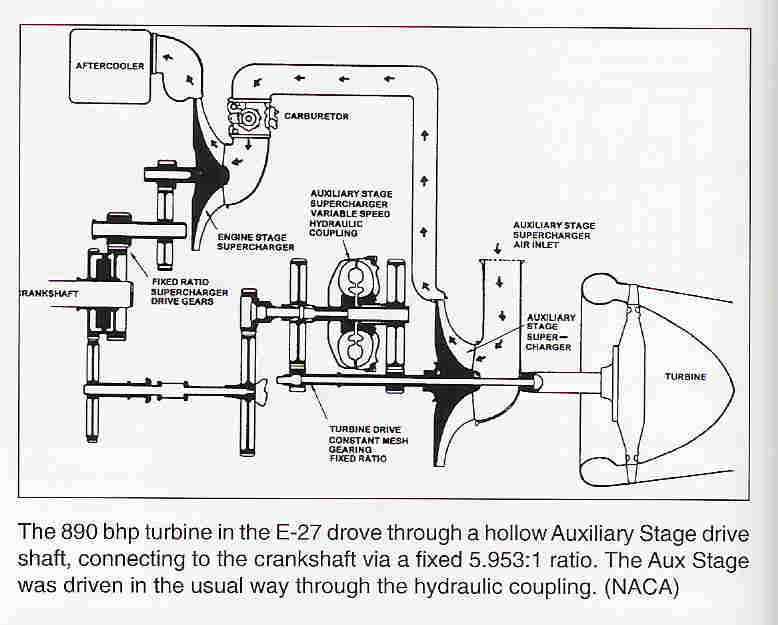
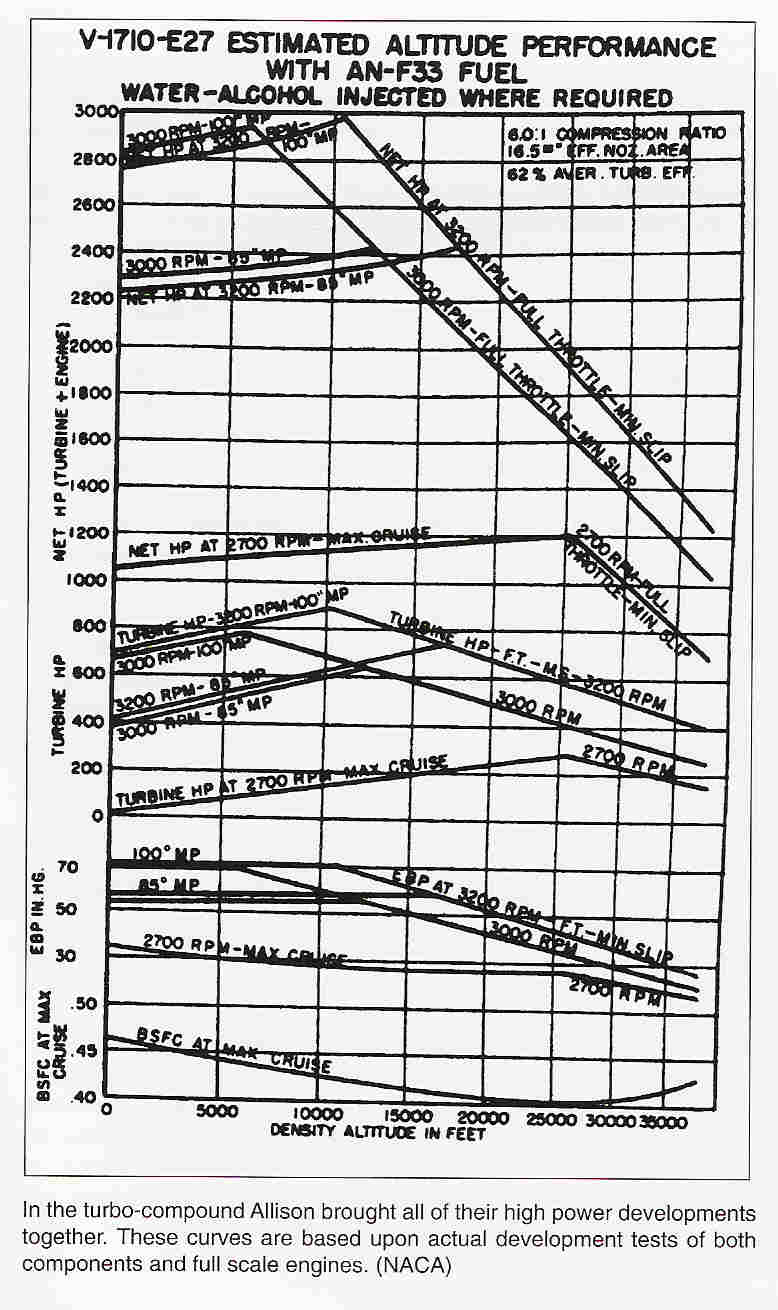
E-27: In many ways this was a very unique engine, and way ahead of its time.
This was the first turbo-compound, or "power feedback" engine built by any
manufacturer. Based on the E-22 power section with Auxiliary Stage
Supercharger, it added a General Electric CT-l power turbine, driving the
crankshaft through 5.953:1 gears. Allison built a mockup of the
configuration in September 1944, followed by a series of component tests,
including a complete compound engine development series run in June 1945.
The first complete engine was produced in September 1945.49 The turbine was
adapted from the CH-5 turbosupercharger and driven by exhaust gasses
collected by P-38 type collector manifolds. Compression ratio was reduced to
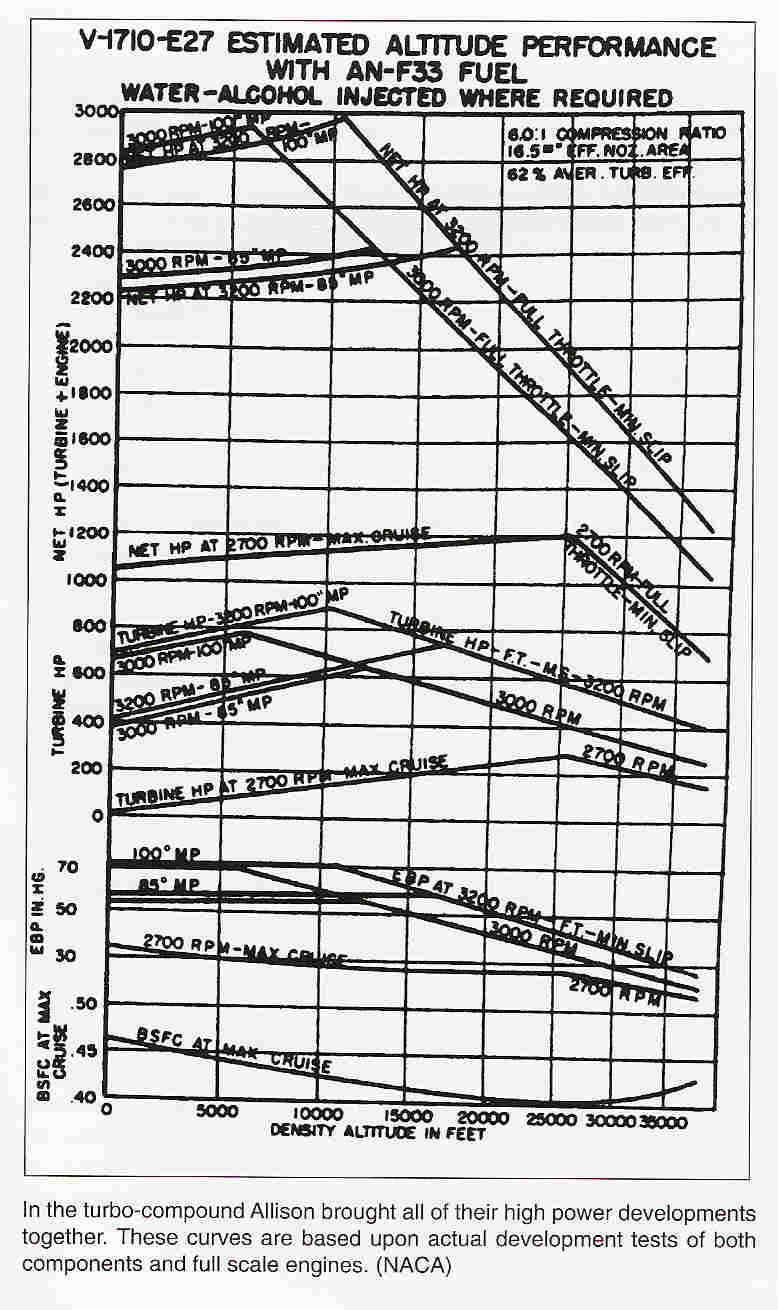
6.00:1 to accommodate very high manifold pressures up to 100 inHgA,
consequently Grade 115/145 was specified. The 12-counterweight crank-shaft
was used allowing ratings at up to 3200 rpm. The engine was in-tended for
the Bell XP-63H, where it would have been able to deliver a WER rating of
2980 bhp at up to 11,000 feet from 100 inHgA, using ADI injection.
Considerable running of related components and complete en-gines was
accomplished during 1944/45. The engine was able to demonstrate a 19%
improvement in cruise specific fuel consumption due to the contribution of
the power turbine. The aircraft never flew because the turbine was limited
to inlet exhaust gas temperatures of 1725 F and at full power this
temperature could be easily exceeded. As a consequence, Allison undertook
a project of their own to design and develop a suitable power turbine with
air-cooled blades, though that occurred only after the V-17 I 0-127(E27)
project was canceled."


Paul Lamar

The Rotary Engine NewsLetter.  Powered by Linux.
ACRE NL web site. http://home.earthlink.net/~rotaryeng/
Copyright 1998-2004 All world wide rights reserved.