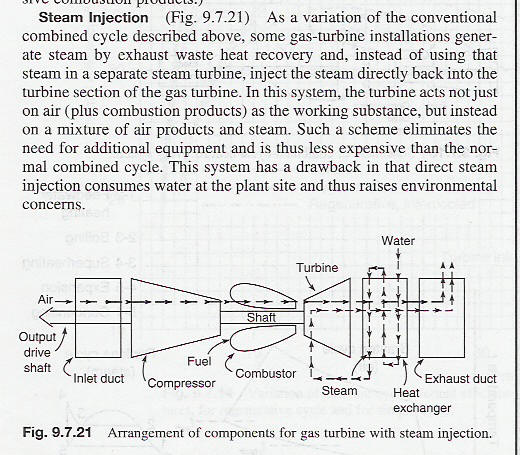
snips...
As far as USEFULLY expanding down to atmospheric temperature is concerned
I agree but I won't give up. We now go to plan B where we convert the
un recovered heat to steam and inject it into the turbine. We then condense
the steam in the exhaust back into water down stream. We might need to carry
a bit of make up water. Here is a diagram from Marks for such a scheme as
it is applied to a gas turbine. Gas turbines with this type of exhaust
heat recovery are called combined cycle engines and according to Marks
approach 60% over all efficiency. Here is a scan from Marks.

I am researching membrane technology as we speak to possibly further extract
water vapor from the exhaust.

I think it ridiculous of the engineering world to go on building 30% overall
efficient internal combustion engines without spending some R&D money on making
them more efficient. Instead the car companies spend billions on electric hybrids
using the same 30% efficiency ICE engines while adding 500 to 700 pounds
to the weight of cars.

A combined cycle turbo compound internal combustion  engine is not going to
be more than 100 pounds heavier if that.

Paul Lamar
snips...
Since the HP numbers are so low in a car cruise situation you could use a
very small turbine and a small heat exchanger and a small condenser.
I think the heat exchanger can be as simple as a counter flow concentric
pipe inside the all ready long exhaust pipe. The condenser can take
the place of the aft muffler. If one is really clever the cooling
system could be  in the loop for additional heat recovery.  It just
takes money for R&D.

Paul Lamar
Hi Paul

I don't have the book about alcohol making.  I'll pick it up though.
Thanks.  So far I have been speaking to and hanging out with some to the
local saki breweries in town.  Make a beery solution, add yeast and distill
the result. It seems ethanol came be made made from hundreds if not thousand
of varieties of plants.   Interesting that those yeasty beasties give off
alcohol and C02 in equal amounts.  Best to sequester the CO2 or we are just
exchanging NOX for another greenhouse gases huh?

As you noticed in the turbocharging book a lot of racers inject
alcohol/water mixtures to lower the detonation point so they can increase
manifold pressures.   I wonder if I need to go to the low compression rotors
on the Renesis if running alcohol with a slight 4psi boost.  One way to find
out huh?  Boom boom.  Of course if I want to get 300Hp out of the Renesis I
will probably have to wait for the low comp rotors, or modify the 13B
rotors.  First lets see what the 13B can do.   110 octane ethanol will help.

OK so the best BSFC on the turbo compound engine was up around 25,000 feet.
That is starting to make sense.

Half Bakery is at this location...Mostly amateurs kicking around all sorts
of half baked ideas.

 http://www.halfbakery.com/idea/Supercharger_20_2b_20Modified_20Turbo

Someone also mentioned injecting steam into an auxiliary turbine.

So if I understand you correctly the exhaust manifold super heats a working
fluid, turns it to steam, which is then injected in a small steam turbine
that is connected to compound mechanism right? A cooling condenser and
storage tank is also in the loop. Sounds like we have to cannibalize an old
refrigerator and high speed pump:)

 Did I ever tell you I lived in Stead, Nevada in 1970 for a year? I use to
wander over to Bill Lear's shop and look at the steam turbine he developed
for the Monte Carlo demo car. He ran it on a closed loop freon system and
turbine.

IMHO this line of thinking for an add on to the 13B or RX-8 aircraft engine
will be way too complex and heavy to create with our limited research funds.
.... But... if integrated into an APU ground station it is a superb and
excellent concept. The building floor, water heating or air conditioning
loop will be the heat sink.  The total efficiencies will be in the high 80s
I am sure.  Of course on the ground in this application we compete with
diesel engines.


I might have missed something.  Is the GT-28R a turbo compound possibility
as well.  It seems small.

Doug in Japan
I'll send the book to you. I think it is long out of print. I just happen
to run across a used copy in the Op Amp book store.

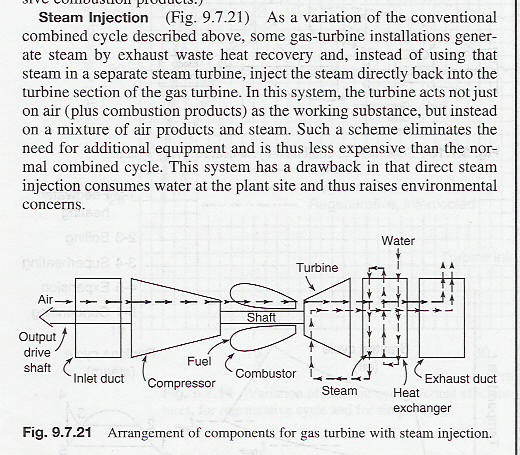
The steam is injected back into the same turbine. No second turbine required.
Here is the diagram again. Perhaps you are not getting all your email.
I was not too clear on this point in my discussion of it above.

No additional weight except for a steam pipe in the exhaust pipe and a condenser.
The condenser's job is to convert what is left of the steam in the exhaust back into
water. The left over heat in the exhaust (900 F) after some of it has been extracted
by the turbine will convert the water in the pipe into steam. I will do
a 3D pluming diagram.

Probably not necessary as the aircraft turbo compounding will be running
at much higher HP numbers so there is a lot more kinetic energy in the exhaust
to drive the turbine.  There is no reasons to believe there was a higher
ratio of kinetic energy to plain heat energy in the exhaust of the R3350 TC than
there is in the exhaust of a 13B rotary engine. (With the possible exception
of the occasional broken exhaust valve parts :)) If they got 20% more HP 60 years ago
with the same amount of fuel we can get 20% more HP now with the same amount
of fuel with hopefully better technology. If Caterpillar and Scania can get
10% more HP out of a diesel engine with a much cooler exhaust surely
we can get 20% more HP out of a hot blooded rotary engine.

I don't think the GT28R would make a good turbine for a turbo compound
engine. Stick to the TO4 for now. I am still gathering information on this
new line of Garrett turbos.

Here is that combined cycle diagram again. Let me know if you don't get
this attachment.

Paul Lamar

The Rotary Engine NewsLetter.  Powered by Linux.
ACRE NL web site. http://home.earthlink.net/~rotaryeng/
Copyright 1998-2004 All world wide rights reserved.