Hurant Karibian wrote:

I belive I said this before. In the navy flight engineer
school
we
were told
the R3350 turbo compund produced no more exhaust back
pressure as
the
space
between the turbine blades equaled the area
of what would be a normal exhaust system for that engine.
Thanks Hurant,

I didn't know that.

Say Paul what do you estimate the HP to be on the first jet
turbine
on
the
charts?

Doug in Japan.
The HP of jets depends on how fast they are going.
19.8 pounds of thrust at 400 feet per second (270 MPH) = 7920
pound
feet
per second
or 14.4 HP. What is more interesting is the mass flow at .55
pounds
per
second
which is just about the mass flow of an RX8 engine at 3000 RPM and
40%
volumetric
efficiency. In other words this tiny turbine is just about right
for a
car
turbo compound. The large one is almost right for an 13B aircraft
turbo
compound.
Before you get too excited you should probably look at the pressure
ratio
and rpm of that turbine.
I thought the goal was a larger, slower turbine, to reduce the
gearing
requirements.  If you can live with 100K+ rpm
it might work-if you can get a high enough pressure ratio across the
turbine.

Monty
We started out with 100K RPM gearing. Pushes the limits of gearing but
I think a traction drive planetary is still the way to go.

Paul Lamar
--Steve Webre wrote:
Paul,

I obviously missed a critical part of this discussion....

How does the assembly maintain the required friction pressures as
everything heats up and cools off again?

Also, what are the proposed coatings for the contact surfaces and how
does this set-up accept wear w/o slipping?

Thanks in advance!

Steve Webre P.E.
Broussard, LA
First its all steel so any over all heat change will affect all parts the same.
There is also a bit of free axial movement of the planet wheels. They are
spring loaded by the belleville washers.

There are no coatings on the steel parts other than the CVT lube used.
Same as steel locomotive wheels on steel rails. Coefficient of
friction is about .7 if your were wondering.

CVT lube has been developed over the past ten years for use in
the CVT transmission in your Ford Focus or half a dozen other
makes of CVT equipped cars around the world.

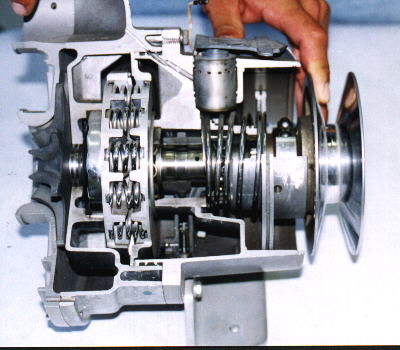
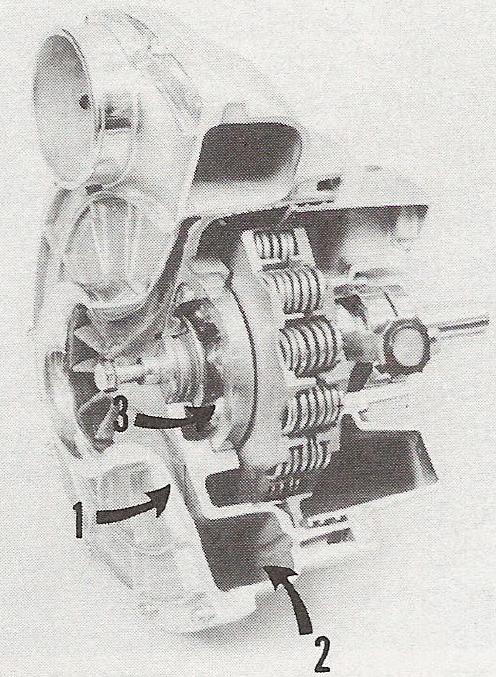
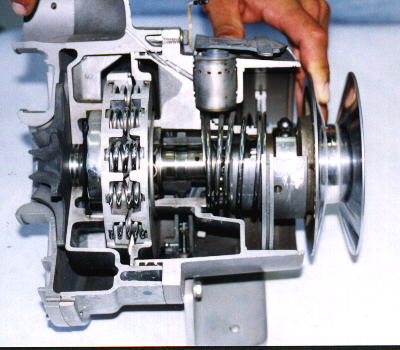
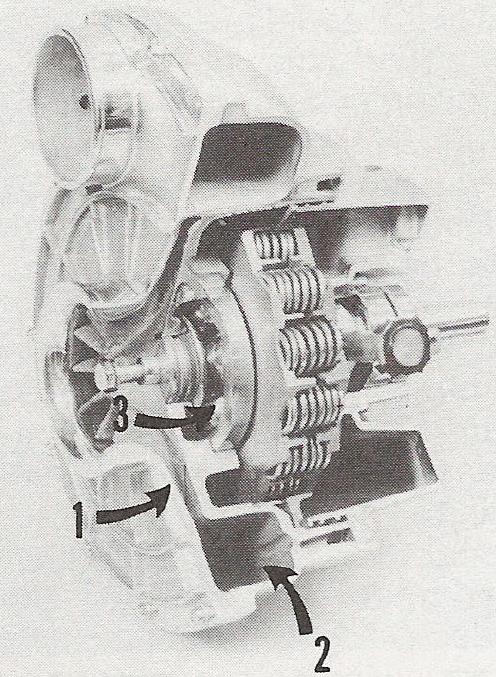
Paxton made and sold a centrifugal supercharger for 50 years with
a ball traction gear box. The balls are hidden behind the spring
pack in this first picture.  Nothing new under the sun.

Paul Lamar

The Rotary Engine NewsLetter.  Powered by Linux.
ACRE NL web site. http://home.earthlink.net/~rotaryeng/
Copyright 1998-2004 All world wide rights reserved.