Hurant Karibian wrote:

I belive I said this before. In the navy flight engineer school we were told the R3350 turbo compund produced no more exhaust back pressure as the space between the turbine blades equaled the area
of what would be a normal exhaust system for that engine.
Marc de Piolenc wrote:
The explanation is a little simplified, but the fact that no extra
back-pressure was produced is correct. NACA tests back in the 30's and
40's, aimed at getting direct thrust from exhaust stacks, showed that
exhaust passages could be restricted to a quite remarkable extent
without shaft-power loss. Likening the exhaust restriction to the
interblade spaces or "nozzles" of a reaction-type gas turbine predicts
that considerable power can be extracted from exhaust flows without
penalty to the core engine... which is exactly what extensive
experimentation later showed.

Work by Rauscher and Philips showed that it is possible to use EITHER
the thermal energy of the exhaust OR the mechanical (kinetic) energy,
but not both, so it makes sense, if you choose to use kinetic power,
to maximize it by running the exhaust flow through the maximum
permissible restriction, thus converting some of the exhaust enthalpy
to kinetic energy.

Marc de Piolenc
A slight clarification on the not both statement. Depends on where in
the exhaust stream you choose to exploit the thermal energy. If it is after
the turbine it can be done. Your local gas turbine power generating facility
is probably doing it right now as we speak. I agree if it is done before
the turbine the mass flow will be drastically reduced.

Paul Lamar
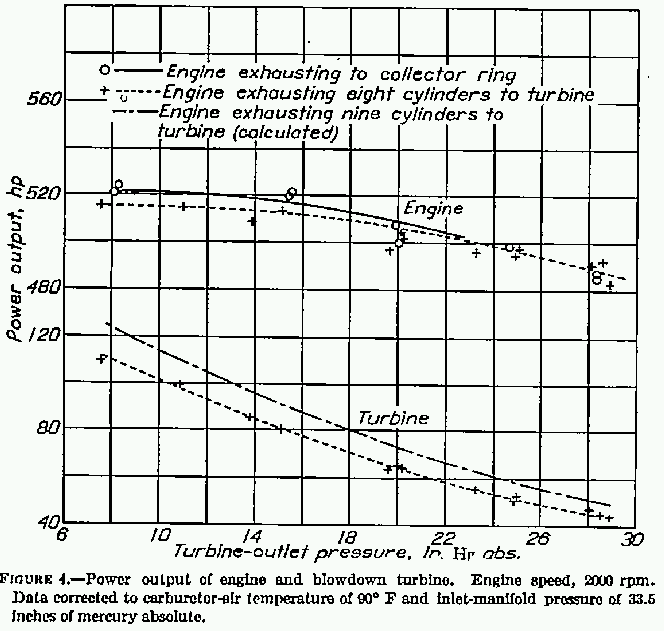
NACA Report 786 confirms these statements of no back pressure to speak of.
This was a mildly supercharged engine running at 33 inches of Hg.
The turbine was connected only to a dynamometer so no feedback from a turbo
charger was involved.

BTW reading this report and others our kinetic energy calculation are way
off for the 13B as you do not get significant power out of a turbine until
the gas velocity is twice the blade tip velocity. Our calculations indicate
around 900 fps for the exhaust gas but it would need to be near twice that
to rev a turbocharger turbine to 130,000 RPM and generate any appreciable
amount of boost.

Paul Lamar

The Rotary Engine NewsLetter.  Powered by Linux.
ACRE NL web site. http://home.earthlink.net/~rotaryeng/
Copyright 1998-2004 All world wide rights reserved.