François Badoux wrote:
Paul, maybe you can send this more compact document to the network?...
That is much better. I am not a fan of doc files.
300K is about our limit.
Most efficient are plain text and gif files.

That CAN network impresses the heck out of me.
As I understand it CAN can send out a whole bunch of real time
info on the engine that can be captured on a notebook computer's
hard disk. Just like OBD II. I am impressed. Pretty ambitious software
project for such a small company like Mistral. I know the big car
companies tens of thousands on this sort of thing. Unless of course
you found this software off the shelf someplace. What engine parameters
can be output in real time? Tracy and I talked about this a while
back and I am not sure if his unit can now do this.

Paul Lamar
Francois Badoux wrote:
Well Paul, you certainly can't buy this software off-the-shelf... especially
in an aviation certifiable version.  It's the result of 18-month of
development with 2 softqare engineers (one of them a PhD and a real wizard)
and 1 hardware engineer full-time.  The CAN system, on the other hand, is a
standard feature just as on your OBD II.  You have to remember that the CAN
sends "packets" of coded information when it's got the capacity to do it.
Therefore it's not real-time (for tiny fractions of a second, though).
Every engine parameter can be transmitted over the CAN EXCEPT RPM and crank
angle indication which MUST BE real time. Ignition and injection actuations
must also be real time.  Everything else can be carried over the CAN.

The CAN greatly simplifies cabling, especially in a twin or a pusher.  You
have only 2 wires (actually 4 for redundancy), instead of a couple of
dozens, to transmit information between the engine, the ECUs and the pilot
display.

I must compliment my electronics team for a great job.  They clearly
overdelivered on my expectations.  And they did it below budget and within 6
weeks of an aggressive deadline.

Francois
I had no idea you had sponsored such an ambitious and sophisticated project.
When you buy a new Lycoming or Continental engine you get nothing. The new Power
Sport did something similar but I never examined it closely as they refused to
sell parts to the experimental market. Fatal mistake IMHO.

Those new color transflective TFT displays are also wonderful. Robin got
a new Blackberry with a color transflective TFT and it is very readable under
all conditions.

The OBD II in my RX8 sends out RPM data along with the exact time to the nearest
thousands of a second. Since the RPM changes slowly in an aircraft engine
I think you should send out RPM. True... nothing is real time in the strictest
sense as a single chip processor can only do one thing at a time.

There is real time and then there is real time. A thousandth of a second
is sufficient for our purposes I would guess. Most single chip processors now a days
can do 10,000 steps or more in a thousandths of a second. Many times more with
the type of processor used in your PC but nobody uses those in engine
monitors or engine control computers I suspect. Programers also program
them in bloated modular C which is much much slower than assemble language. Just
for academic reasons what type of processor are you using?

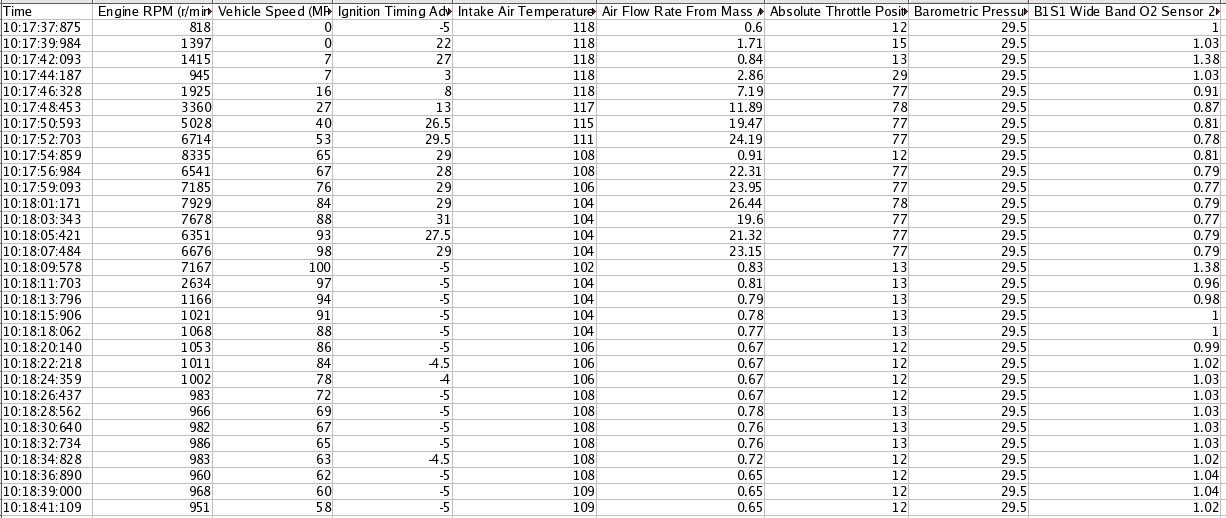
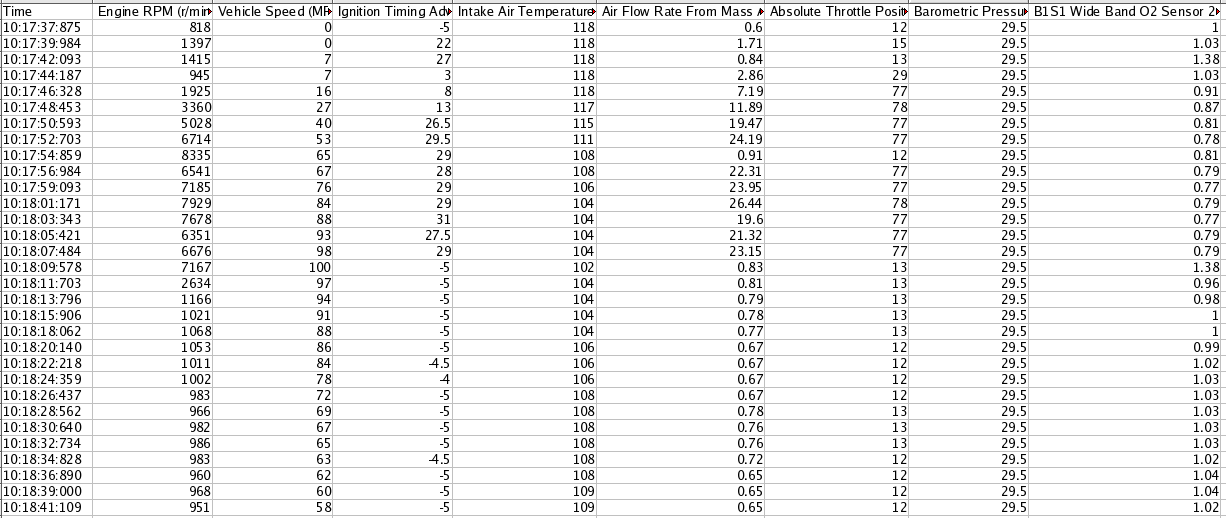
Here is sample of what my RX8 OBD II puts out. Notice it sends out a new
data set ever tenth of a second or so. This was a 0 to 100 MPH acceleration
run where the RPM is changing rapidly.

A similar sample from your system would be a great demonstration and sales tool of
what your system can do.

BTW the RX8 also has a CAN network and Racing Beat is using that instead
of OBD II for engine development

Paul Lamar

The Rotary Engine NewsLetter.  Powered by Linux.
ACRE NL web site. http://home.earthlink.net/~rotaryeng/
Copyright 1998-2004 All world wide rights reserved.