I found a couple of turbine books in London.
First one at Motor books on Saint Martins Court by a couple of
Rolls Royce engineers. Title was Gas Turbine Performance.
40 pounds on sale half off as I recall. Having read some of it I
don't recommend it as it is not easy to follow. Many of the math symbols
were not defined and crucial diagrams and charts are scattered
all over the book relative to the text. Looks like it was thrown
together by amateurs from data supplied by the authors. Text in
one place charts in another and formulas in a third.

The other book in stark contrast is excellent. I found that one in Foyles
on 113-119 Charing Cross Road. Title is Fundamentals of Gas Turbines Second
Edition 1996 by Professor William W. Bathie, Iowa State University of
Science and Technology. ISBN  0-471-31122-7

BTW Mark and Monty do either one of you guys have either one of
these books?

Having read some of the book I am now beginning to understand turbo
chargers a bit better. Turbo chargers are just small gas turbine engines.
It would help if one had a first course in thermodynamic which I don't.
I am considering going back to school.

The charts in the new Garrett on line pdf catalog are beginning
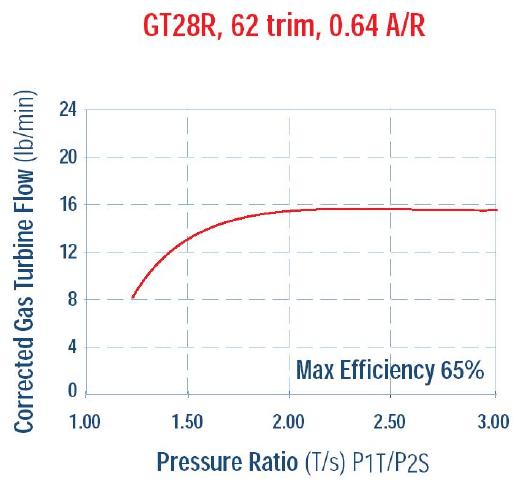
to make a bit more sense. For example this chart from the Garrett catalog
is the traditional way of expressing the performance of a turbine.
Where the curve flattens out is called the choke point. Little increase
in flow will occur after that point is reached. The flow has little
to do with rotor speed. More about that later.

Another thing that I always knew but never thought about the significance
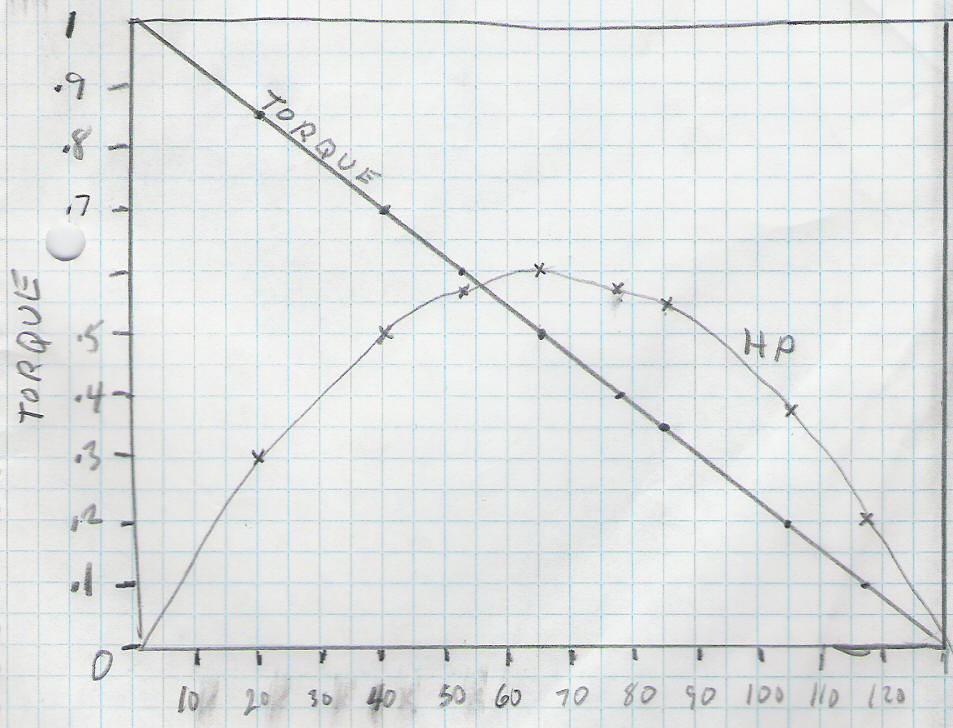
of was torque of a properly designed turbine is maximum at zero RPM and
declines in a straight line to zero at maximum unloaded RPM with a given
flow rate.  If you do a vector diagram of the mass flow direction
and turbine blade geometry over a range of RPMs this will become obvious.

I had a few hours with nothing to do in England so I calculated and plotted
a HP curve given this info. Here it is. So there is only one RPM at which
maximum HP can be extracted from a turbine and that is about 50% of
the no load RPM. The chart assume one foot pound maximum torque and to read
off the HP you must multiple the torque by ten. In other words this turbine
will generate a maximum HP of 57. This assumes you are below the choke point
and the structural redline of the turbine RPM is greater than the no load RPM.
Generally that is probably not the case. That makes it a bit more difficult
to determine the best HP RPM. Looks like a small dyno is called for.

As can also be determined from this chart there is only one RPM
where the turbo charger will operate depending on the HP load
the compressor is presenting to the turbine and the exhaust gas flow
among a zillion other things. It is called the equilibrium point.

This feed back closed loop situation is enormously complicated and it
would take a very sophisticated iterating computer program to optimize
a turbo charger for any given engine. That is why most people do it
by the trial and error method.

Conversely it is much easier to design a separate turbine when building
a turbo compound engine. Either a separate turbo charger or an engine driven
super charger like the R3350 TC had is indicated. Unfortunately this would
not be the lightest in weight configuration but one must walk before one can run.

Paul Lamar

The Rotary Engine NewsLetter.  Powered by Linux.
ACRE NL web site. http://home.earthlink.net/~rotaryeng/
Copyright 1998-2004 All world wide rights reserved.