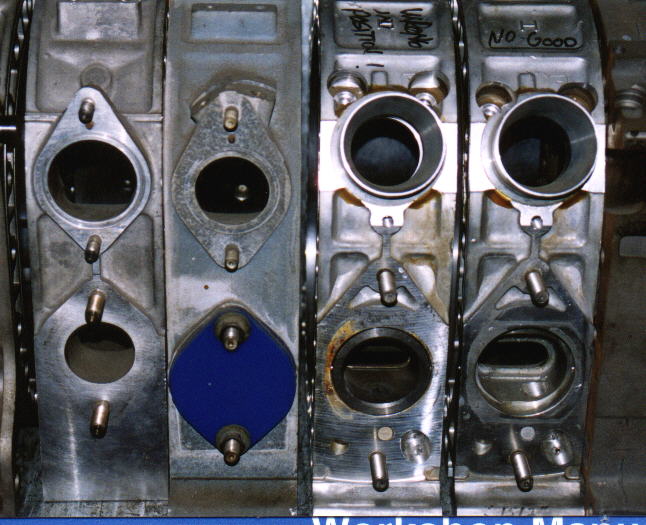
Well for over 200 HP you will need a p-port or a turbo charger.
A p-port is cheaper, weighs less and is more reliable than a turbo.
A Christavia on floats is unlikely to cruise long distances at 14,000 feet
where a turbo charger would pay off big time.

The basic 2 rotor engine is structurally good for 800 HP.

A Warp drive would probably work but a wood prop might be slightly more
efficient. Large diameter is good for low speed thrust but 84 inch might limit the
RPM and therefore the HP. You want to shoot for about 7500 RPM for takeoff.
My guess for a first cut is keep the prop diameter down to about 76 inches.
Best to use a variable pitch prop with sea planes. An IVO prop is variable
twist which is not what you need. Also Ken Welter has extensively used NOS
in his 3000 pound Coot to get it off the water.

Paul Lamar
"Echo Lake Fishing Resort (Georges Boucher)" wrote:

Hi! Paul
Thank you for your reply to my questions. From what I read 200hp with street porting is attainable ( local racer claim 212hp, how true I don't know). I'm concerned about idle speed with P-ports
on
a float plane. I'm considering street porting with NOS for take-off on small high lakes. I have a McCauley FFA 7563 prop. (from a 180hp Grumman Tiger that I can use as measuring stick without
NOS.
I have little knowledge of NOS possible ill effects on a rotary and would appreciate any input. What is your opinion?
Regards.
Georges & Gail Boucher
Yes the idle might be a problem.  Power Sport and others put butterflies close
to the rotor housing and claimed the idle was much better but I don't
have any numbers. On the other hand with a 2.85:1 PSRU the engine can idle
at 1750 RPM while the prop is turning only 600 RPM. About the same
as most direct drive AC engines can idle. I am almost certain a P-port with
the throttle close to the rotor housing will idle at 1700 RPM.

Here is a P-port slide throttle that is worth 10 or 15 HP over butterflies.
I am working on designing a sheet metal version that will be cheaper to
makes.

Paul Lamar
"Echo Lake Fishing Resort (Georges Boucher)" wrote:

Hi! Paul
Ivopro's site shows an electrical in flight adjustable prop & Warp drive doesn't  show a controlable prop.
 Did you have it mixed?
Thanks.
Georges & Gail Boucher
2126 Creighton Valley Road
Lumby, British Columbia
Canada  V0E 2G1
(250) 547-6434
www.echolakefishingresort.com
www.echolakefishingresort.ca
Yes that is correct. IVO is not really a variable pitch prop however. The blade
is twisted rather than pivots like a true adjustable pitch prop.

The Warp Drive is ground adjustable. Also as Ken mentioned you can add
more blades for more blade area. Ken has years and years experience
with rotary powered Coots. Here are a couple of pictures of Ken's Coot.

Apparently blade area pays off in high static thrust for getting you
up on the step and off the water. Sensenich makes air boat props with
lots of blade area. Here is a shot of a Sensenich air boat prop.
This one is also ground adjustable.

There are other ways to go. You could use a Mistral gear box that has provisions
for a hydraulic constant speed prop. Cost is around 7,000 as I recall and another
500 to 1,000 for a governor used or new. Then there is the prop it self at 2,500
to 6,500 used or new.

Another way is to use the Tracy Crook gear box and a German Hoffman or MT electric
prop.  About 3,000 for the gear box and 10,000 for the prop all US dollars.

Frankly with a Christavia sea plane on floats take off and cruise speed are pretty
close together due to the high drag so a ground adjustable prop like the Warp Drive
or Sensenich is the low cost way to go. You will see little advantage with
a true adjustable pitch prop.

Paul Lamar
Thanks Paul
You've given lots to think about. You didn't comment on my idea of street port & NOS.
Regards.
Georges & Gail Boucher
2126 Creighton Valley Road
Lumby, British Columbia
Canada  V0E 2G1
(250) 547-6434
www.echolakefishingresort.com
www.echolakefishingresort.ca
NOS has  has no adverse affect on the rotary.
The rotary engine is extremely structurally robust and will tolerate
up to 800 HP.

It is very difficult to get 200 HP with a street port at 7500 RPM or
below where aircraft versions of the rotary operate.
My suggestion is go with  P-ports.

Paul Lamar

The Rotary Engine NewsLetter.  Powered by Linux.
ACRE NL web site. http://home.earthlink.net/~rotaryeng/
Copyright 1998-2004 All world wide rights reserved.