Douglas Fir wrote:
Great news.  Now I can sit back and wait for the big companies to do the
work:) I wish.... Not really.  I noticed all these projects involve
diesel
engines.

Paul maybe it is time to send Mazda another notice although with their
new
RE  hybrid they will have the SR motor/alternator in the housing and the
other gen/motor on the turbo so they are half way there. They should be
able
to pick up 7-10hp.

Doug in Japan
I sent off a copy of this to Mazda. Ironically there is far less waste
heat in a diesel exhaust and cooling system than there is in a gasoline
engine.
I don't really think hydrogen is worth pursuing at this time. Perhaps in
50 years.
The required hydrogen infrastructure will not happen anytime soon and the
hydrogen
range issue will be a very tough nut to crack.

Mazda is wasting precious R&D resources fooling around with hydrogen when
they could be using that money for turbo compounding and bottoming cycle
R&D. Not only that but so far they have only achieved
a hydrogen engine overall efficiency of about 23% or so. A gas engine is
about 30% and a diesel about 33%.
Also all the above R&D on combustion efficiency will be lucky to pay
off one or two percent. What the heck does the DOE think engine
manufacturers have
been doing for the last 100 years? Turbo compounding and waste heat
recovery through combined cycle has the potential to double engine
efficiency using scaled down
power plant technology.

Paul Lamar
You gotta love politicians, if only you could legislate physics we could all
have atomic space cars that run on banana peels and cost $5.

All of these are for commercial diesel engines because they are not
throttled and work at much higher duty cycles, making turbo compounding a
possibility.

Turbo compounding is fine for gasoline aircraft engines that operate at a
high duty cycle at high altitude, it is not an option on a car on the road
throttled back to the point that it makes 20 hp or less. It will consume
more in gear train losses than you will gain from it. I believe you posted a
graphic of this very phenomenon a while back Paul. It was from a NACA study
and showed a LOSS in efficiency below certain throttle settings.

A car at road load is fundamentally different from an aircraft engine-is
this not a major point you always like to make Paul? The same reason that
makes the argument for putting a rotary in an aircraft also makes the
argument against turbo-compounding at road load part throttle. You do not
have much to work with, even if you could get it out-30% of 20 hp is only 6
hp, then you have efficiency losses, and gear train losses, and extra weight
and cost- if you really want to save this tiny fraction, just turn off the
AC. Make the car lighter or more aerodynamic, or smaller. There are huge
gains to be had without resorting to a complicated, expensive, technically
risky option.

There is a thermodynamic limit to the efficiency of the Otto cycle, I don't
care what the hell kind of crap you strap on it.

If you make it a hybrid engine and operate the IC engine at high duty cycle
and use the battery/capacitor to soak up the transient loads then
turbo-compounding will work otherwise it is a waste of time.

Monty
Turbo compounding for diesels are already here. Both Caterpillar and
Scani make turbo compound diesels.

True, making cars smaller and lighter with less aerodynamic drag works
to a certain extent but 20% smaller, lighter and less aerodynamic drag
is unrealistic. People need to want to buy the cars. Turning off the AC
will not gain you 20% and people won't do it anyway. Even for 20% more MPG
if that were possible.

Some cars are as small, light weight and have as low an aerodynamic drag as they
are going to get short of making them out of carbon fiber and shrinking people.

Gear losses are given in percentages. Usually in the low single digits. If they
were not percentages mechanical watches would never work.

Therefore I don't buy your argument. I did at one time and then it dawned on me.
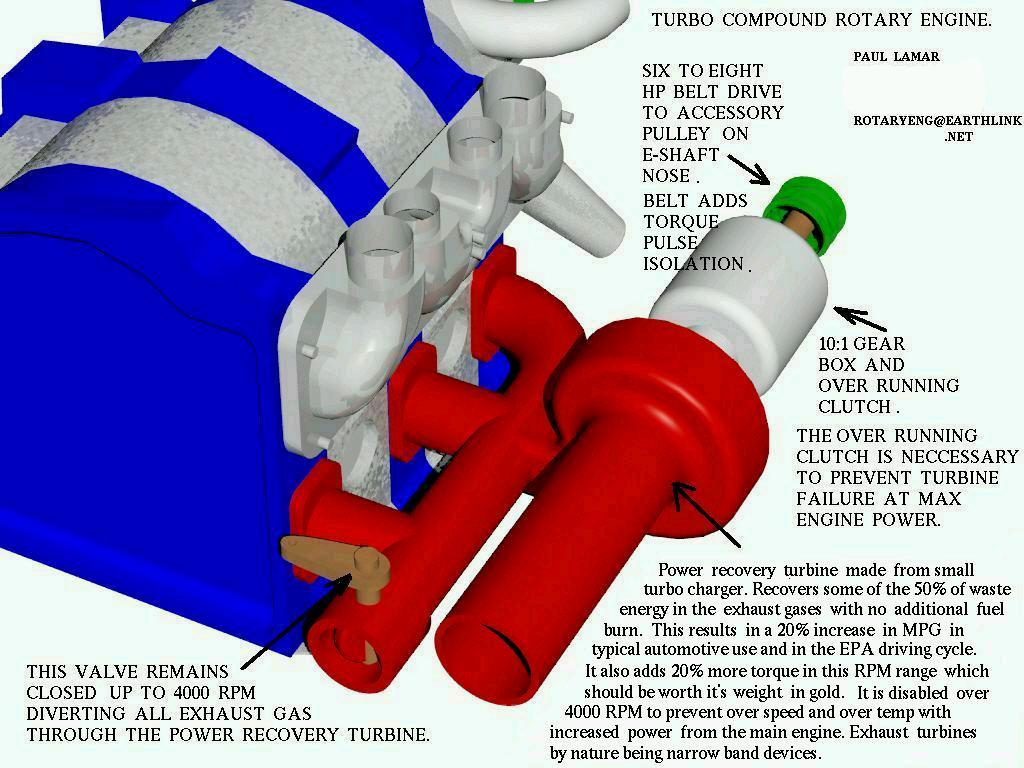
If the steady road load is 40 HP all you need to improve the MPG 20% is
8 HP. That is almost a model turbo jet engine sized turbine. Does a model
turbo jet engine work? Yes of course it does. You simply bypass the 8 HP turbo
compound system when you accelerate as per the 3D below. You only use it
when you are cruising down the freeway at a steady 70 MPH. I thought sure
I said this on here several occasions before. Perhaps I need to say it
some other way?

20% increase in car highway MPG world wide is not a tiny fraction.
I was just in England and people drive 80 to 90 MPH for hours on
the motor ways over there as well.

If you want real extra weight and cost build a hybrid car.

Good thing the Wright Brothers did not take no for an answer.

Paul Lamar

The Rotary Engine NewsLetter.  Powered by Linux.
ACRE NL web site. http://home.earthlink.net/~rotaryeng/
Copyright 1998-2004 All world wide rights reserved.