Turbo compounding for diesels are already here. Both Caterpillar and
Scani make turbo compound diesels.

True, making cars smaller and lighter with less aerodynamic drag works
to a certain extent but 20% smaller, lighter and less aerodynamic drag
is unrealistic. People need to want to buy the cars. Turning off the AC
will not gain you 20% and people won't do it anyway. Even for 20% more MPG
if that were possible.

Some cars are as small, light weight and have as low an aerodynamic drag
as they
are going to get short of making them out of carbon fiber and shrinking
people.
Gear losses are given in percentages. Usually in the low single digits. If
they
were not percentages mechanical watches would never work.

Therefore I don't buy your argument. I did at one time and then it dawned
on me.
If the steady road load is 40 HP all you need to improve the MPG 20% is
8 HP. That is almost a model turbo jet engine sized turbine. Does a model
turbo jet engine work? Yes of course it does. You simply bypass the 8 HP
turbo
compound system when you accelerate as per the 3D below. You only use it
when you are cruising down the freeway at a steady 70 MPH. I thought sure
I said this on here several occasions before. Perhaps I need to say it
some other way?

20% increase in car highway MPG world wide is not a tiny fraction.
I was just in England and people drive 80 to 90 MPH for hours on
the motor ways over there as well.

If you want real extra weight and cost build a hybrid car.

Good thing the Wright Brothers did not take no for an answer.

Paul Lamar
Monty Roberts wrote:
OK Paul,

Here is the NACA data that you posted. Please note the loss of power at low
power settings. If you are so convinced build it, test it, and I will
believe you.

Good thing the Wright Brothers actually built and tested things.

Monty
____________________________________________________________________
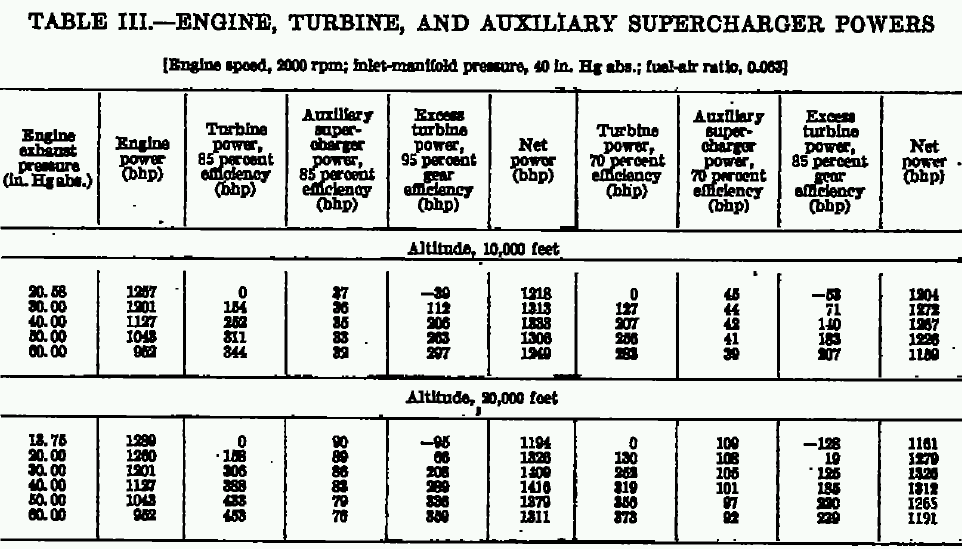
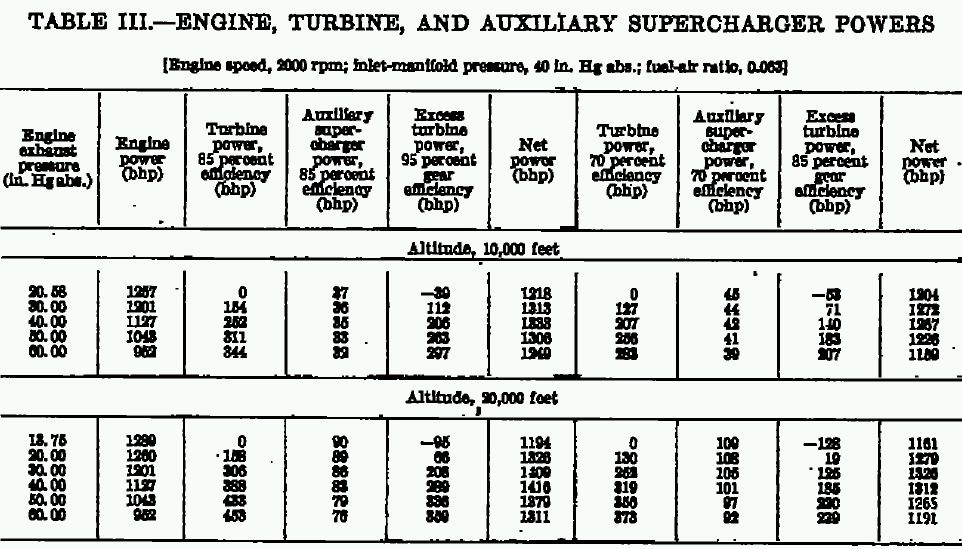
This is a table from NACA Report 822 on a 1200 HP 18 cylinder
turbo compound engine. You can get a rough idea from
these percentages on how much power you can get out of the
blow down turbine and how much power a centrifugal supercharger
would consume.

For a turbo charged engine just subtract the super charger HP
consumption from the turbine HP to get the net HP out of the turbine.

There are two turbines in this table. 85% efficient and 70% efficient.

Paul Lamar
___________________________________________________________________

I suspect you are still missing the point Monty. The turbine in this table was
sized for 20% of peak power or 200 HP. Great for aircraft use.  For a car we size
the turbine for 20% of road load HP and bypass it for any HP above that
level. Turbines, as you well know, are point design devices. Efficiency
suffers greatly off point. So we pick a HP point close to road load
and size the turbine for that. If we sized it for peak power on an
RX8 engine it would be 50 HP.

A small 8 HP turbine gear box and all would probably weigh less than 15 pounds.

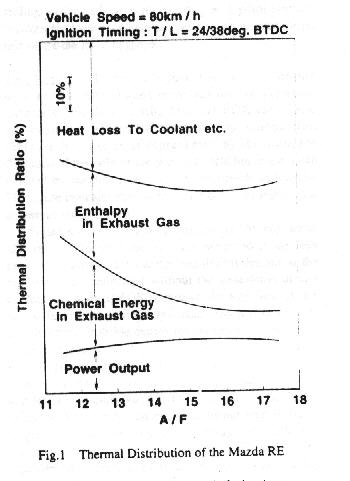
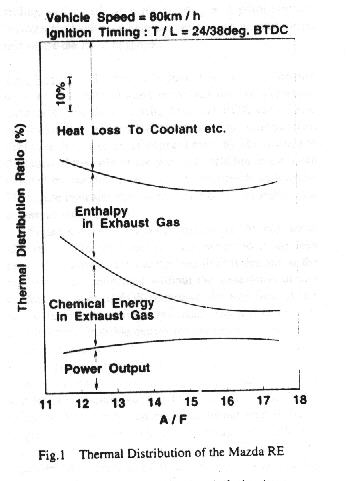
Here is another heat balance chart for a car rotary engine operating
at 80 KM per hour. If anything there is a higher percentage of waste
energy in the exhaust. The RX8 side exhaust port engine has probably
reduced the high percentages of chemical energy (unburned HC) in the
exhaust as shown in this chart. That was the whole rational for the side
exhaust ports.

Paul Lamar

The Rotary Engine NewsLetter.  Powered by Linux.
ACRE NL web site. http://home.earthlink.net/~rotaryeng/
Copyright 1998-2004 All world wide rights reserved.