OK Paul,

Here is the NACA data that you posted. Please note the loss of power at
low
power settings. If you are so convinced build it, test it, and I will
believe you.

Good thing the Wright Brothers actually built and tested things.

Monty
____________________________________________________________________
This is a table from NACA Report 822 on a 1200 HP 18 cylinder
turbo compound engine. You can get a rough idea from
these percentages on how much power you can get out of the
blow down turbine and how much power a centrifugal supercharger
would consume.

For a turbo charged engine just subtract the super charger HP
consumption from the turbine HP to get the net HP out of the turbine.

There are two turbines in this table. 85% efficient and 70% efficient.

Paul Lamar
___________________________________________________________________

I suspect you are still missing the point Monty. The turbine in this table
was
sized for 20% of peak power or 200 HP. Great for aircraft use. For a car
we size
the turbine for 20% of road load HP and bypass it for any HP above that
level. Turbines, as you well know, are point design devices. Efficiency
suffers greatly off point. So we pick a HP point close to road load
and size the turbine for that. If we sized it for peak power on an
RX8 engine it would be 50 HP.

A small 8 HP turbine gear box and all would probably weigh less than 15
pounds.
Here is another heat balance chart for a car rotary engine operating
at 80 KM per hour. If anything there is a higher percentage of waste
energy in the exhaust. The RX8 side exhaust port engine has probably
reduced the high percentages of chemical energy (unburned HC) in the
exhaust as shown in this chart. That was the whole rational for the side
exhaust ports.

Paul Lamar
Paul,

This is a hard point to get across, and no I am not missing the point here.
There is not a student of thermodynamics in the world that has not been
through these excercises thinking they could get all kinds of things for
free, at least until they get to the second law of thermodynamics. The
counter intuitive thing is that the amount of heat is irrelevent. It does
not matter what the quantity of the energy is, it is the QUALITY that
matters. There is a lot of energy in the exhaust if you look at it from a
ratio standpoint, but the state of that energy relative to the state you
have to reject it to is the issue. When the engine is operating at part
throttle with low manifold pressures and the mass flow is restricted, the
amount of expansion that occurs in the engine is rather large and the amount
of expansion left to perform to atmospheric is small. When the manifold
pressures are high, and the mass flow is large, the amount of expansion that
can be accomplished in the engine is smaller (engine is fixed volume
device), consequently there is still a useful amount of expansion you can
accomplish to the rejection state (with your turbocharger, turbocompound,
bottoming cycle or whatever you want to use.) Note that diesels are not
throttled.

I think it is funny that they want to raise the efficiency of the otto cycle
to 45% by 2012 The theoretical max efficiency for the otto cycle approches
around 60% at reasonable compression ratios of 8 or so. That is for an ideal
adiabatic cycle. This would be an engine with no coolant or lubrication or
frictional losses. GOOD LUCK!

You will also note that one of the things mentioned in the news release is
that they will be working on CVTs. This is so you can have a massive
overdrive and operate at higher manifold pressures. Similar to a CS prop for
cars, an approach worth considering.

The turbine in the example was sized to 20% of peak power because that is
what was available, thermo has not changed much in the last 100 years. This
is not a sliding scale where ratios apply in any situation. Just because you
can get 20% of peak power does not mean you can get 20% of the power at 20%
throttle.

Why don't you measure the exhaust gas temperature and pressure at different
engine conditions first to see what you have to work with. Remember if you
put a restriction in there (turbine) to get the back pressure up, you will
limit the expansion the main engine can accomplish, and therefore the work
it produces.

Get an EGT guage, and a water manometer (if you so please) and hook them to
your RX8 exhuast manifold. Go out at steady state cruise at 80 km/hr on flat
ground take measurements in 2 directions about 5 times and average them then
report back.

There is a reason everybody keeps telling you this will not work. It has
been tried over and over, and over.

Build it, test it, and show me.

Monty
I agree with you on raising the efficiency of the otto cycle with out
some sort of energy recovery from the exhaust to 45%. If it was that
easy it would have been done years ago. Ceramic engines were tried
years ago.

Since I have about 1500 subscribers I would hardly say everybody is telling
me it won't work.

In my extensive research on the subject I can find no references to any
organization that has tried a small turbine optimized for road load HP.
Do you have any such references? I can look up just about anything at
the UCLA technical library.

The new Ford 500 with a 200 HP engine is using a CVT plus torque converter.
Unfortunately I don't have any numbers as to RPM verses cruising speed yet.
Running the engine at a lower RPM for a given cruising speed yields a larger
throttle opening and a higher manifold pressure reducing the pumping losses
like you say. The industry term for this is called down speeding. A process
that has been on going for the last 30 years with four speed overdrive automatics
and six speed manual transmissions in conjunction with lower axle ratios. My
1994 V8 Cougar cruises at 80 MPH at about 2000 RPM with its four speed overdrive
automatic TX. IMHO it is largely responsible for the improvement in car MPG over
the last 30 years. Lower RPM, same displacement, higher volumetric efficiency,
same mass flow. Engine friction loss is less however due to the lower RPM.

If all it takes to improve the quality of the exhaust is a larger throttle
opening for a given car speed that can be arranged. However IMHO intuitively
it won't make much difference as the HP is directly proportional to the mass flow.

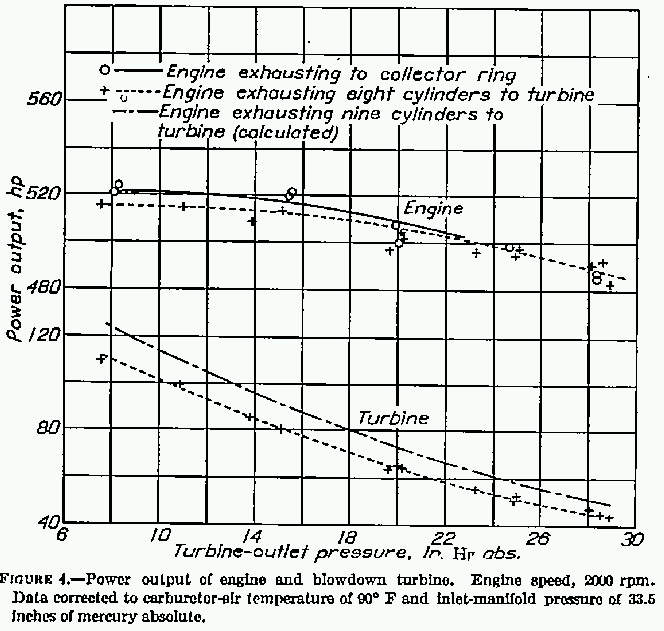
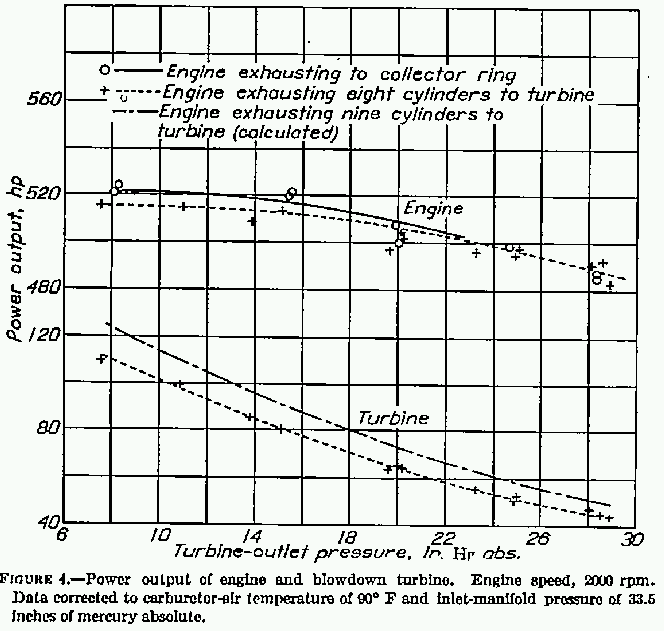
This chart from NACA Report No. 786 shows little or no reduction in engine HP (back pressure) as a result of the turbine while at sea level (15 psi absolute) the
turbine is generating 17.6% of max engine HP of about 510 HP. Obviously pressure (back pressure) is not an issue and the vast majority the energy to drive the turbine is kinetic. The nozzle is a fixed
size so the heat added to the mass flow expands
the exhaust gas increasing its velocity entering the turbine. Kinetic energy is m x V^2.
My reasoning is we make the nozzle such a size as to  extract the max HP from the
exhaust while the engine is generating only 40 HP without increasing the back
pressure significantly.

Paul Lamar

The Rotary Engine NewsLetter.  Powered by Linux.
ACRE NL web site. http://home.earthlink.net/~rotaryeng/
Copyright 1998-2004 All world wide rights reserved.