Douglas Fir wrote:
Paul,
My concern is too much complexity.  Screws need lockite so they
don't back out and get ingested.

A suggestion... Make two flat plates of the same design and use for right
and left sides and rivet or screw them together.  Between the two sections
place a Teflon slotted rail that the throttle plate rides in. This composite
structure will give enough rigidity if the materials are sized adequately.
IE. stainless 304 - 2mm thick.

For a design hint you may remember the wooden upper and lower rail design
of the sliding closet doors in the Japanese Inn you stayed at?  In the same
manner but the  Teflon 'rail' extends around the perimeter between the two
outer plate sections and the joining fasteners pass through it. Sandwich
construction.  If you really need a tight seal, use another plate of Teflon
across the whole face of the engine side of the throttle.  Obviously on one
end there will need to be a hole or slot to allow the throttle plate control
rod to pass through.   The inner wall thickness of the Teflon  only needs to
1mm. or less.  Small hole in the middle of the closed throttle plate is
advisable to allow some air in.

The adapters to the manifold should be screwed from the outside of the
plates and there might as well be identical parts for both sides. The
adapters, P ports and intake manifolds should have a lip  machined into
their ends, (I forget the name of the connection but we often use it in the
stainless food processing business) so one screw U profile shaped
circumferential clamp is all it takes to secure the throttle body to the P.
ports as well as the manifolds on the other side.  The lip in cross section
looks 'T' shape. We also have an O ring that seats inside to prevent liquid
leaks but may not be needed in this application.

The throttle plate sharp corners need to be radiused to move smoothly.  The
control rod should be attached at the 4/5 up from bottom (Japanese geisha
smooth door opening techniques) rather then in the middle which causes
binding.

Advantages.
No parts to bend, use stainless for best weight to strength performance. The
sandwich construction assuming the Teflon rail is at least 5mm in thickness
combined with the attached 'fittings' will make it stiff enough.

Feel free to put this comment on ACRE.

Cheers

Doug
Be nice if I had a drawing. :) We are thinking about doing away with
the ball bearings and using teflon sheets. If the teflon coefficient of friction
is as low as .1 that means the worst case force would be less than 9.5 pounds.
McMaster has it in 12 by 12 inch bondable sheets .015 inch thick up
to a 1/4 inch thick. Cheaper too than ball bearings. We would bond the sheets
to both sides of the aluminum before bending. .020 is part number 8711K82 $8.81 page
3282 in the paper catalog # 108

Checking in Marks  Mechanical Engineers Hand Book gives the teflon
coefficient of friction on steel  as .06 which means the worst case
would be 5.7 pounds. The worst case might be throttle closed, prop wind milling.
Of course that might not happen as the prop may not drive the engine with
the throttle closed. Another worst case scenario is closing the throttle to idle
on final approach and then jamming it open for a go around.

Teflon might be fine for an aircraft engine as one does not do a lot of
throttle action. I think we will try it. I'll redo the sheet metal drawing.

Paul Lamar
mprather wrote:
Is there coeficient of friction data on teflon as temperature changes?  I
know it sounds crazy, but I am still thinking about a turbocharged/
normalized p-port engine, and the induction temperatures will be more
than room temperature.  How would a brass throttle plate do?  Or is
there a nice anodized wear coating that could be added to Al?  I do like
the idea of getting rid of the bearings.

Matt-
I don't recall seeing that info anywhere. Teflon is usually good to 500 to 800 F.

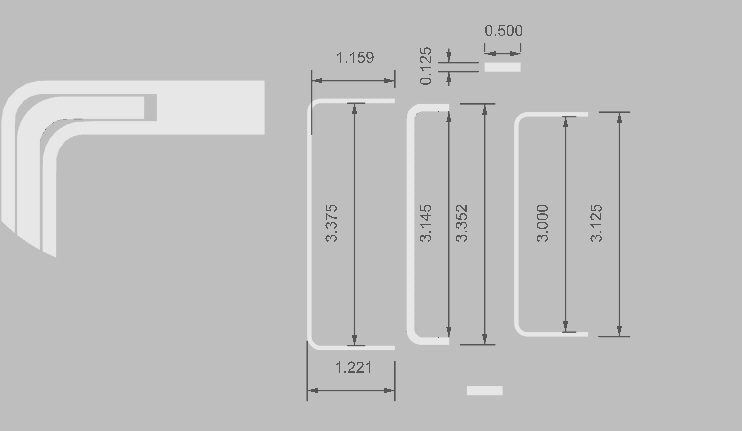
Here is a new 2D of the teflon coated slide. I used .020' teflon laminated sheet
on both sides of the slide. Can be sheared and bent after laminating.
Total thickness of the slide is now .0625 + .040 or .1025". The inner
and outer channels are spaced .125" apart vertically giving a bit of slop
up and down. In and out can be adjusted when bolted together.
If the teflon wears out it can be overhauled by replacing just
the slide. Sure makes the sheet metal easier to bend.

As I understand teflon coated anodized aluminum sheet can be had
but I worry about the very thin coating wearing out.

Paul Lamar

The Rotary Engine NewsLetter.  Powered by Linux.
ACRE NL web site. http://home.earthlink.net/~rotaryeng/
Copyright 1998-2004 All world wide rights reserved.