Ben Baltrusaitis wrote:

I'll be visiting a local shop in a couple of weeks that does a lot of
specialty work on the rotary. They are well know in the rotary racing world
and have experience building drag cars. Two options
they offer are "coolant porting and oil passage porting".
I haven't heard any mention of this on the list and was wondering if
anyone has any experience in this area or would recommend either one or
both. It makes sense to me to improve the flow,
especially the oil, but I don't want to risk any thin walls in critical
areas.
What do all of you think and what should I be asking about these
modifications?
Thanks!
Ben
Rumor has it the oil temp can be reduced 10 to 20 degrees by changing
where the oil
comes out out of the block.

Paul Lamar
"Brian D. Cain" wrote:
Hi Ben,

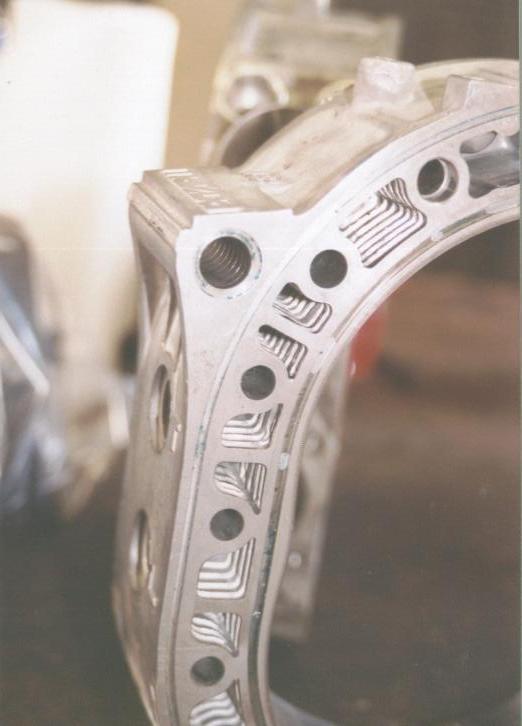
The cooling passage porting is basically the roughing up of some of the
water jackets around the spark plugs' area on each rotor housing.  Paul can
tell you more about this and whether or not it's actually worth it.

The oil porting thing -> the only thing I can think of is some work done to
the oil galleys in the front iron housing to reduce pressure drop points.
There is no chamfering or edging work done on the oil galleys once they're
machined.  The oil, from the point of the strainer to the first oil cooler
line, has to make about 5 or so sharp, right-angle turns.  Work can be done
to reduce those pressure drop points there.  Another thing that can be done
is enlargening and smoothing/scuffing/polishing of the pickup galley where
the oil strainer bolts on.  That seems to have a positive effect by reducing
the workload of the oil pump and making it more efficient.

Depending on how radical you want to go, there's a number of things that can
be done.

B
___________________________________________________________________________
Brian D. Cain -/- Dallas/Ft. Worth, TX -/- bdc196@comcast.net -/-
bdc@bdcmotorsports.com
BDC Motorsports | Performance Rotary Engines, Haltech EFI Tuning &
Installation, Specialized port work
MSN bdc196@nospam.hotmail.com, Yahoo! bdc196, AOL Symajhi, ICQ# 1733105
http://www.bdcmotorsports.com -/-
http://groups.yahoo.com/group/HaltechSupport
In aircraft at less than 100 HP per rotor use the ribbing of the internal
water jacket has not been proven necessary. Perry Mick and Chuck Dunlap both
flew their engines for hours at 220 to 230 F with out apparent harm to the
rotor housings.

Racing Beat is fond of doing it for racing engines however.
Here is what it looks like. Racing Beat also adds an additional water
port for turbo engines generating over 300 HP per rotor. Second picture.

Paul Lamar

The Rotary Engine NewsLetter.  Powered by Linux.
ACRE NL web site. http://home.earthlink.net/~rotaryeng/
Copyright 1998-2004 All world wide rights reserved.