The tubes are splayed 20 degrees but I think that is a bit
too much. 15 degrees might still give the Mustang II cowl clearance.

This is also a compromise fuel injector location.

When we test it on the dyno the ram air scoop and air box will
not be done. I will actually have more power at top speed with
the ram air scoop. Paul Lamar
Paul, I urge you to have a set of fuel injector bungs shoooting
straight into the throttle/port, that way you can dyno both
configurations easily.

Hans Conser
Why?

We use two injectors per runner. No room down there. Besides putting
fuel
injectors down by the exhaust is more of a fire hazard. Racing beat
and Mazda
both report better BSFC with the injectors near the start of the
runners.
They don't use them on street engines because of throttle response
problems.
Not a problem for us.
Paul Lamar
Two reasons.  Mistral reports the opposite in terms of BSFC.  Someone
(Ed?) on our list reported hard starting with the injectors distant to
the intake, problem solved by adding injectors close in.

Why not test and find out for sure?

I am also surprised that you are leaving the exhaust ports stock for
initial testing.  Many times you have said, the bigger the ports, the
more power you get.  Why not start with the highest power potential?

Hans
One data point in each case compared to 35 years of rotary use.
Could be any number of other factors.

Well if it is hard starting and that is the real reason we can move them.

There is fundamentally no difference between fuel injection and a
carburetor in one respect. In this case both introduce fuel into the air stream
at about the same place along the runner. However fuel injection works
better than carbs  with p-ports during starting because no reliance on
runner air velocity is necessary. P-ports have low air velocity during starting
due to the large areas of their runners. Carbs always need high air
velocity in their venturi to give correct mixture signals.

The exhaust ports are a special case. Later timing is needed to extract more
energy from the fuel so decreasing the opening time by making them larger could
be counter productive.

Also it is a question of cost effectiveness. P-port intakes pay off big time.
Larger peripheral exhaust ports might help but no where near as much as changing the
intakes from side to peripheral.

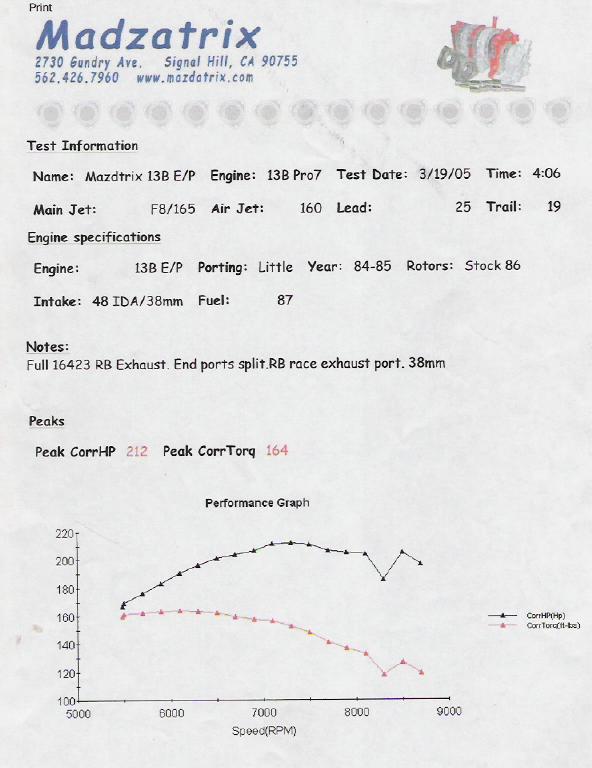
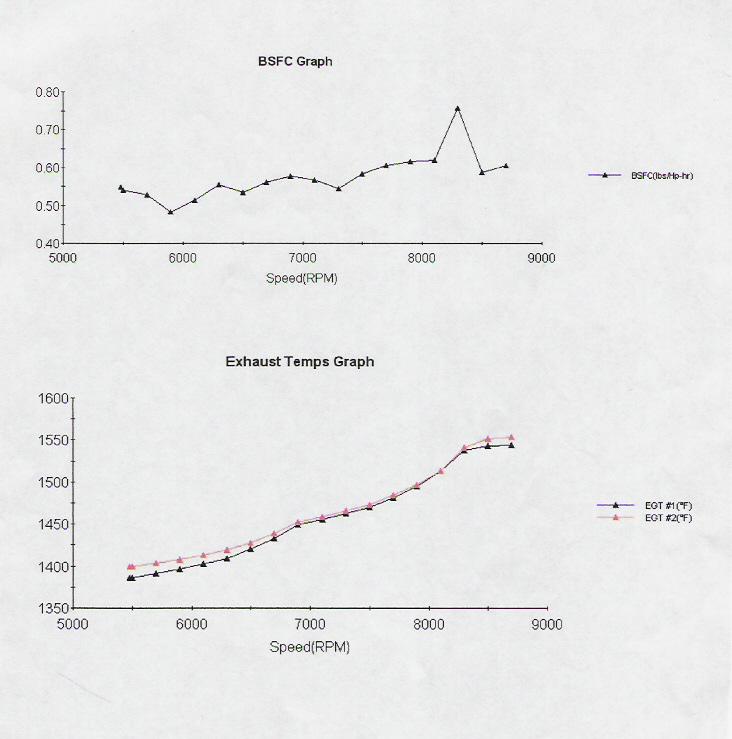
Dave Lemon at Mazdatrix gave me this HP curve of a Weber equipped 1984 13B
today. Little or no porting. BSFC would be better if there was an easy way
to lean the mixture at low power.

Also BTW the oil pressure in this engine was above 130 psi throughout the range.

There is some sort of resonant glitch in the dyno at RPMs above 8000. Dave
is working on getting it fixed  but that will not affect our use as we only care
what it is up to 7500 RPM. Dave needs it working well to 11,000 RPM.

Paul Lamar

The Rotary Engine NewsLetter.  Powered by Linux.
ACRE NL web site. http://home.earthlink.net/~rotaryeng/
Copyright 1998-2004 All world wide rights reserved.