Here is a scale drawing of the Lemans engine showing runner
diameter and position of intake port in case you want to bore your
own p-ports. These are the dimensions we used on the current
test engine. Hopefully it is shortly ready for the dyno as Mazdatrix is
building it as we speak. Well maybe not today.

This two is roughly the HP you can expect from
this configuration. The third plug was only worth about 3%
improvement in the BSFC.

If you dynoed the engine with a fixed length runner you would not see
this curve. That is because the Leman engine had variable length
runners. You will however see close to this HP with a fixed length
runner optimized for the RPM you choose. This is perfectly acceptable
for a fixed pitch prop. Variable length runners are only needed in car
applications.

You choose the best fixed runner length in the range of about 14 to
20 inches for the RPM where you want peak HP to occur. My guess for
7500 RPM is probably around 15 inches. This length will vary with
the diameter of the runner so smaller runners will have different
optimum lengths for a give RPM.

The runner tube Mazda used is slightly larger than 2 inch OD. I suspect they
used a metric size. Probably around 54 or 55 mm. Since metric or english tubing
in that size is hard to come by I used the closest size tubing
I could find and that is 2 inch .065 wall. Consequently I expect
a little less HP. We shall see shortly.

Paul Lamar
Ian wrote:
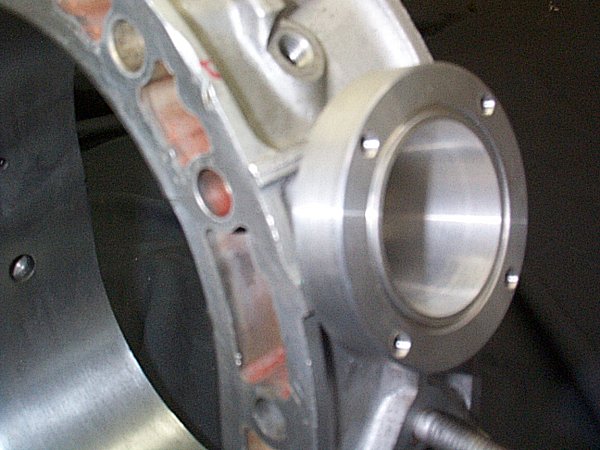
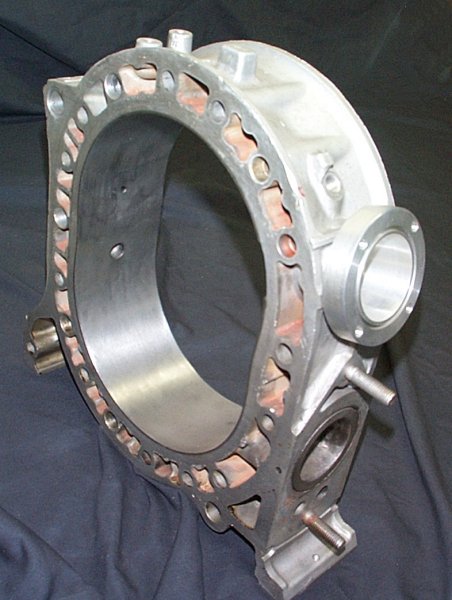
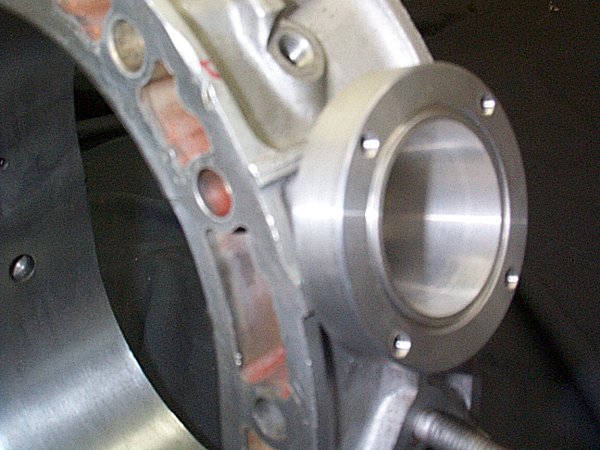
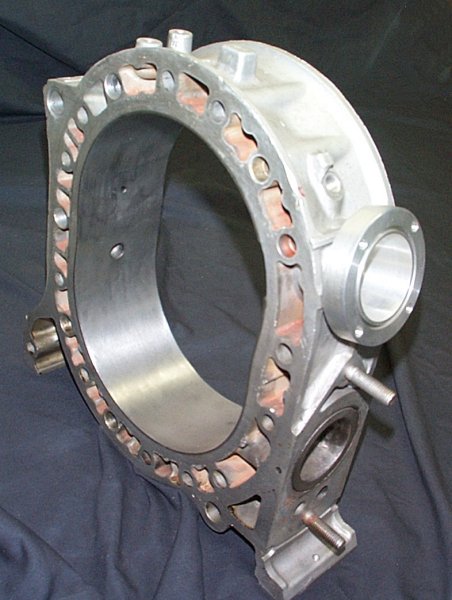
the actual housing bore looks to be angled slightly.. I'm ready to mill
my housings, just wondering what that angle is ? thanks.

ian
BAS
I made mine parallel with the bottom of the rotor housing.
In other words perpendicular to the rotor housing vertical center line.

Here are a few tips. Clamp that thing really well as you will be boring some BIG holes.
It tends to move around and deflect the mill ram. This would best be
done on a heavier duty machine than a Bridgeport.

Start with a 1/2 inch drill and work up to a 1 1/4 inch drill in a few steps.
I then used a 1 3/4 shell mill in a 5C shell mill holder. Nice and
rigid.

I finished with a boring head to do the 1 7/8 hole through the wear surface.

I then countered bored it out to 2 inches as far down as I could go with out
getting into the steel liner. Unfortunately when you insert the 2 inch tube
there are some gaps around the bottom of the tube. Tape them up from
the inside of the tube so the epoxy potting compound does not leak by
into the rotor housing. You will probably have to sand and polish the
inside of the tube to get rid of the tape. The epoxy potting compound
will then become part of the runner surface.

It took me and my buddy Jim with 100 years experience total a few hours
to work out the best way to machine this quickly.

Paul Lamar
BTW Xtreme and Racing Beat angle the p-port. IMHO this is not the hot tip.
When the port first opens the face of the rotor is perpendicular to the
axis of the runner. The air then must make almost a right angle curving
sharply up to the top of the engine. Mazda choose a straight in port on the Leman
engine for a reason. It gives a more favorable angle and more airflow. The
air does not have such a sharp angle to turn as it enters the engine. The
same principal applies to the exhaust port. The air wants to flow upwards
as the port opens.

It is easier to angle the p-port as the tube will seal better at the bottom of the
bore. That can be overcome with the high temp epoxy porting compound and a bit
of tape inside the tube.

Paul Lamar

The Rotary Engine NewsLetter.  Powered by Linux.
ACRE NL web site. http://www.rotaryeng.net
Copyright 1998-2005 All world wide rights reserved.