I am working on my Sun n Fun forum talk next week.
I will start with Dave Leonard's interview video and
our RX8 races a turbo RV6 video and then slip into
cooling system design with good and bad examples. The
videos are on the web site below under what's new.

What is wrong with these cooling system designs?

Picture of round intake by permission of Bernie Kerr.
Consider this a quiz for all you people that have been
on here for years :)

Paul Lamar
Pick me, pick me!

#1 has too little duct lenght and no expansion profile to slow the
incoming air so that it can pass through the core.  End result is, at
higher airspeeds, air will dam up and simply go over the cowl rather
than through.

#2 appears to be the same thing, only in actual reality.

#3 Radiator behind hot object (motor).  Since delta t is everything in a
cooling system, pre-heating the air is bad.  Proximity to the
firewall.... no smooth friendly ducting to 'encourage' proper airflow
through core.

Chris C
You get a B Chris :) On a scale of D- to A+

Paul Lamar
Sealing behind the spinner?
Is that a thermostat in the Powersport install?
Is that a water/oil heat exchager I see as well?
One belt instead of two?
Hidden from our view is the poorly beaded aluminum tubing
that will pop off at any moment?

Just guessing now....

Chris Cosman
Getting very warm.

Paul Lamar
I've got it!

It is absolutely imperative that you install the top cowling! :)

Do I get extra credit?

Chris Cosman
Getting close to hot.

Paul Lamar
I am going to upgrade you to a B+ for perseverance and effort Chris.
You are also homing in on the problem and I have to shut down the
newsletter for a week later today as I am leaving for Sun n Fun early
tomorrow morning.

You have noticed that the top of the duct is formed by the top portion of
the cowl. Almost all air-cooled aircraft engines have this feature in common.
What is missing in Bernies picture and my 3D is the rubber strips that are
supposed to seal the cowl. Notice that these must curve in to work properly.
The reason this is very important is if you are measuring six inches H2O of static
pressure ahead of the rad  that is .22 psi.  One foot of water is about .45 psi so
six inches is .22 psi. That means for every square foot of duct wall you
will experience an exploding force of 32.5 pounds. This tends to deflect and
separate the cowl from its mounting surfaces on the fuselage and the joint
between could and duct.

Imagine what the forces would be on the Power Sport cowling. The .22 psi
is applied to the entire under surface of the cowl. Roughly speaking there are
somewhere in the neighborhood of 4000 to 5000 square inches of surface
area on the inside of the cowl. 0.22 times that is 880 to 1100 pounds.
Obviously something  must give and when it does it causes massive air leaks
and a reduction in pressure.

Where does the air escape? Wherever it wants to including the area around
the spot where the PSRU pokes through the cowl behind the spinner.
That is why the Power Sport system fails to cool. Sufficient pressure is
never applied to the rad to force sufficient air through it to adequately
cool the engine. The velocity of the air going through the intake scoop
then becomes academic. Making the scoop larger and larger is counter
productive.

How much static pressure can we expect at the front of the rad at climb speeds?
Generally speaking the pressure in front of the rad can be up to 80% of dynamic.
At 100 MPH dynamic flat plate pressure is 26 pounds per square foot or .18 psi.
80% of that is .144  psi.

At 150 MPH the pressures are doubled or .36 psi and 80% of that is .28
psi. That all assumes you have a perfect duct shape. Either a wedge
or a K&M Trumpet shaped duct.

The real fast racers like Dave Anders and Tracy Saylor figured this out
years ago and that is why they use very carefully sealed plenums over their
air cooled engines. They use wet suit material and hose clamps to make large
diameter rubber hoses to connect the plenums to the round air scoops.
Smaller intakes result in less cooling drag.

Here are some 3D's showing properly ducted radiators.

Paul Lamar
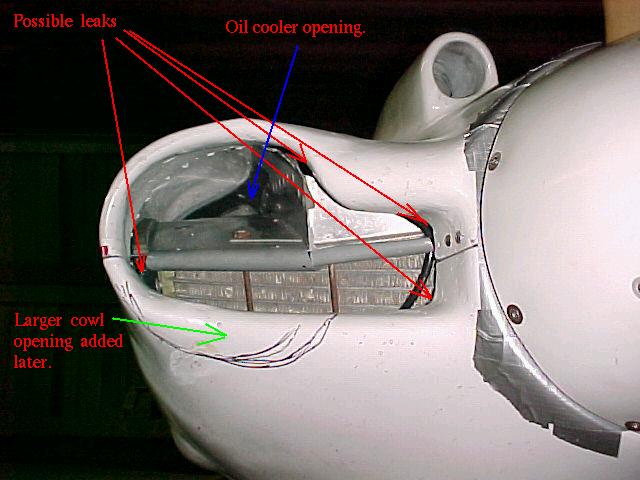
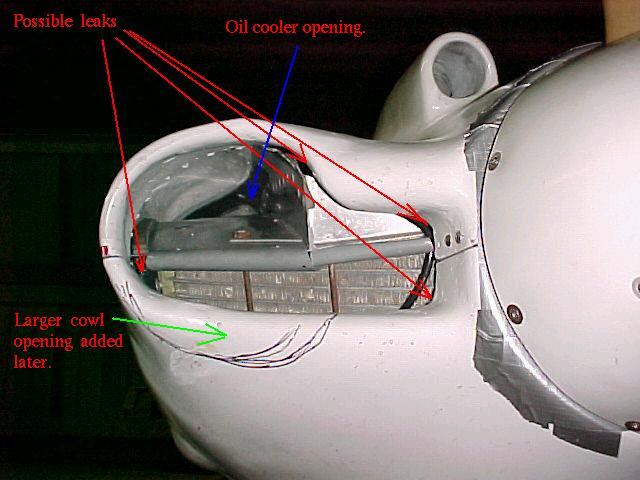
I went to Florida specifically to do some test on Tracy airplane
in Feb. 2002. I must admit I screwed up. This problem never occurred to
me. I was unsuccessful in making any significant improvements in his
cooling, probably precisely because of this problem. It just never
occurred to me. Noticed the enlarged openings compared to air cooled
engines of about the same HP. This has always bothered me in the back of
my mind but I could not put my finger on the problem.

Here are a couple of pictures from that time
and another one after the race in 2004. I'll take a few more next
week with the cowl off.


Paul Lamar

The Rotary Engine NewsLetter.  Powered by Linux.
ACRE NL web site. http://www.rotaryeng.net
Copyright 1998-2005 All world wide rights reserved.