Douglas Fir wrote:
 Hi Paul,

Welcome back.  Michiwa finished the translation but there still were a few
phrases that got chopped out in your enlargement but we I believe got the
jist of it. Let me know if you want the hard copy of which part goes where
but it appears self evident, that is if can read some Japanese:)

Cheer

Doug in Japan

...................
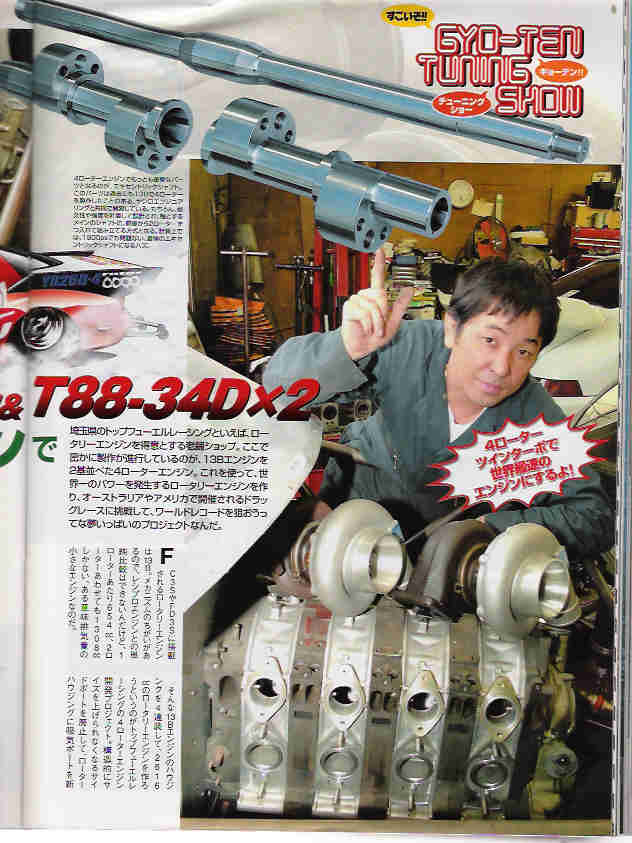
"Top Fuel Racing" in Saitama Prefecture [near Tokyo] is one of the oldest
shops creating rotary engines in Japan.  Now a 4-rotor engine with two 13B
engines side by side is being manufactured.  They also have the big dream to
set  some world records, challenging the drag races in Australia and the
U.S.A.

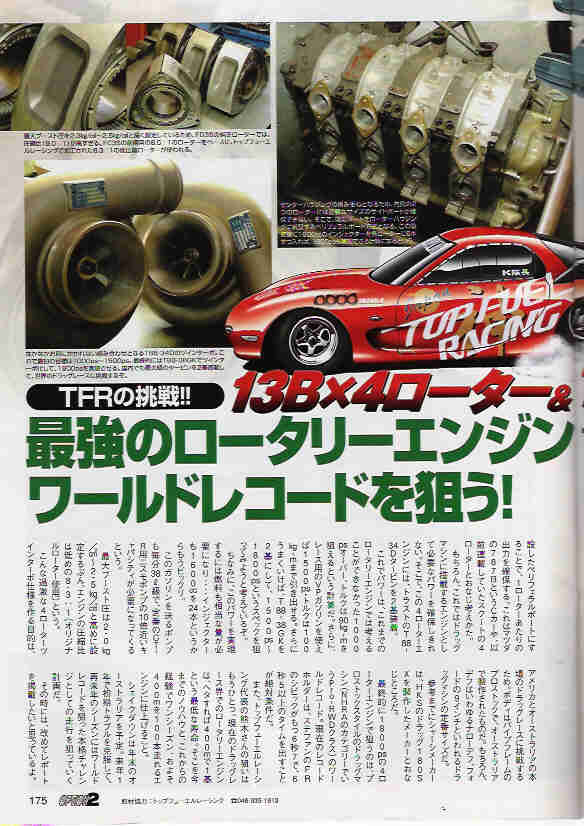
  This is a T88-34D twin-turbine, which is rare to see.  The first aim with
this turbine is to boost the engine to between 1000 ps [HP] to 1500 ps.
Eventually they want to achieve 1800 ps  by using the T88-38GK twin turbine.
So they are planning to challenge the world drag races with two of the
biggest turbines in Japan!

  The most important part of the four- rotor-engine is the eccentric shaft.
This is now under development in cooperation with Yashiro Engineering, who
had made 4 rotors engine based on the 13B before.  They designed the shaft,
calculating the durability and strength, assembling the main shaft with two
rotors slide on from both ends.  This method is considered the most perfect
and  powerful eccentric shaft to handle  1800 ps.

  The rotary engine mounted with  FC3S and FD3S [rotors????] is a 13B.
Though the engine cannot be simply compared with a “reciprocal  engine
because of the differences in mechanisms, this is an engine of very small
displacement: 645 cc per 1 rotor, 1308cc with 2 rotors.
  Top Fuel Racing is now working on “Four-Rotor Engine Development”
Project.  They are aiming to make a 2616 cc rotary engine connecting four
13B engine housings.  They abolished the side ports and went with P ports.

  The ratio of pure compression of FD3S, which is 9.0:1, is too high because
the largest boosting pressure is set very  high at 2.3 kg/cm3 to 2.5 kg/cm3.
The low compressed rotor, 8.3:1, constructed by “Top Fuel Racing”, will be
used, and is based on the 8.5:1 rotor used in the  first generation FC3S.

  The NA four rotor engine cannot get enough power to challenge the drag
races title, so they have mounted two “trust? (In Japanese English To ra su
to” T88-34D turbines on it.
  This, in their calculation, could enable the  engine to go over 1000 ps
and the torque to be more than 90kg・瘢雹m.  In addition, they expect that they
can eventually reach 1500 to 1800 ps using two T88-38GK.

  As can be imagined, quite a large amount of fuel is  necessary to realize
this big of power, hence the need for twenty four  1600 cc injectors.
  The pump for this gasoline is so big as to pump up to 38 liters per
minute.  This is  ten times the capacity as the regular GT-R “Nismo?”
pumps.
The pump boost pressure is from 2.0 to 2.5cm2 which is a little bit higher
than usual so the compression ratio is only 8.3:1. The chassis of the car is
made of pipe frame by the Australian company "ProStart."  Tires are 9"
normal width,  Ford .....unreadable....

  The chassis maker is the same company that produced the HKS dragster
180SX.

 The final goal of the 1800 ps four-rotor engine engine is aimed at getting
the pro-stock style dragster world record, that is, Pro-RWD class in the
NHRA category.  The present record is 6.7 seconds, which was made by Stephan’
s FR civic.  In order to break it, they must get over 6.5 seconds.

  Mr. Kumaki, the director of Top Fuel Racing, has another goal.  The life
of the rotary engines for drag races is very short: it could run only 400 m
at worst.  He wants to make the engine run 400 m 100 times.
Thanks Doug. I think some of it is still in HTML.

Paul Lamar

The Rotary Engine NewsLetter.  Powered by Linux.
ACRE NL web site. http://www.rotaryeng.net
Copyright 1998-2005 All world wide rights reserved.