Paul wrote:

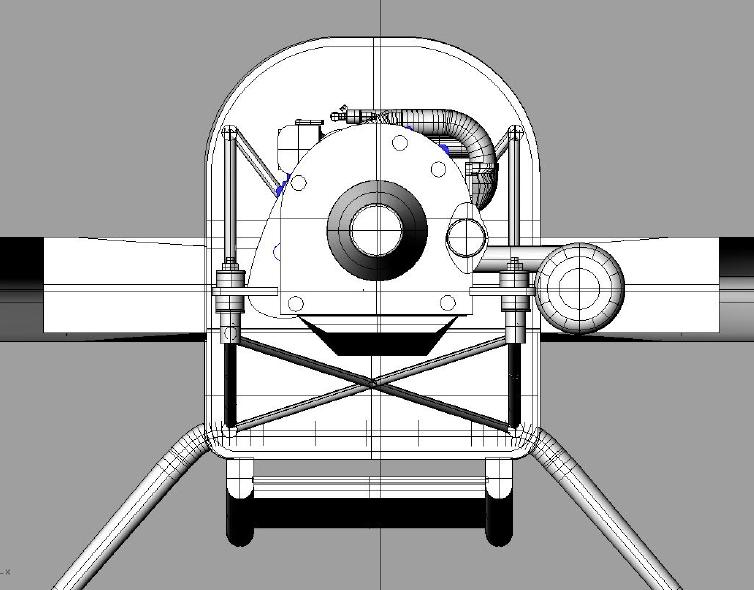
Hi all...here is the latest success story for my 13b powered
SQ2000
canard. I removed the ram air scoop from the top cowling. I
then
installed a NACA duct with a 3 inch hose outlet in the lower
cowling in the wing root area.  I made an aluminum plenum with
a 3 inch
hose outlet to attach to the new NACA duct. Now, the incoming
air goes
directly to the throttlebody and no longer pressurizes
the low pressure area of the cowling. Climbout water temps
dropped from
the previous 205 (with the ram air scoop) to 180. I think if I
seal the
plenum as Paul Lamar suggested, I can further
decrease my temps.  It was 81 degrees outside, and the water
temps
climbed to 180 during the climb. Settled down to 170 downwind.
I think
I'm on the right track....will try sealing the plenum
next. Oil temps maxed out at 180, and dropped to 160 downwind.
Not as
low as I would like them to be, but going in the right
direction. Here
are a couple pics of the NACA scoop and the intake
plenum. Paul Conner
You will get more power with a ram air scoop instead of the
NACA.
What is current intake manifold pressure?

Paul Lamar
I have to look at it during flight. My MAP fluctuates between 15
and 20 at
idle, and if I recall correctly, at WOT it was around 5. That is
the only
indicator I have. There is a small rubber hose attached to the
intake
manifold that goes directly to the MicroTech ECU. The screen on
the handheld
programmer (that is actually hard mounted to the instrument panel
instead of
being handheld) shows the MAP to be around 15 to 20 at idle, and
decreases
with rpm's, up to around 5" MAP. That was with the ram air scoop.
I failed
to observe the MAP readings with the new intake plenum and the new
NACA
scoop. Static rpm's were excellent, however. I will take note of
the MAP
during flight on the next flight. It was a short flight (a couple
of
circuits around the pattern) as I wanted to get back on the ground
to make
sure nothing was coming loose, etc. Pulled the top cowling and
everything
is still in the same place. I like it when things stay put.
     I like the idea you came up with (the red rectangular fix to
seal the
NACA inlet to the radiator). I was considering silicone or
silicone rubber
engine baffle material, but I prefer just sealing it as you
suggested. All
it will take is a small piece of aluminum which I can secure to
the sides of
the plenum with blind nuts and L shaped aluminum angle, and a
little
silicone in the joints. That way, when I remove the lower cowling,
it will
have no effect on the integrity of the radiator/plenum seal.
Thanks. Paul
Conner
That that should help but the ultimate is get rid of the NACA duct,
use a P51
type scoop, Kays & London wedge diffuser and mount a thinner rad
under the
engine like Perry Mick is doing.

Paul Lamar
Paul(L) -
I know you don't like NACA scoops for cooling - but with Paul's
(Conner) current temps (~180f) don't you think the P-51 scoop is going
to add more drag - and potentially not improve temps all that much?

I think Paul Conner has a winner just like it is.  He might even be
able to tweak it a bit and get another 5-10 degrees off by radiusing
the aft end of the NACA and putting a capture plate in the bottom.
But I don't think he needs to do any extreme surgery. Let's
congratulate him on a great success!

Joe Hull
Bellevue (Seattle), Washington
Cozy MkIV #991 (still working on Engine & Electrical & Finishing)
http://www.maddyhome.com/canardpages/pages/JoeHull/index.html
True P-51 scoops add frontal area and consequently drag.
It is not just me. It is the inventors of the NACA duct that don't like
them
for heat exchangers :)

So far Paul Conner has been flying in cool weather. That makes a big
diff.
The temp difference  is 80 F to 180 F. 100F. For every one degree F
loss
in
temperature difference there is a loss of 1% in cooling capacity
roughly.
Ruff rule of
thumb. Wait until summer when the ambient gets to 110 F. Also climbing
out
to pattern altitude is not hard. Try climbing over a mountain or cloud
in
summer
for a half hour.

My favorite for pushers would be this 3D. Real easy to implement. I
suspect
less drag than a P51 type scoop.

Nobody is not congratulating him. He has been on here for years but
went
ahead anyway against conventional wisdom and he is now asking for help.

Paul Lamar
Hi, Paul....yes, I may have gone against conventional wisdom....my
problem
is that I question the wisdom that comes from NASA.  In the attached
excerpt
you provided from NACA, they state that "Submerged inlets do not appear
to
have desireable pressure-recovery characteristics for use in supplying
air
to oil coolers, radiators, or carburetors of conventional reciprocating
engines". That is pure bunk.  I had a NACA inlet suppying air to my
carburetor on my "conventional reciprocating engine" powered LongEZ, and
it
worked very well.  I can provide the names of several others who also had
similar success with a submerged inlet providing air to their carburetors
on
Lycoming (conventional reciprocating engines).
     There are also several other builders who have had success with
radiators and NACA ducts, such as Al Wick's Subaru powered Cozy, John
Slade's rotary powered Cozy, etc.  In my opinion, this paper is out of
date
and incorrect. This coming from the same folks that said "The foam that
impacted the spaceship Columbia wing should present no problems upon
reentry".
     I totally agree with you that a P-51 style duct would be more
effective, and that the proposed under belly radiator solution you
presented
also has merit. My only problem with that is that the radiator fins are
subjected to airflow coming in at a significant angle to the cooling
fins.
With my setup, the incoming air attacks the radiator at right angles, as
it
does in an automobile, and I believe that would provide less drag than a
system where the air hits the radiator at a severe angle. If a radiator
had
fins at an approximate 45 degree angle, then I think your proposed
under-belly radiator design would probably be the most efficient
possible.
     While the NACA duct is admittedly not as effective as a P-51 style
scoop, I believe it has merit.  If I cannot bring the temps down another
10
degrees with sealing the rather large joints in my plenum and by possibly
providing a radius inside the NACA duct, I will be the first to admit
both
failure and stubborness.
      I flew it again today, and I find that after retracting the
nosewheel
and climbing at 120 instead of 100, yielding 1200 to 1500 fpm climb
rates,
upon reaching 6000 feet, the temps continued decreasing, due to the
cooler
temps at altitude and the higher climbout airspeeds. My previous temps
were
acquired at a climbout speed of 100 and with the nosewheel still down.
Given
the greater speeds attainded by retracting the nosewheel, I am close to
achieving the temps that will make me feel comfortable. I also need to
sand
and paint the plane and install the main gear wheelpants. That should
also
help reduce drag and yield higher airspeeds (better cooling) at the same
power levels.  I have not yet thrown in the towel.  Please understand
that I
do appreciate a lot of the work that NASA has done....as well as the
valuable service you provide to rotary engine enthusiasts....I just think
that there just might be that "happy medium" between optimum cooling and
acceptable cooling. (And yes, I could be wrong....wouldn't be a first).
I
will keep you informed as I seal the plenum and possibly provide a radius
to
the area indicated inside the plenum.  Thanks again for your input and
suggestions.  Paul Conner, having a ball flying my rotary powered SQ2000
in
Mobile, AL
I don't think it is bunk. Are you and aerodynamic engineer? I don't think
Boeing thinks it is bunk nor do I think Lockheed and Messerschmitt
engineers think
it is bunk. Bernie Kerr with 30 years at Pratt & Whitney does not think it
is bunk.
Tracy Crook does not think it is bunk either.  Mooney aircraft does not
think it is
bunk. Tracy Saylor with the fastest RV6 in the world 237 MPH does not
think it bunk.
So too Dave Anders with the fastest RV4 in the world at 255 MPh does not
think it is bunk.
All of the people and companies I just mentioned use ram air scoops for
carb air. If that
is not conventional  wisdom I don't know what is. Don't make me upload
pictures of all these
air intakes because I can :)

Yes the engine will run with a NACA duct supplying air to the carb but so
would a hole
in the cowl work as well. The engine is then expending HP to pump the air
into the carb.
The engine would work better and probably provide more MPG with a ram air
scoop.
Ram air scoops have proven they provide more engine HP than they consume
in drag HP.

Yes of course climbing out faster works. The dynamic pressure goes from 26
pounds
per square foot (.18 psi) at 100 MPH to 37.4 pounds per square foot (.26
psi) at
120 MPH. It will cool even better if you climb at 150 MPH 58 pounds per
square
foot (.40 psi) providing your engine will generated enough HP breathing
through a
restrictive NACA duct. Just hope you never have to climb over a mountain
or a cloud at max angle on a hot day as frequently occurs out here in the
west..

Wait till July and August. You have not begun to see the problem.

Paul Lamar
Hi, Paul....Sorry if I got you going....What I meant by "bunk" is that I
agree with you that a hole in the cowl would work for a carburetor, so for
them to make a statement saying that a submerged inlet duct would not work
for a carburetor is unrealistic. You could feed air to a carburetor through
a garden hose, for crying out loud.
     Of course ram air scoops are superior to NACA ducts.  Doesen't mean
NACA ducts don't work at all. I know you can download lots of pictures of
ram air scoops. I imagine you could also download lots of pictures of NACA
ducts.  Please understand I am not trying to start an arguement here....just
noting that a statement saying that a NACA duct would not work for a
carburetor is, well maybe not bunk, but incorrect. Lots of EZ aircraft using
a NACA duct to feed their carburetors.
    One other question comes to mind....the statement that ""the required
diffusion of the air and the range of inlet-velocity ratios is too great to
give desireable characteristics at all flight conditions". Any idea what
they mean by "all flight conditions"  I am assuming that means that in some
flight conditions it would be better than others? Not sure what they are
implying here.
     On a final note, if you have some time on your hands, I was wondering
if you would check out the following link regarding Al Wick's Subaru powered
Cozy and interpret some of his findings?  Thanks in advance for your valued
input.  Sorry if I riled you up.... that was not my intention Here is the
link I was referring to.
www.maddyhome.com/canardpages/pages/alwick/engine.html   Take care, and
thanks again for the suggestions regarding the sealing of the bottom of the
NACA duct. I will work on that Monday.   Paul Conner
You are missing the point Paul. Maybe >> I << said NACA ducts don't work for carb air.
If I did I said it for emphasis. The NACA engineers that invented the NACA duct did
not say that. What I and they meant is NACA scoops are not the best for carb air
and cooling.

What we engineers try to do in aircraft design (design in the engineering sense and not
in the styling sense) is choose options that optimize the overall performance of the
aircraft and minimize the fuel burn and that work. If a NACA scoop works no better than
a hole in the cowl why go to all the trouble to fabricate a NACA scoop. A simple hole is
easier to fabricate.

The fact of the matter is people like the NACA scoops looks. It is trick looking
and high tech from a stylist point of view. From a naive point of view it looks
like it should work great. If you are just going to climb out and futz around in
the pattern for a couple of hours fuel cost and range are of no concern.
Anything will work that cools under those conditions and that allow the engine to run.

I can think of a few analogies from the automotive world. Try a Honda (Toyota?)
Element for example. Probably the highest aerodynamic drag car sold currently.
Supposedly these companies are environmentally conscious yet they are selling
these boxy, relative gas hogs for use on the highway. If you ask the owner, out
of context of her choice in cars, she will tell you she too is environmentally
conscious. (Ducting from the politically correct incoming. :))

If you want a proven, relatively low drag pusher cooling system that is easy and
quick to fabricate use this cooling system. Raise the front of the rad to lower
drag at cruise. Lower the front of the rad during climb out for max cooling.
Use silicon rubber hose to connect it to the engine. No cowl flaps required.

Paul Lamar

The Rotary Engine NewsLetter.  Powered by Linux.
ACRE NL web site. http://www.rotaryeng.net
Copyright 1998-2005 All world wide rights reserved.