Paul, You will play heck trying to solve your cooling problems going
     on coolant temperature alone. Too many variables. Climb out speed, ambient
     temperature, humidity, etc., etc..  Many variables are automatically
     compensated for by relating all measurements to static pressure.

     It is far far better and faster to relate the pressure ahead of
     and behind the rad to static pressure. You will gain an education
     in the process and be able to help others. I might not be around for
     ever. Further more the resolution of the measurements is much much
     higher using a water manometer. As much as one tenth of a inch
     of water pressure difference can be measured. One inch of water
     is .0376 psi. One tenth of an inch is of course .00376 psi.

     Go to the hard ware store and buy a bunch of drip irrigation fittings
     and some clear plastic tube. Use the black irrigation hose and
     porous kitchen foam to hot glue to the end of the black hose
     wherever you want to measure the pressure. Make the manometer
     about 2 feet high. The resolution then becomes one part in
     6,382. Amazing for any measuring instrument. Use red food die in the
     water to make it easier to see and photograph with a digital
     camera. No need to write things down when you are flying.
     Just snap a picture of the manometer and scale the readings
     off the picture.

     You can also measure the actual air velocity exiting the rad
     by merely pointing the black hose (without the kitchen foam)
     in the direction you think the air is flowing from.

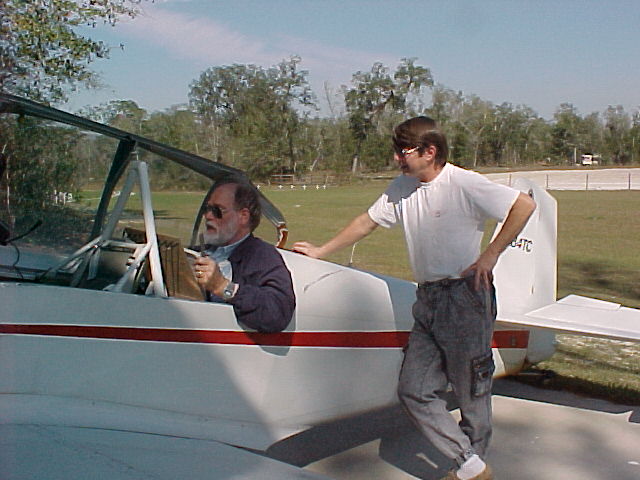
     BTW that is Jerry Hey in the cockpit.

     Paul Lamar
Paul:

You are absolutely correct.  This is so easy to do and teaches so much regarding such questions as:  mass airflow sufficient?,  pressure drop across heat exhcanger?, dynamic pressure recovery at
heat exchanger face (diffuser efficiency)?, pressure in the cowl downstream of the heat exchanger (pressurized cowl from other inlets)? uniformity of pressure across heat exchanger face? and.....if
one has the inlet and outlet coolant temperature as well, 95% of all the issues are at hand in order to create an exceptional installation.

My friend spent three months installing two different systems and over $700 in materials alone...which both failed for different reasons.  But.....both "looked like they should work"!  The radiator
shop that built the brass "king kong" radiator was "absolutely certain this will work" (insufficient fin area, but low delta P!).  An expensive lesson.

We spent less than one day, built a water manometer as you direct above and knew what needed to be do by sundown.  Now it cools at 85 deg F, WOT climb, 115 mph as long as one wants...and even cools
on the ground.  The installation is an underslung located right on the CG.  A little ahead of the "best place" at the approx. 2/3 chord of the wing, but other installation issues dictated that
location.

Note:  We learned a lot on the ground with the manometer before we even flew wiith the "designed with information" system.  By this time he was a bit tired of 250 deg F while trying to climb high
enough to make a normal pattern and get back on the ground with the first two systems!  Reduced the pucker factor by a factor of at least 4!

The digital camera is a great idea.  Make certain TAS & O/S temp is recorded at the moment of photo.  (Humorous note: The owner did overspeed on one trial and spit red food dye and water all over
himself since we had one or two of the tubes open to cockpit pressure-he didn't think it was too funny).  It is very important to record accurate speed and O.S. temperature readings in order to
compare changes.  We didn't record cockpit vs. O/S static pressure which had us scratching our heads for a bit, but the lessons were so obvious it didn't matter as it turned out.  Cockpit was
approx. 0.5" H2O lower than static, and speed dependent.

It is GREAT to be able to cool in all flight conditions and then be able to make modifications to reduce drag by working back (too cool) toward the edge of the "maximum efficiency: cooling
capability vs. drag" envelope rather than the other way around from the "too hot" side.

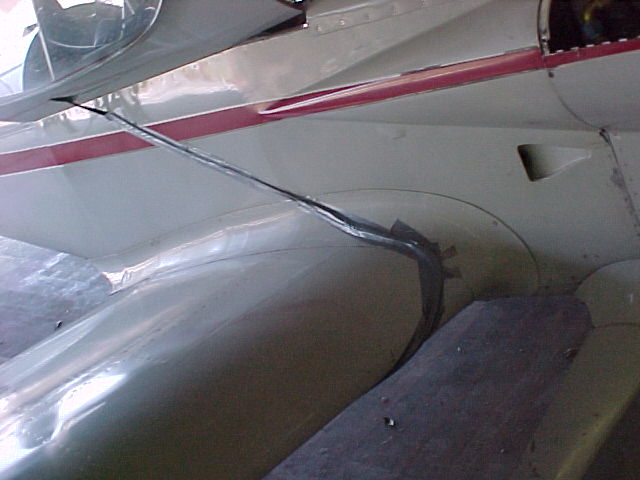
Great advice and good pic of manometer board.  We just used high quality duct tape (plane unpainted at the time) to protect the pressure lines that were routed along the outside of the fuselage.
Worked for us.

Doug in CO
Speaking of duct tape :)
Here are some shots of Tracy airplane covered in duct tape :)


The Rotary Engine NewsLetter.  Powered by Linux.
ACRE NL web site. http://www.rotaryeng.net
Copyright 1998-2005 All world wide rights reserved.