You are missing the point Paul. Maybe >> I << said NACA ducts don't work for carb air.
If I did I said it for emphasis. The NACA engineers that invented the NACA duct did
not say that. What I and they meant is NACA scoops are not the best for carb air
and cooling.

What we engineers try to do in aircraft design (design in the engineering sense and not
in the styling sense) is choose options that optimize the overall performance of the
aircraft and minimize the fuel burn and that work. If a NACA scoop works no better than
a hole in the cowl why go to all the trouble to fabricate a NACA scoop. A simple hole is
easier to fabricate.

The fact of the matter is people like the NACA scoops looks. It is trick looking
and high tech from a stylist point of view. From a naive point of view it looks
like it should work great. If you are just going to climb out and futz around in
the pattern for a couple of hours fuel cost and range are of no concern.
Anything will work that cools under those conditions and that allow the engine to run.

I can think of a few analogies from the automotive world. Try a Honda (Toyota?)
Element for example. Probably the highest aerodynamic drag car sold currently.
Supposedly these companies are environmentally conscious yet they are selling
these boxy, relative gas hogs for use on the highway. If you ask the owner, out
of context of her choice in cars, she will tell you she too is environmentally
conscious. (Ducting from the politically correct incoming. :))

If you want a proven, relatively low drag pusher cooling system that is easy and
quick to fabricate use this cooling system. Raise the front of the rad to lower
drag at cruise. Lower the front of the rad during climb out for max cooling.
Use silicon rubber hose to connect it to the engine. No cowl flaps required.

Paul Lamar
Hey Paul,  in that drawing, is that really the size of the Dodge pickup
truck radiator?  How much radiator volume would you need to cool a 3
rotor like ours given about 240 H.P. for takeoff?

Chris Cosman
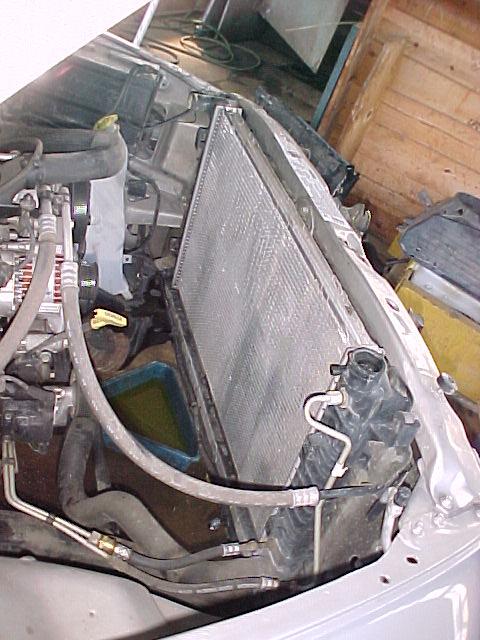
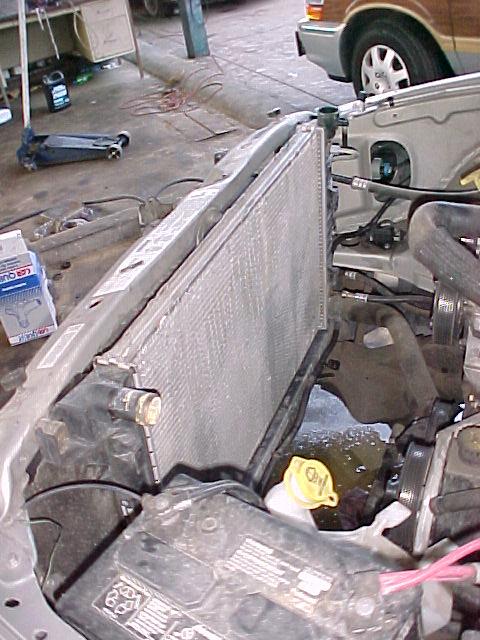
Yes the Dodge PU rad is about 32 inches wide by about 20 inches high.
About 5/8th  to 3/4 inch thick of an inch thick. 400 to 480 cubic inches.
Probably designed to cool about 150  engine HP going up a 5% grade with 10,000
pounds at 50 MPH.

About 900 cubic inches if you did it comparable to the average results
we are seeing now. If you did it perfectly maybe as little as half of that :)

Paul Lamar

The Rotary Engine NewsLetter.  Powered by Linux.
ACRE NL web site. http://www.rotaryeng.net
Copyright 1998-2005 All world wide rights reserved.