Right now the RX8 engine is running at about 3250 RPM at 65 MPH and
getting 25 MPG. My guess it is using about 30 HP to go 65 MPH.
That would be a fuel burn of around 2.6 gallons an hour or 15.6
pounds per hour or a BSFC of around .52.

BSFC is defined as the number of pounds of fuel burned for
every HP generated in one hour.

An RX8 engine running at the best BSFC point should be around .47
according to the measurements some have made in aircraft service.

This is a problem in common with all cars. The best BSFC
point for the engine is rarely at highway speeds or highway RPMs.
The main reason smaller engines get better MPG on the highway is
the small engines are running in a higher efficiency levels.
Namely wider throttle openings. Putting smaller engines in cars
with higher axle ratios (lower engine RPM) to improve the MPG is
called down sizing and down speeding. So a smaller rotary engine
would get better MPG in an RX8 car at steady speeds of around 65 MPH.

A turbo compound rotary could achieve a BSFC of about .38.
Turbo compound engines use small turbines extracting HP from the
50% waste energy in a gallon of gas and feeding it back into the
output shaft. A well known technology from the 1950's used in
airliner piston engines. One of the problems with these A/C engines
was the failure of an exhaust valve would take out the turbine.
Needless to say the rotary has no exhaust valves. The 8 HP turbine
would be geared down by at least ten to one.

Working backwards a BSFC of .38 would be a fuel burn for 30 HP of
11.4 pounds per hour or 1.9 gallons per hour or a MPG
of 34.2 MPG at 65 MPH.

The trouble with turbo compounding a 240 peak HP engine while
running at 30 HP is it does not appear to work. What we need
is a small rotary running at 80% of peak power or more to
achieve a BSFC of .38 with a turbo compound configuration.

One of the unique features of a wankel engine is the possibility
of drilling a straight hole through the output shaft from end to end.

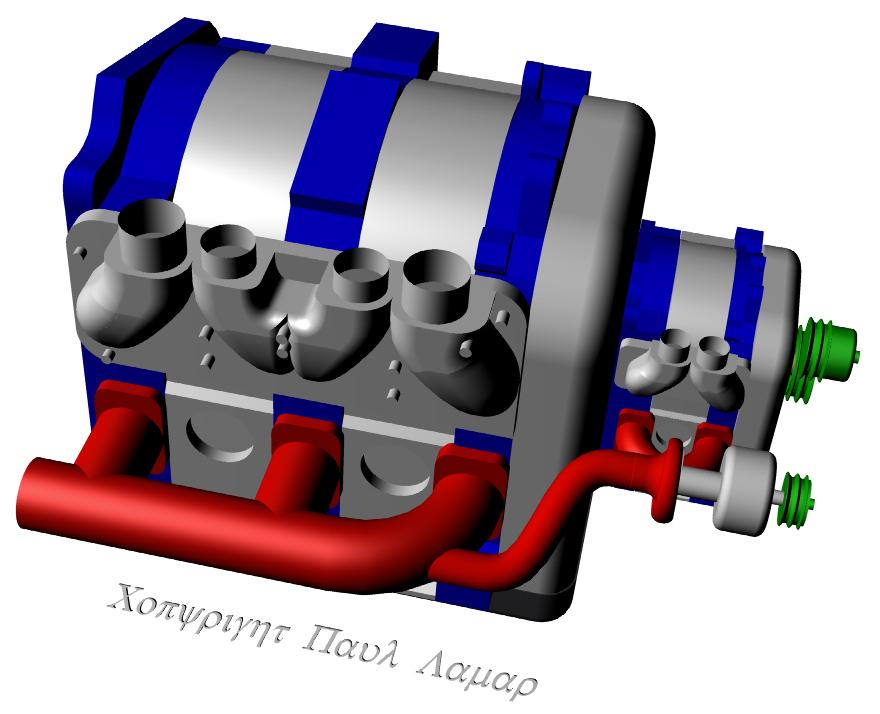
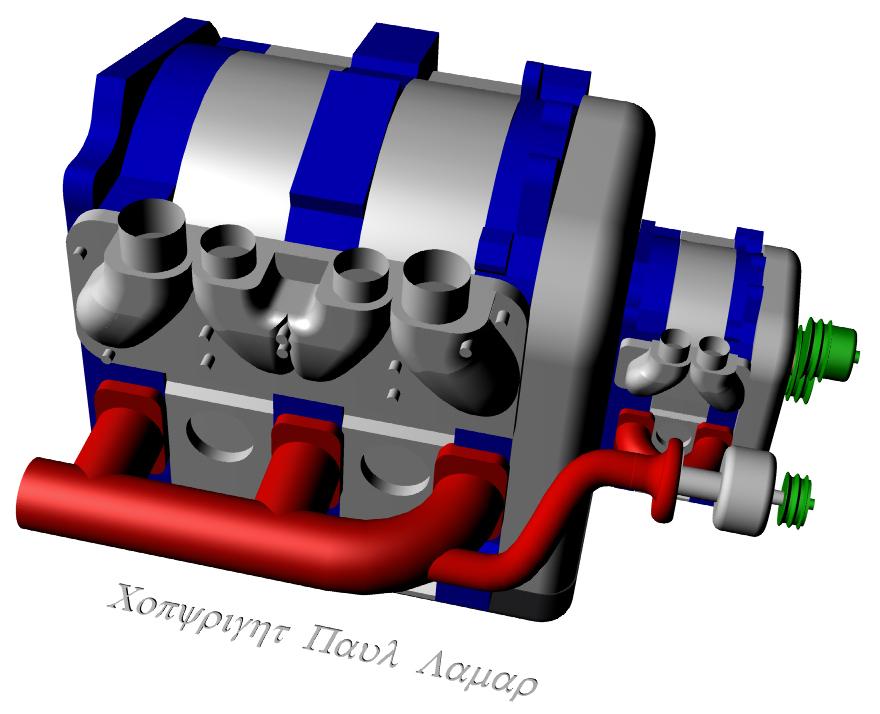
If we design a small single rotor turbo compound engine of around
50 HP we can achieve 35 MPG on the highway at a steady speed of 65 MPH. This
engine could feed its power through the large two rotor engine  shaft while the
two rotor engine is shut down. The large engine is only needed for acceleration
and climbing hills. All accessories such as water pump and alternator would
be driven by the small engine.

Here is a 3D of such a configuration.

Comments are solicited. This is going on the web site soon.

Paul Lamar

The Rotary Engine NewsLetter.  Powered by Linux.
ACRE NL web site. http://www.rotaryeng.net
Copyright 1998-2005 All world wide rights reserved.