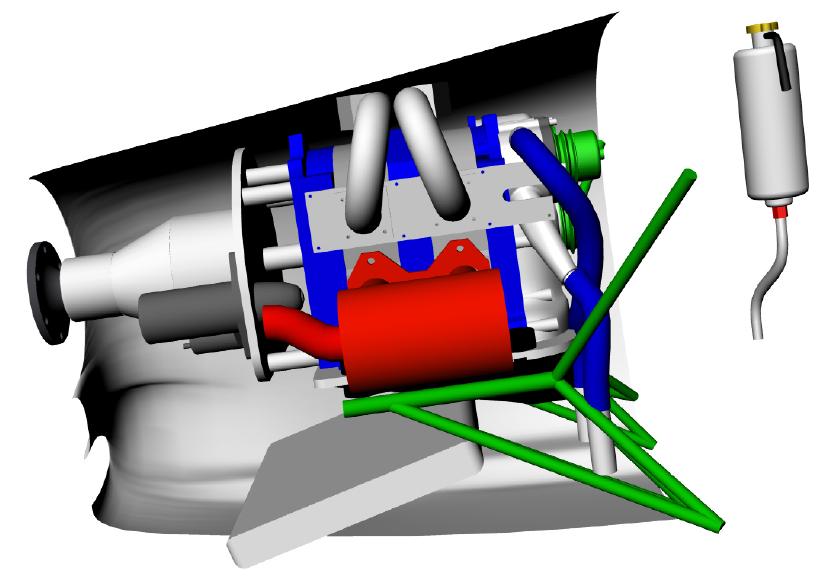
This is preliminary and scaled off the 3D's that Will sent me.
A more accurate 3D will be done when I get a few more actual
dimensions. A full size mock up should be done in the absence
of accurate section drawings on the cowl. If I do a 3D without
section drawings it will be a guess.

Configuration a: rad height is limited to about 10 inches.
Since width will be limited to about 20 inches, due to the
taper in the cowl, core volume may be on the shy side around
400 cubic inches. That assumes a core thickness of 2 inches.
air flow comes in from the bottom of the rad and flows upward
through the core.

If the core is thickened to 3 inches it might work but airflow
will be reduced at low climb speeds. Unless completely ducted back
of rad will be subjected to the radiant heat from the exhaust and
ambient heat from the engine compartment.

Configuration b: rad height is limited to about 16 inches.
that is better as core volume will be about 600 cubic inches
with a 2 inch thick core. Back side of the rad near the top is
too close to the engine so air flow through the rad will be reduced.
Unless completely ducted the back of rad will be subjected to the radiant
heat from the exhaust and ambient heat from the engine compartment.

Configuration c: Same size rad as b. Air comes in on top
of the rad so inlet ducting shields the rad from exhaust radiant heat
and  ambient heat from the engine compartment. If venetian
blind type cowl flaps are not desired a single conventional
cowl flap can be used with fixed louvers under the front bottom
of the rad to relieve the pressure build up in the cowl below
the rad. In other words these louvers augment the conventional
cowl flap reducing its effectiveness somewhat. It can probably
be completely closed at cruise.

Paul Lamar
Will and Ben,

The motor mount limits the up angle in the back of the rad.
It will still required fixed or variable louvers under the front
of the rad to prevent pressure build up between the back side of the
rad and the lower part ofd the cowl.

Paul Lamar

The Rotary Engine NewsLetter.  Powered by Linux.
ACRE NL web site. http://www.rotaryeng.net
Copyright 1998-2005 All world wide rights reserved.